
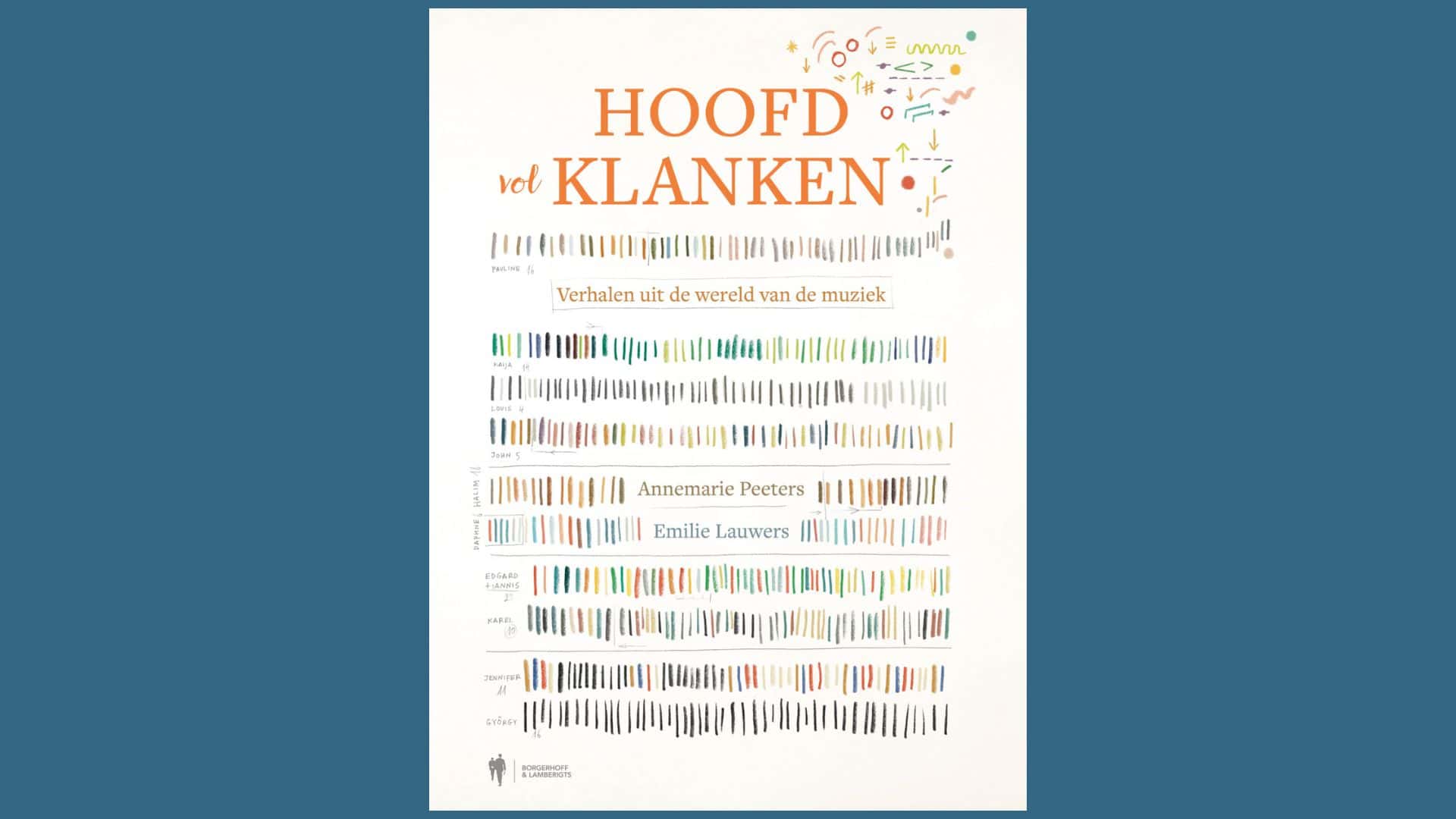
At the initiative of MATRIX [Centre for New Music], the daring book 'Hoofd vol klanken - Verhalen uit de wereld van de muziek' has just been published. A book with portraits of people who dared to turn an idea in their head into music. Daring in its conception through the variety of texts and drawing styles. Daring because it appeals to both children and adults. Daring finally because half of the sixteen people portrayed are women. The mere fact that this deserves and must be highlighted speaks volumes. But perhaps times are changing after all. 'Did you have trouble finding enough men', asked a young reader at the book presentation.
This exceptional book is the fruit of collaboration by (mainly) women. During the corona period – which in retrospect proved to be so fertile for many creative minds – Rebecca Diependaele, head of MATRIX, sighed to Annemarie Peeters on a terrace opposite that she dreamed of a (children's) book about music. After all, she had a vivid memory of the books by celebrated children's author Gerda Van Cleemput about Mozart, Felix Mendelssohn and Clara Schumann that had drawn her into the world of music as a child. Wouldn't they be able to do that again with a book about so-called 'new music'? Annemarie – 'writes, listens, thinks and makes music' – was immediately won over by that idea. Together they engaged Emilie Lauwers, visual artist who had already earned her stripes with graphic design for festivals such as Lunalia and Musica Divina and many more musical and other experiences.
Rich and versatile
Hoofd vol klanken became a multi-layered book in the hands of these women in which different disciplines come together. What immediately stands out is that all sixteen chapters have a different design. Logical, thinks Emilie Lauwers, because the 'characters' are also different. They were born in the 20th century, but grew up in different countries and continents, cultures and circumstances. 'The text material that Annemarie gave me was so rich and versatile that it would have felt strange to choose one drawing style. The form of the texts was very inspiring. Sometimes it was newspaper articles, then again more playful stories that called for a comic strip for example.'
Annemarie Peeters: 'Each story is different because each person is different. In their life story and in their music. Each composer evokes their own world. After I, with the help of the people from Matrix, did extensive research and listened to a lot of music, I also saw how I wanted to tell about them. In one case it was through letters (Karel Goeyvaerts), in another with newspaper clippings (Louis Andriessen) or a story in the you-form (Meredith Monk).'
The story of Finnish Kaija Saariaho, who was so fascinated by the northern lights and heard sounds in them, gave Emilie Lauwers a black background with twinkling illustrations.
Fantasizing
Sometimes research wasn't enough and Annemarie had to get into the head of the composer herself, she told at the book presentation in Leuven. 'Sometimes I wanted to know everything that I could no longer find out. Why, for example, did Galina Oestvolskaja reject Dmitri Sjostakovitsj's marriage proposal and later even speak disparagingly of her teacher? Many of their letters have unfortunately disappeared. So I took the liberty to fantasize. Not everything in the stories actually happened. But I do indicate that on the documentary pages with which each chapter ends.'
At the same time, such more or less fantasized stories give you the urge to google and read further. Because, indeed, did Galina really throw Dmitri's letters in the Neva? The book in any case gives you the feeling that you get very close to the people portrayed, even if you didn't know them before. It is telling that they are described and addressed by first name. 'We also have the feeling that we've known them for so long. They've become friends', said Emilie, who at the book presentation had to be reminded by Annemarie of a composer's last name.
Test readers
The book is intended 'for readers aged 9 to 99'. 'That the stories work well for children, we could establish with our test readers from primary school and the first year of secondary school', says Rebecca. 'I've also already read some stories to my six-year-old son. But we hope that adults will also enjoy reading them all.'
The makers in any case hope to take children and young people into the world of (new) music. There is also a lot to learn, more than just about music. In passing, young readers learn more about, for example, the Vietnam War (with Pauline Oliveiros), about the squatter movement (with Louis Andriessen), about silence, sound and Buddhism (John Cage), Expo 58 (Edgar Varèse and Iannis Xenakis), Sabena (Karel Goeyvaerts), the BBC (Daphne Oram), the Holocaust (György Ligeti), Stalin (Galina Oestvolskaja), the apocalypse and ancient tortoises (Meredith Monk), the disease ALS (Johanna Magdalena Beyer) and much more. Difficult words are not avoided. But it's all easy to understand. Besides, does a child have to understand everything? Something always sticks. And it's about being stimulated and wanting to know more.
What is music?
The creators also wanted to open up who or what a composer is. They certainly don't all have to be Mozartian child prodigies. Composers can be war refugees, or shy girls who failed the entrance exam for the conservatory, people like you and me with doubts and insecurities. Or people who, like Mark Applebaum, just grab some stuff and tinker together an 'instrument' that produces weird sounds. Or who wrote a 'score' for three conductors who get to wave their arms vigorously while there's not a note to be heard. Because he thinks (classical) music is 'so boring anyway'… What is 'music' anyway?
'I hope our book is an incentive for young people to dare', says Annemarie. 'Because I gained enormous admiration during the writing process: even when they didn't know if the idea in their head made sense, or if it would work or not, and if they could even do it, these composers just tried it anyway. That taught me a lot and because of that I now dare to do things I didn't dare to do before. So if you have an idea in your head: just do it!'
Half women
Perhaps for many adults too, for whom new music still sounds quite unfamiliar to the ear, quite a few names of the featured artists are new. Rebecca: 'We too encountered figures we didn't know so well at first. Moreover, we didn't choose the usual suspects, such as a Pierre Boulez or a Karlheinz Stockhausen, who have done enough to put themselves on a pedestal. Although Stockhausen does get attention as a friend of Karel Goeyvaerts. After a lengthy brainstorm, partly based on Mark Delaere's handbook, Een kleine muziekgeschiedenis van hier en nu, we came up with a longlist from which we ultimately selected sixteen names.'
Remarkable: from the very beginning, it was clear to the creators that half of the featured artists had to be women, with which they wanted to do even better than the 40/60 ratio in Delaere's book (also an initiative of MATRIX incidentally).
'Every female artist reaches a certain point where she realizes that lessons and courses on art, music or literary history are almost exclusively about men', Annemarie explains to the children in the room. 'As a woman, you can then start to wonder what you're doing there. Do you fit in that story? You can start to think that women are just not as good. Because that's what people thought in the past. That's why they didn't write about them and didn't program them either. Fortunately, that's changing.'
History remains silent
Extremely illustrative in that regard is the final chapter, dedicated to Johanna Magdalena Beyer. Johanna who? Well, a composer who was completely forgotten, simply because nobody was interested in her. 'So nobody bothered to write things about her', reads a kind of justification at the end of the book. 'And so anyone who today wants to find out something about her has a huge problem: history remains silent!' Until then a few researchers, more by accident, were triggered and discovered that this Johanna was a 'top person' and her music 'is so incredibly exciting'.
'But of course we also think the music of men is good and important', Annemie added with a wink at the book presentation. On that occasion, a reading jury of three young children asked the questions. That the times may indeed be changing, became clear from Ilya's surprising question: 'Did you immediately have as many men as women for your book or did you have trouble finding enough men?'…
In any case, there were still many more women on the wish list, Annemarie responded, enough perhaps for another book. It made me think of the observation by Annelies Van Parys when I interviewed her: 'Perhaps as many as two-thirds of the leading composers today are women.'
Coloured stripes
You don't have to read the book from cover to cover. You can flip through it and browse. Besides, the order of the chapters is largely arbitrary; a chronology made little sense. 'When all the texts and illustrations were ready, we laid all the sheets on the floor and chose how we wanted to arrange them', Rebecca explains.
Moreover, that working process had an impact on the cover of the book. On it are rows of coloured stripes, which turn out to stand for the number of pages each chapter contains and its colour palette. Emilie: 'Capturing sixteen different personalities in one image I didn't find obvious. But at a certain point we came across a sketchbook by Iannis Xenakis, a kind of visual score. That gave me, as a visual artist entering the world of music, the idea to make my own version of it, with stripes and colours and pencil notes. So you can view the cover as the score of the book.'
Listening
Only about the placement of the chapter with extensive explanation about electronic music – which ended up in the middle – and about the first and last chapter were the makers fairly quickly in agreement, Rebecca adds. In the first you get into the head of American composer and accordionist Pauline Oliveros, who coined the concept of deep listening. 'We too place the focus on listening', Annemarie emphasizes in conclusion. 'Listening is so important. It would be nice if we could pass that on to our readers.'
- Annemarie Peeters en Emilie Lauwers: Hoofd vol klanken - Verhalen uit de wereld van de muziek, Borgerhoff & Lamberigts, 224 p.
- Listening can be explored extensively via the listening page on the website accompanying the book.
- This review also appeared on the blog Notities van een vrouw aan de piano.