
It hung by a thread during this year-end period, or rather, a gut string to be precise: the premiere of a brand new series of concerts at the Brussels Musical Instrument Museum. Fortunately, there was the Council of State, which allowed Le musée en concert to start on a positive rather than a false note after all.
Caroline Veyt, the hostess of the occasion, was visibly delighted about this. And the masked audience along with her – almost, at least! The well-filled semicircle on the 8th floor of the MIM was awaiting a programme that was both attractive, exciting and stylistically diverse. There was a diptych by Schumann, a piece entirely to the taste of his wife Clara: refreshing and passionate at the same time. Then would follow Debussy's swan song, also his only violin sonata. The finale of this work is like a serpent biting its own tail, according to the composer, not without symbolic meaning. In any case, Claude's fantastic music certainly still has eternal life. Something that can also be said of the Mozart phenomenon, of course. That came last on paper. With a cheerful piano trio that you can whistle your way through the whole weekend with, so we were promised. Thanks to all this beauty, there was perhaps no one left who still yearned for the original programme. Given the exceptionally uncertain circumstances, the musicians ultimately refrained from performing Schubert's second piano trio (D 929), which is as challenging as it is grandiose. Understandable: if you put in the effort for a marathon, you want to reap the benefits of it. And that's that!
For the very first matinee concert of Le musée en concert, MGConcerts and the CPE festival, the combined forces behind this brand new initiative, had enlisted a Belgian-Russian combination. As one of the twelve laureates of the Queen Elisabeth Competition 2019, and winner of both audience prizes, we have certainly not forgotten 'our' Sylvia Huang – despite all virus mutations! Her two-year-younger sister, the violinist, on the other hand, is meanwhile steadily building her career and her own reputation. Who knows, Stéphanie may well follow in her footsteps in the spring of this new year during the cello competition, as learned from a Q&A with the three musicians that was announced as an epilogue. A real scoop indeed, which spontaneously drew applause from the audience. But also somewhat of a risky slip of the tongue: we won't find out until mid-March whether Huang's candidacy actually survived the preselection. And thus whether pianist Boris Kusnezow may accompany her again after today. In any case, there is a considerable chance that we will see the Moscow-born pianist on the Flagey stage in May. If Kusnezow was already connected to several international Wettbewerbe in his adoptive country Germany, he was also engaged for the first time in Brussels in 2019. He then accompanied, indeed, Sylvia Huang towards the finish line.
Too much joy of playing?
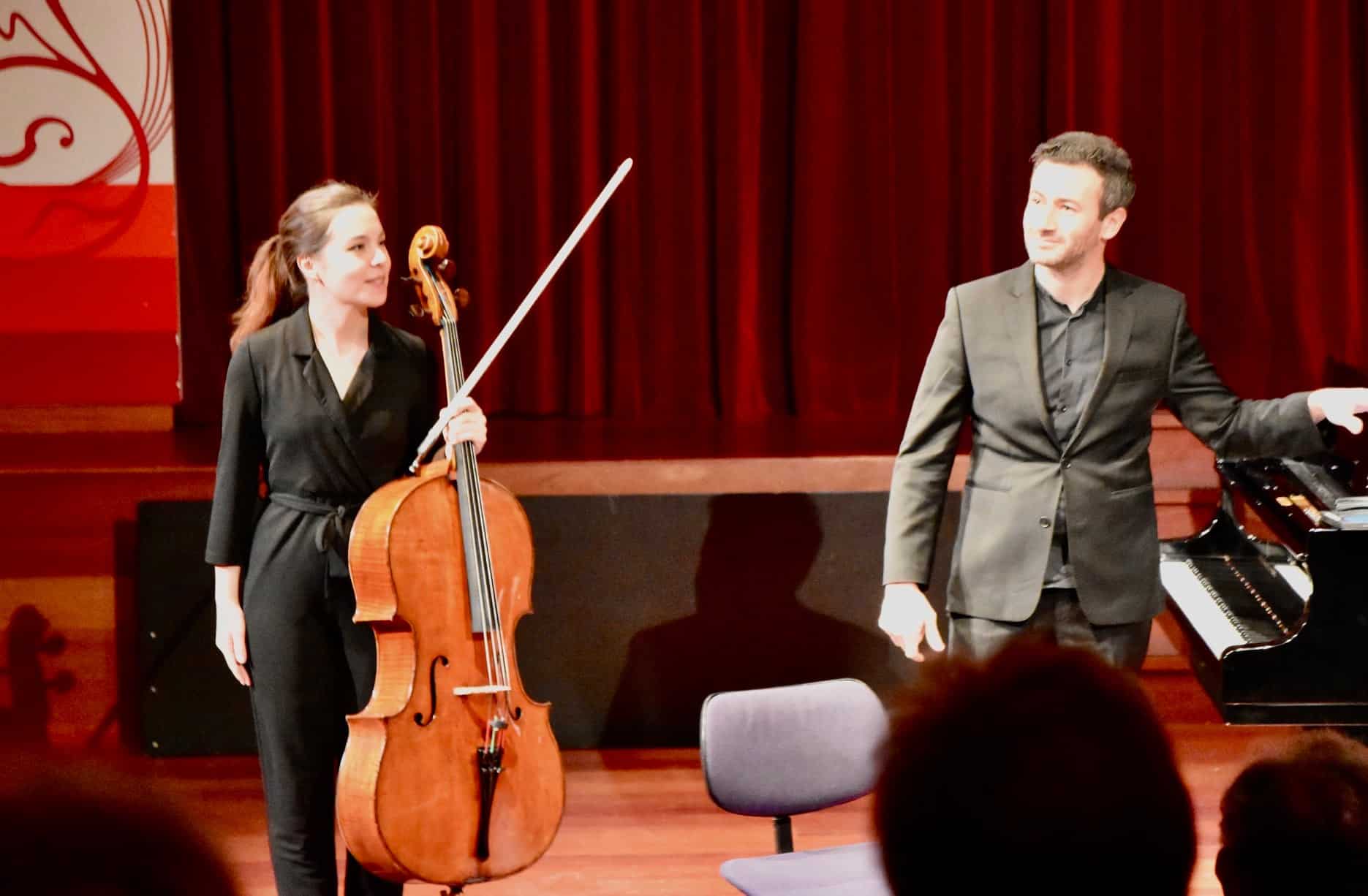
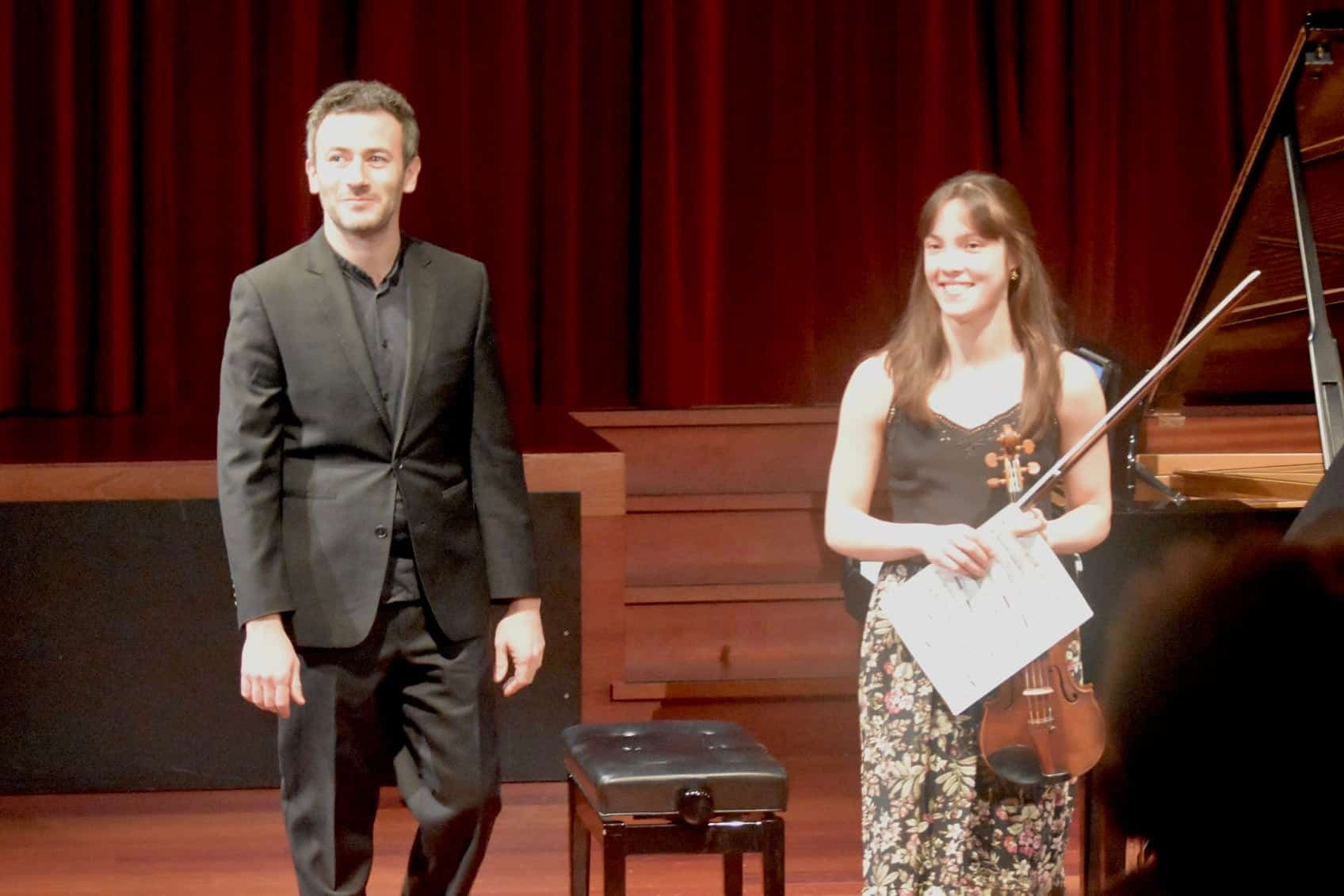
At the side of the youngest Huang, Kusnezow confirmed his qualities as a duo partner who was at times subtle and at times assertive. The cellist initially placed a beautiful, mildly lyrical tone against it, only to tap, as if by thunder, from a very different, considerably more energetic barrel. They had completely made their own the characteristic, split intonation of Schumann's Adagio and subsequent Allegro from 1849, an opus initially conceived for the French horn. Yet there was an essential difference between the two performers, which surfaced quickly, especially in the gently-mannered first part. The phrasings at the keyboard sounded considerably more freely than the string playing: a difference in approach and temperament that, remarkably, made their joint story all the more compelling. If the inspiring tonal richness of Debussy's sonata for violin and piano is naturally engaging (1917), it was the praiseworthy control and precision of 'the eldest Huang' that made a fine interpretation of it. It was clear that she has this score thoroughly at her fingertips. Yet somewhat more volume and an extra boost of enthusiasm in the outer movements would have made the tragic whole more deeply felt and thus even more convincing. Kusnezow was also on point once more, as evidenced, for example, by his attentive touch in both the lively interlude (Fantasque et léger) and the bustling conclusion (Très animé). Or how our musical triumvirate with Schumann and Debussy gained the necessary confidence, in itself and in each other, for the Mozart that was about to come.
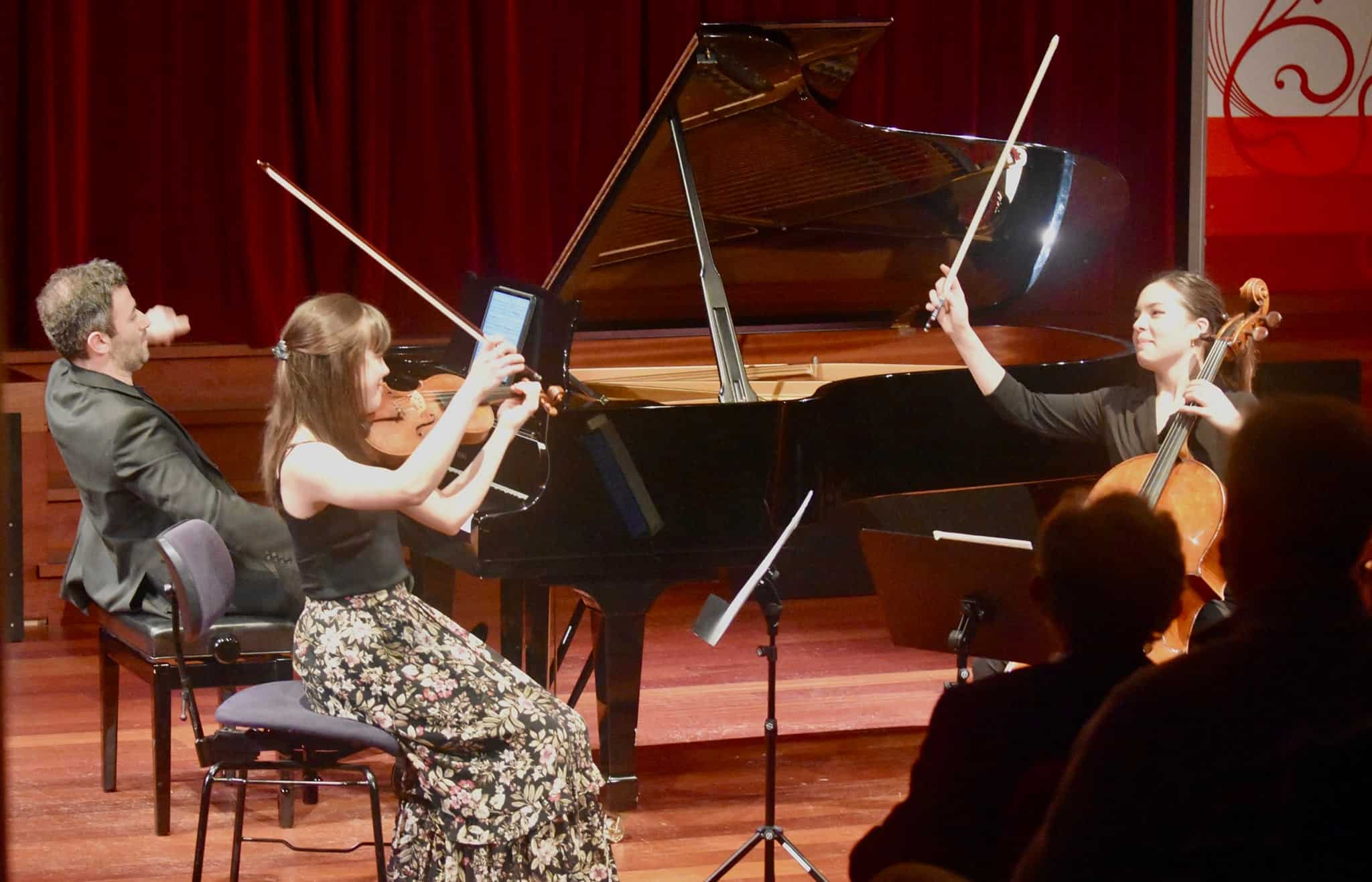
Mozart, Haydn or also Hummel for example require a different approach and playing style than what we heard in the first half of this concert. It seems self-evident, you might think, but that is not the case at all. Too often the opposite is rather true, and the audience gets their beloved Viennese classics with a romantic sauce poured over them. The occasional trio also chose such a Mozart in a more modern jacket this afternoon. As if one had forgotten to turn the knob for his penultimate piano trio (1788). No, not every note was vibrated. And the keyboardist was also rather sparing with his sostenuto pedal. But the sometimes artificial accents did put an unnecessary brake on elegant, flowing articulation. Incidentally, the opening section whizzed by (Allegro), without pausing for breath even once. Unfortunately, it did not benefit the expressiveness, despite some tasteful embellishments from Kusnezow and the visible amusement with the Huang sisters. There was certainly no lack of playing joy, something one would generally only applaud. Yet the line between an unforced smile and remarkable giggling unexpectedly became thin. A way to shake off the image problem of serious classical music or to present Mozart – like Peter Shaffer – as the jolly Amadeus? Unconsciously, it leaned towards nonchalance, an attitude that a composer of this caliber hardly deserves. Moreover, the elaborate Andante cantabile also has a thoughtful, less light side to this piano trio, and the Schubertian modulations in the concluding Allegro suddenly reveal a more dramatic Mozart. There was still work to be done to make those messages more credible, although that should certainly be possible together. Or to quote the motto of the late medieval family Gruuthuse: Plus est en vous!
This became immediately apparent from the trio's encore. The Andante con moto tranquillo from Mendelssohn's first piano trio (Opus 49) reinforced Cervantes' wise words with a host of sublime notes. "Donde música hubiere, cosa mala no existiere." Where music is, as the ingenious Don Quichot already taught, there can indeed be nothing bad. It is up to you to discover this in the coming months during Le musée en concert, beginning on Sunday, January 23 with the unique sounds of violin and luthéal: a thoroughly Belgian invention for a very special keyboard instrument from the MIM's own collection.
- WHO: Sylvia Huang (violin), Stéphanie Huang (cello), Boris Kusnezow (piano)
- WHAT: Robert Schumann (1810-1856) – Adagio & Allegro in A-flat (Opus 70) | Claude Debussy (1862-1918) – Sonata for violin and piano in g (L 148) | Wolfgang Amadeus Mozart – Piano Trio in C (KV 548)
- WHERE: concert hall, Musical Instruments Museum (MIM), Brussels
- WHEN: Saturday, January 8, 2022
- PHOTOS: © MGConcerts
- ORGANIZATION: Le musée en concert – MGConcerts in collaboration with the CPE festival