
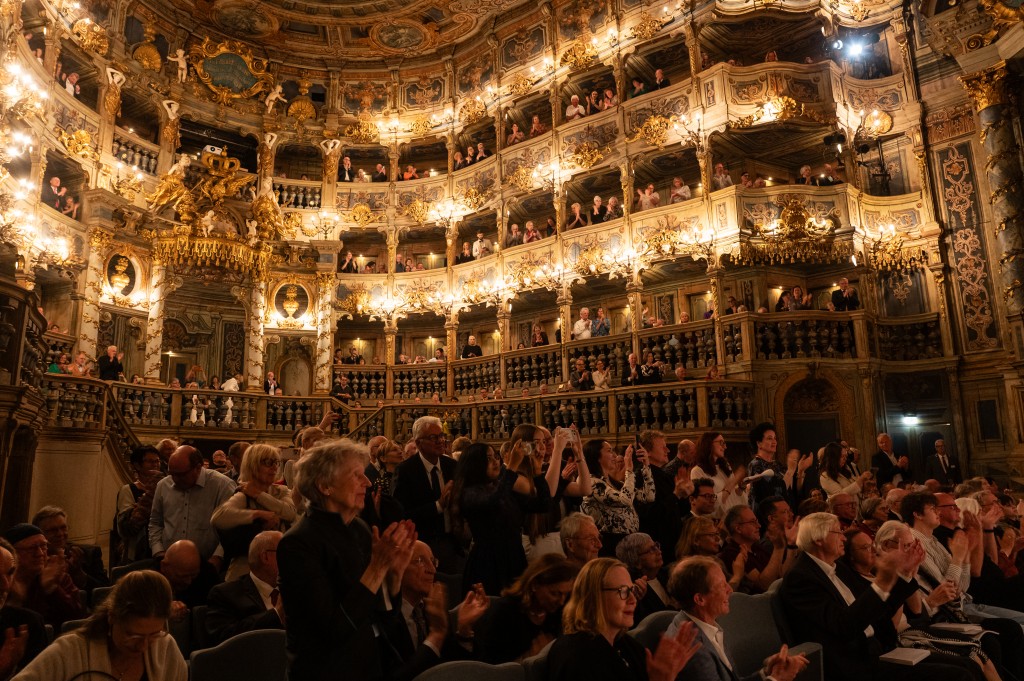
No Wagner in Bayreuth? Oh yes, indeed, not a corner or spot in beautiful Bayreuth without Wagner is conceivable. He is even hidden in login passwords. Wagner is fortunately no longer alone. There is Bayreuth Baroque and recently Gluck was the main attraction.
Christoph Willibald von Gluck (1714-1787), the undervalued, almost slipped between the folds of music history composer without whom there would have been no classicism and possibly no Mozart and even no Wagner. Who really knows more about him than 'Ach, ich habe sie verloren' and the ballet from his Orfeo ed Euridice? Few. The Gluck Festival now brings change to this neglect and just under 240 years after the genius composer's death, he receives once again the recognition he deserves. Wagner knew well what Gluck stood for and he arranged his music. That in itself says enough that Richard Wagner, not an overly simple man, did that. Whether those arrangements were successful is open to debate, but everything must be seen and understood in its time.
The 'Gluck Festspiele 2026' which puts the theme Amor & Psyche in the spotlight, invited a number of music critics to get to know and report on two operas by Gluck. One in an arrangement by Wagner, Iphigenie in Aulis, the other, Paride ed Elena, in original setting. The setting for the Wagnerian Gluck was in the (not yet fully completed) Friedrichsforum complex, the 'Großer Saal' and for the opera Paride ed Elena one chose the Markgräfliches Opernhaus. The latter is, more than rightly so, UNESCO World Heritage. A rococo hall and stage with striking amounts of trompe-l'œil paintings alongside solidly executed woodcarving and stuccowork. What stands out is that all large curtains that are normally in red velvet are here simply part of the trompe-l'œil painting.
Iphigenie in Aulis or still Gluck through Wagner's eyes
The greatly renovated Großer Saal in the Friedrichsforum, which has been undergoing renovation for years, received the musicians and the public to listen, to experience how Wagner adapted the nowadays actually unknown opera Iphigenie in Aulis by Gluck to suit him and how he respected the original. In that respect, he succeeded. His temperament has made this opera, which besides the solos gives striking attention to the choir and of course the orchestra, quite an intense whole that somewhat overwhelms. It is certainly beautiful, unusual too. We heard a musical whole under the direction of Michael Hofstetter, which was in very good form and completely engrossed in a concert performance. This was deliberately chosen precisely to give more attention to the music unknown to most of us and to emphasize the importance of Gluck for opera after him. Because it must be said and written: without Gluck there would possibly be muddling through and musical theater might well have died out because in the long run it could possibly bore people given the turbulent times of novelties in all areas of society at that time.
[caption id="attachment_55656" align="alignnone" width="650"]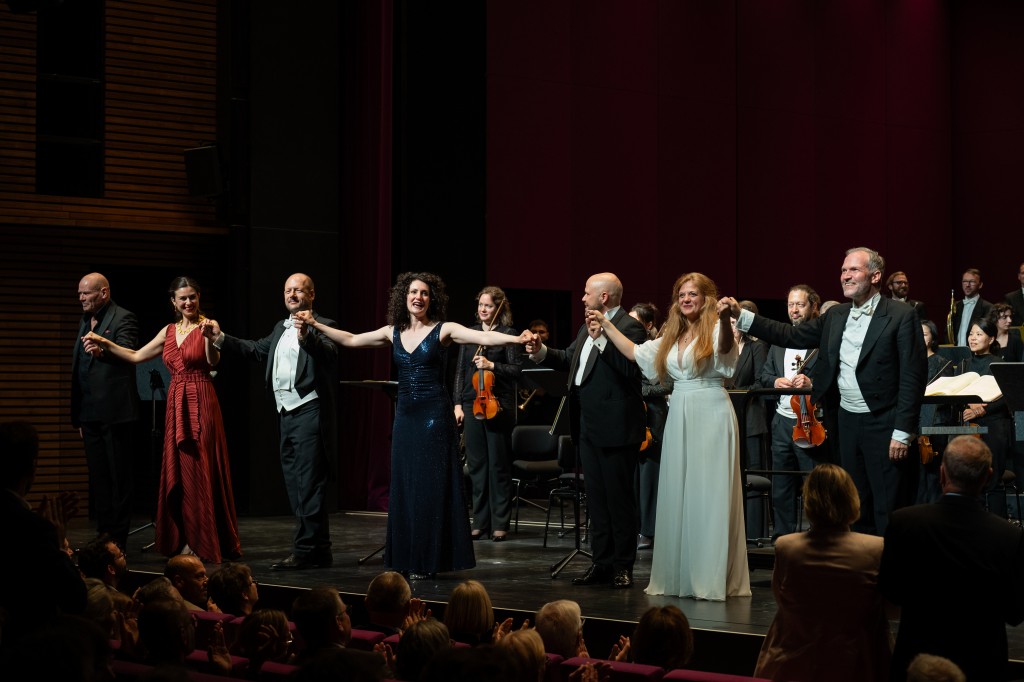 The performers in a row: Bo Skovhus, Agamemnon - Vero Miller, Clytemnestra - Francesca Lombardi Mazzulli, Iphigenia - Aco Bišćević, Achilles - Christian Miedl, Calchas - Soula Parassidis, Pallas Athena – the choir Cantus Thuringia - ThüringenPhilharmonie Gotha-Eisenach - Michael Hofstetter, conductor[/caption]
Pure Paride ed Elena in my top 3!
Perhaps I was a bit brief in my review of Iphigenie in Aulis, but that? That has a reason and that reason is the performance of the opera Paride ed Elena. Musically shaped by the same dedicated conductor – a man who meditates before getting to work – and the same choir, with different singers to be sure and this time with no less than the Akademie für Alte Musik Berlin. A collection of musicians that guaranteed and guarantees the best of the best and whether that was proven.
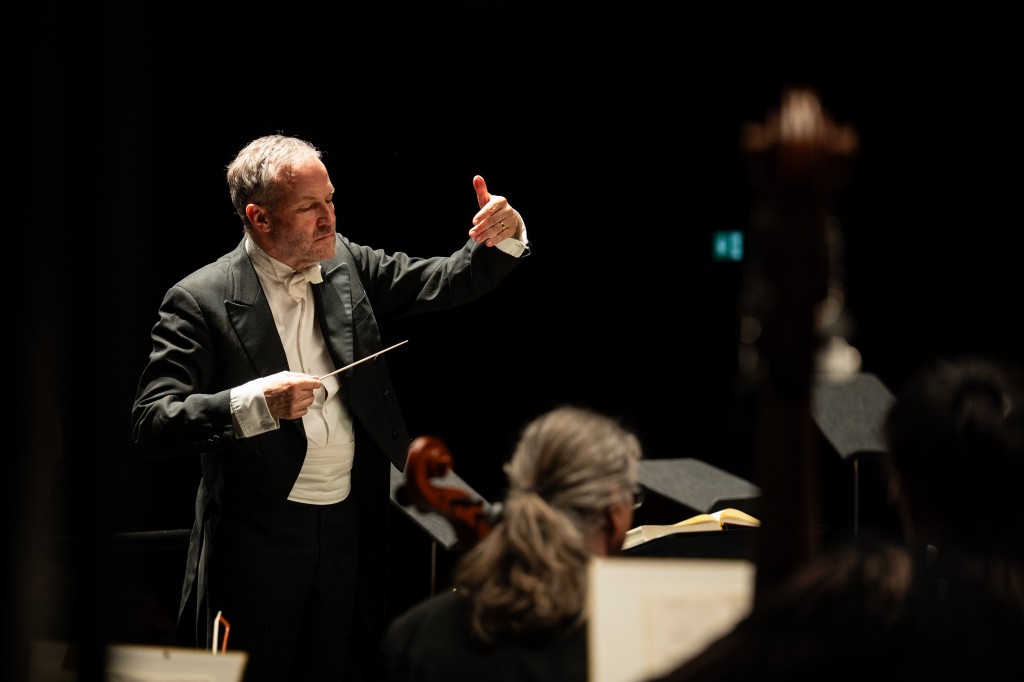 Hofstetter, besides conductor also intendant of the Gluck Festspiele 2026, chose once again for a concert performance. You could find it a pity because such a Greek tragedy calls for beautiful scenery, the folding clothing of wealthy Greek ladies in those old times and what else, but nobody missed the theatrical aspect. The stage decor in itself is more than rich, a solid piece of baroque harmony and symmetry that gives plenty to the eye. From the acting, in such a story as this you can expect little more than what is stilted walking back and forth, but it was cleverly replaced here by singers who presented very expressive mime and measured gestures whereby you had absolutely no need for supplementary theater.
As far as the eye was concerned, it was already more than satisfactory, but musically we experienced something unparalleled. I am not exaggerating: it was one of the three best opera performances I have ever been privileged to witness live. In first place, and it will remain there, is Don Carlos by Verdi performed by the Opéra de Wallonie-Liège in 2020. I reserve second place for, after necessary deliberation with myself (a matter of conscience), Rigoletto by Verdi in Novi Sad in 2019, and now, as third or tied with Rigoletto, this Paride ed Elena. Three completely different works, but with the same artistic inspiration that entails unconditional loyalty to the original, the greatest respect for the work of composer and librettist. It is a pleasure to watch a conductor at work who is completely absorbed by the score and with a radiant smile conducts his musicians in an inspiring and immediately encouraging manner for a work you do not know.
This opera was not unknown, listen to Mozart's Idomeneo…
What does Mozart's Idomeneo have to do with this today unknown opera by Gluck? Not everything, but more than you might think. Mozart certainly brings in Idomeneo a tribute to Gluck with the closing chorus. The castrato role has two extended musically compelling, deeply moving arias that demand virtuosity, technique and above all very great artistic talent, and which leave the audience silent, barely daring to breathe. They are arias that no longer make you think of Gluck, but much more of Mozart. Genius is also found in the other arias and indeed the entire score, but nonetheless, this opera is perhaps even more than Gluck's Orfeo the revolution in opera that led to, among others, Mozart.
The artistic achievements of the famous orchestra and choir were already compelling, but the singers' limited yet so emphatic mime and gestures conveyed the whole as though it were a scenic and not at all a concert performance.
Just as the evening before, listening to excellent singers and to a voice you can never forget. The professionalism of the trio Roberta Mameli as the lovestruck reluctant and conquered Elena, Vanessa Waldhart in the role of the all-dominating Amor and the hard, vengeful Athena by Soula Parassidis was of the highest level. And then Paride… A castrato role now sung by women because men, thankfully, are no longer castrated at age 12 for their beautiful boyish voices, is performed by the singer - not a female singer - more than impressively. There are men who can sing as a castrato, or close to it, though it possibly sounded somewhat different, fair enough. Now and then you get to hear one of them. One of these singers is Samuel Marino. Highly trained in the artistic milieu with ballet and singing, son of university professors who had difficulty, alas, with their son because he was indeed 'different'. Thus he did not experience a full voice break, a rarely occurring but existing phenomenon. Read more about him via this link.
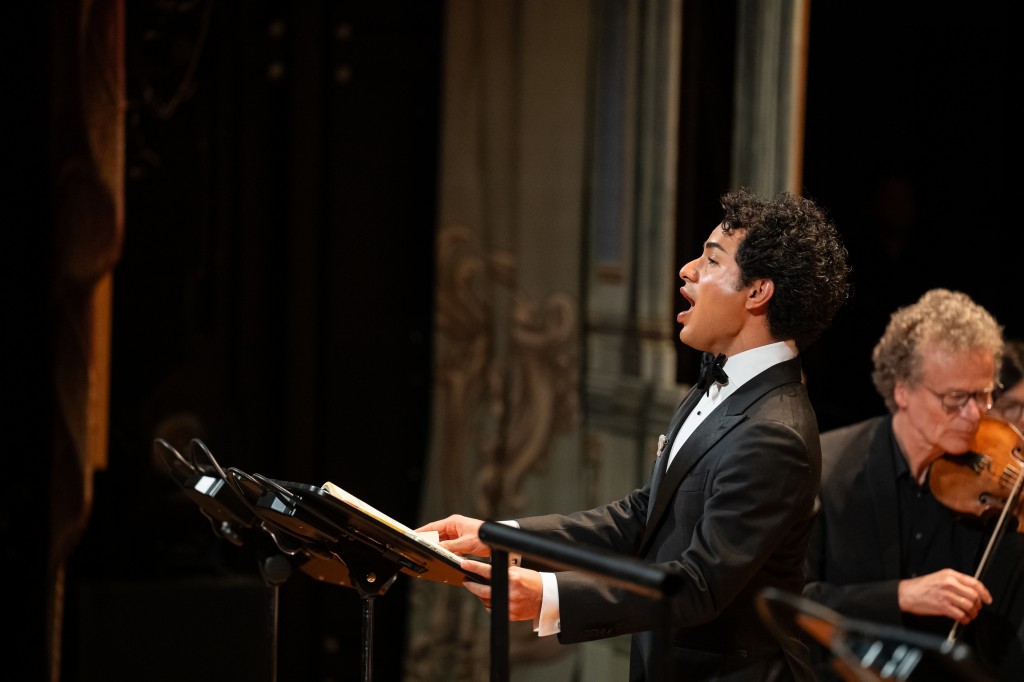 Marino is a musical gift from God. How must you express what cannot be expressed? On the various channels where you can listen to music, you find recordings with this unique singer, a sopranista. Dear readers, go for it, search, discover and find out where and when you can experience this musical rarity. And furthermore, you have by now learned that Bayreuth is much more than just Wagner, thanks to none other than, indeed, Wagner.