
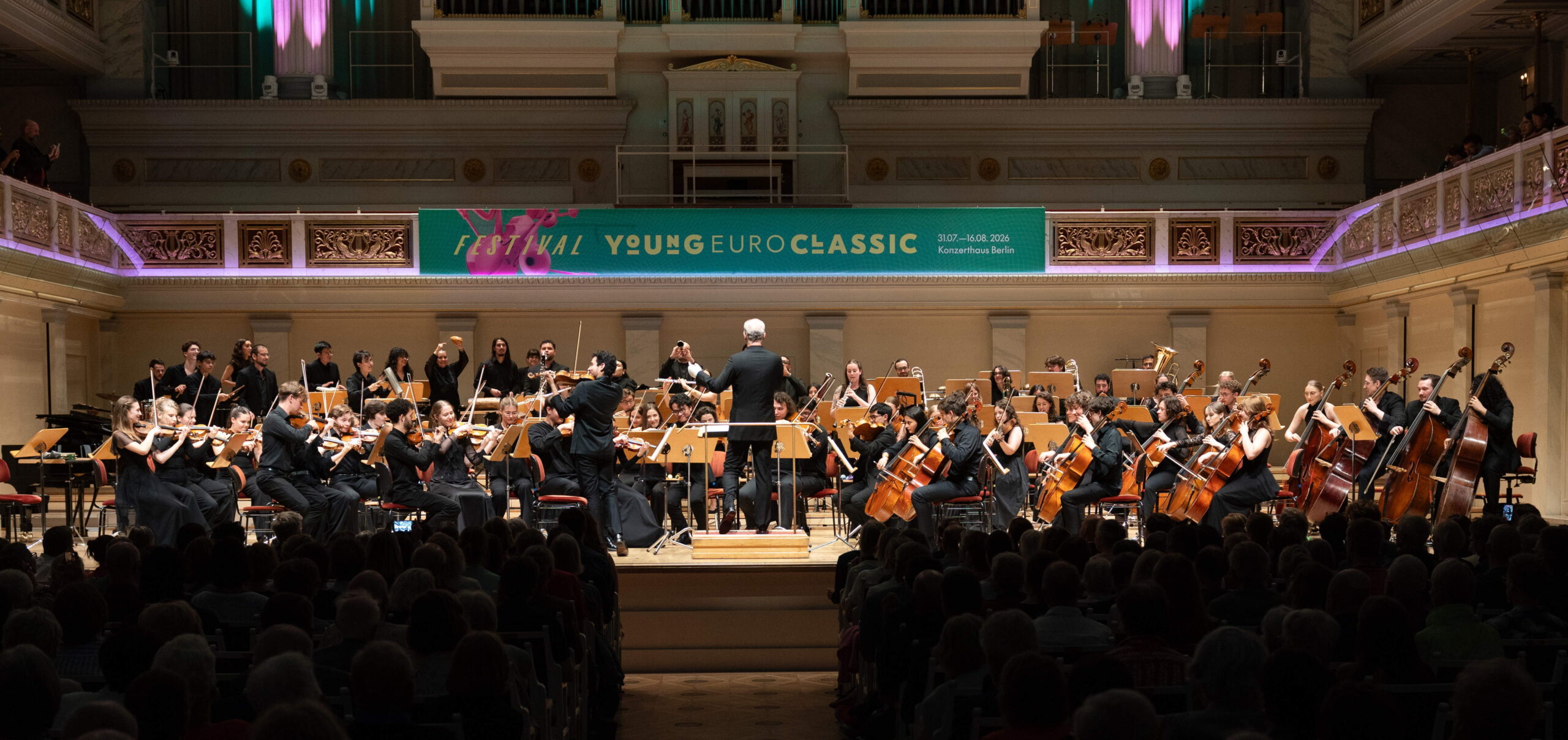
An orchestra is by definition a place of encounter: dozens of musicians bring their instruments, training and musical personalities together to create something that no one can achieve alone. But what happens when not individual musicians, but two youth orchestras meet each other? The Orchestra of the Americas and the Penderecki Youth Orchestra provide a convincing answer during Young Euro Classic on Monday, August 10: on the stage of the Konzerthaus Berlin, after just one week of rehearsals, they prove capable of forming a remarkably cohesive orchestra.
That encounter does not begin on the stage. Some of the young musicians from the Orchestra of the Americas initially only knew each other via Zoom and came together physically for the first time in Poland. Through a screen you can get to know each other, but only when you sit next to each other do you hear how someone breathes and how quickly another musician reacts.
That process fits the character of the orchestra: the musicians, between eighteen and thirty years old, are selected annually from approximately six thousand candidates for eighty positions, and since its founding in 2002, the ensemble has already performed more than four hundred concerts in over 35 countries. The Penderecki Youth Orchestra, founded in 2013 from the Krzysztof Penderecki European Centre for Music in Lusławice, brings a pronounced Polish and European component to this. On the stage of the Konzerthaus, musical experiences from different parts of America and Europe thus come together.
Penderecki as a connecting figure
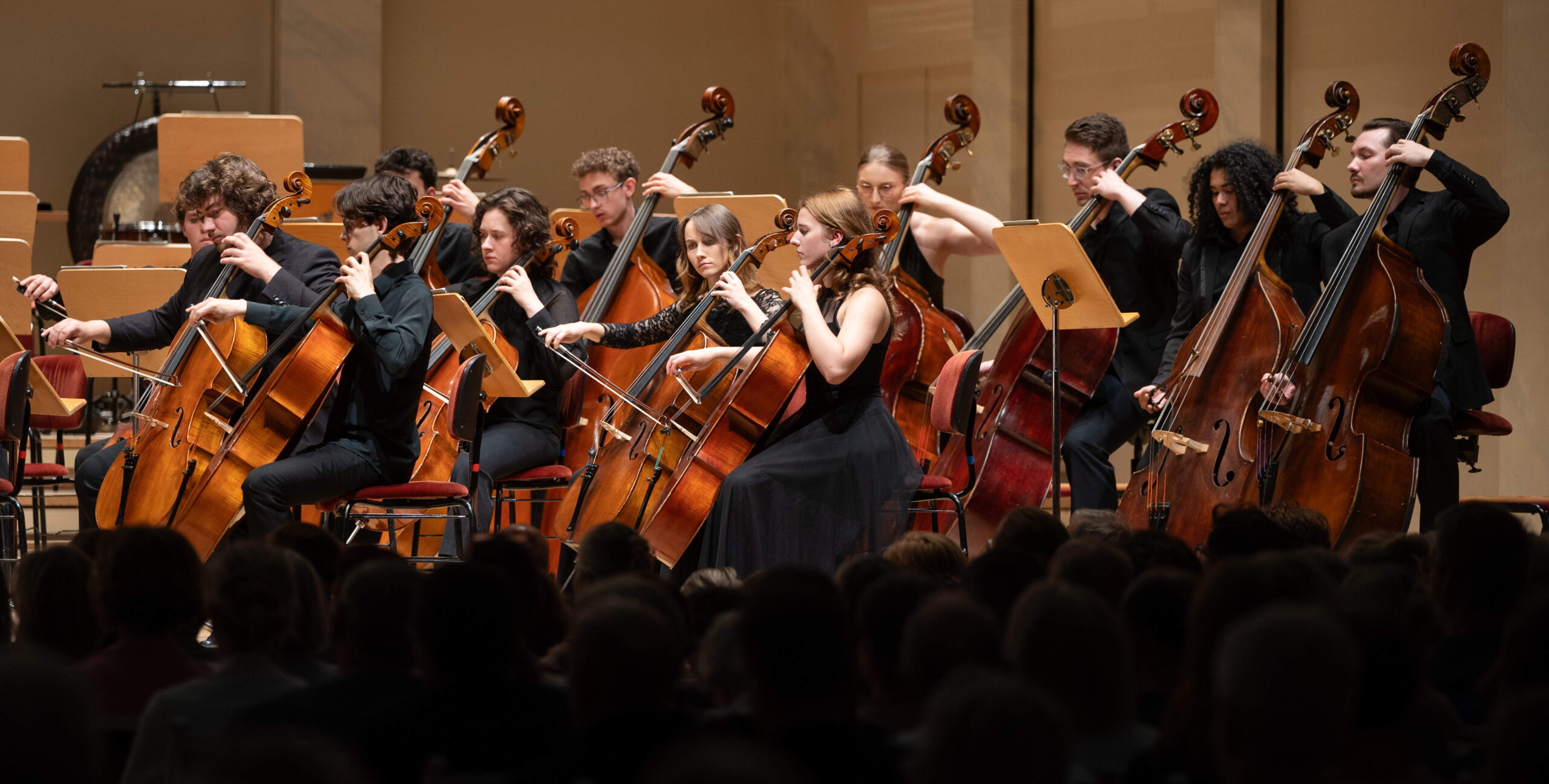 The concert opens with the festival hymn by Iván Fischer (°1951), performed by the brass – somewhat rough, but this short, festive greeting can certainly handle that. Then it becomes quiet and the sound world changes completely with Ciaccona in memoria Giovanni Paolo II by Krzysztof Penderecki (1933-2020), a work in memory of Pope John Paul II and later incorporated into the Polnisches Requiem. Penderecki builds the work around the old form of the chaconne, in which a recurring bass model carries the music while the tension becomes increasingly denser.
Even before that structure can be analyzed, the warm, homogeneous sound of the strings strikes us. There is a deep engagement in it that makes the Ciaccona sound not as a compositional technical exercise, but as a truly deeply felt farewell. For the young Polish musicians, who carry the composer's name not only on their orchestra folders but also on their institution, the work thus takes on a special, almost symbolic significance.
A surprising interpretation
And then Johannes Brahms (1833-1897). Sometimes you hear a work so often that you think you know it after decades – and then you sit in a hall one evening and the first movement suddenly seems like a completely different work. That happened to me during this performance of Brahms' Third Symphony. The first movement was taken exceptionally slowly: no dramatic haste, no emphasis on the heroic, but a warm summer evening glow that let the music breathe very intensely. It required getting used to, but the longer the movement lasted, the more this choice revealed itself as a melodic richness that had escaped me until then.
What was stunning was how quickly these two orchestras had developed such a homogeneous, warm sound: the lower strings provided an intense glow, and the instrumental groups stood nowhere as separate blocks next to each other. Even in the hushed passages that Prieto introduced, the music remained perfectly audible, as did the pizzicatos. The woodwinds were given all the space for beautiful, characteristic solos. The same tendency continued in the Andante and Poco allegretto – delightful enjoyment, without anything needing to constantly happen to still have something to say.
In the finale, the familiar fire returned: more dramatic, fiercer and ideal to close things in this classical way nonetheless. A particularly strong find was the positioning of the brass together, instead of spreading the horns opposite the rest of the brass in different corners. This allowed the brass to speak as one block instead of boxing against itself, and that worked incredibly well here.
It clicked between Carlos Miguel Prieto and both orchestras, something that was already palpable during the conversations that afternoon. Prieto had said then that for him it was especially the process that mattered; the concert itself was the culmination, the festive conclusion to the hard work that preceded it. After this Brahms, you understood what he meant. For me, the symphony experienced a true rebirth that evening – not because the work sounded radically different, but because time, warmth, silence and breath were placed into the music.
Impetuousness trumps
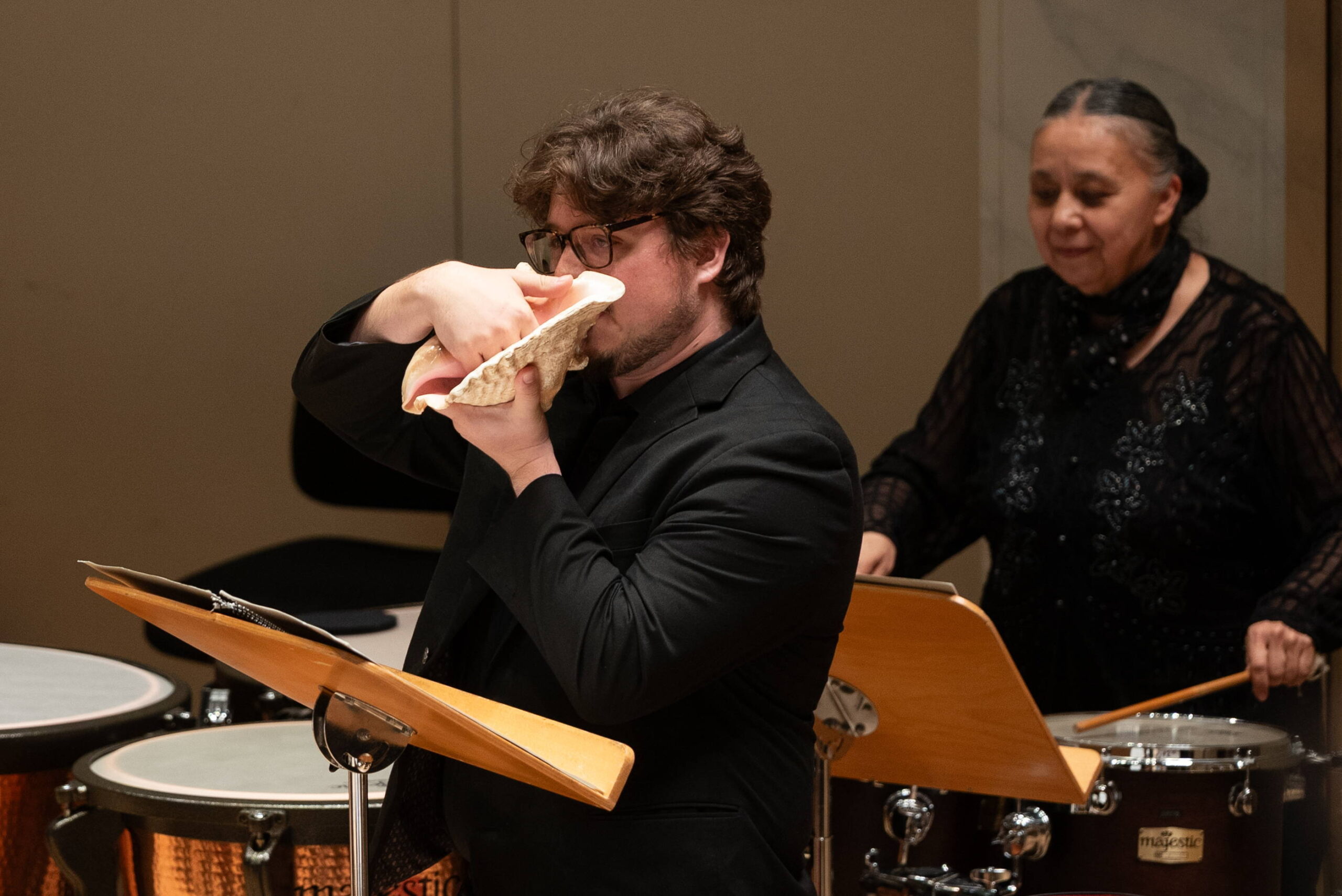 After the intermission, the atmosphere changes completely. Prieto briefly explains La noche de los Mayas by Silvestre Revueltas (1899-1940) and says that this generation gives him hope for the future – a simple remark that takes on extra meaning after everything that preceded it. He has the percussionists introduce themselves and their instruments one by one, and by the time everyone is seated again, you know: something awaits us here.
What follows is a purely musical celebration. The work was created in 1939 as film music and was only compiled into the well-known four-part orchestral suite by José Yves Limantour in 1960. The percussion receives an exceptionally large place, including bongos, congas, güiro, rattles, tom-toms, teponaxtles, huehuetl, caracol, tam-tam and xylophone. The caracol in particular – the shell that serves as a wind instrument – stands out in eye and ear, together with the wooden teponaxtles and the large huehuetl drum.
What was especially striking was how physically the musicians responded to the music. They did not sit still behind their music stands, but moved along on their chairs, as if Revueltas' rhythm was not only in their hands but in their whole body. And that applied not only to the musicians of the Orchestra of the Americas: the young Polish players had also visibly made this Mexican rhythmic language their own. Nowhere did it sound as if one group was playing the other's music. Two orchestras that had been largely strangers to each other just weeks earlier were making music here with the same drive and the same alertness.
Important to note: with so many percussionists, it would have been easy to make a demonstration of orchestral power out of it, but that doesn't happen. The sections respond sharply to each other and the rhythmic exuberance never becomes anything arbitrary. The second movement ends with a small flourish that the audience immediately receives with a laugh; the timpanist too is a pleasure to watch, while the balance between the sections remains well guarded. Also beautiful are some flute solos that rise as light, almost playful lines above the rhythmic foundation.
In the fourth part, that becomes even more impressive: it is fascinating to see all those variations in the percussion apparatus emerge and at the same time hear how musically they are embedded. The strings are not always equally audible, but that hardly detracts from the whole – the power lies in the way the layers together form a constantly changing rhythmic landscape.
It is a very different orchestral world than Brahms, but the underlying quality remains the same: it is about listening, only the language has changed from breath and phrase to rhythm and color – in Revueltas, a breath that is more rhythmic, more physical and more exuberant.
A city that dances ceaselessly
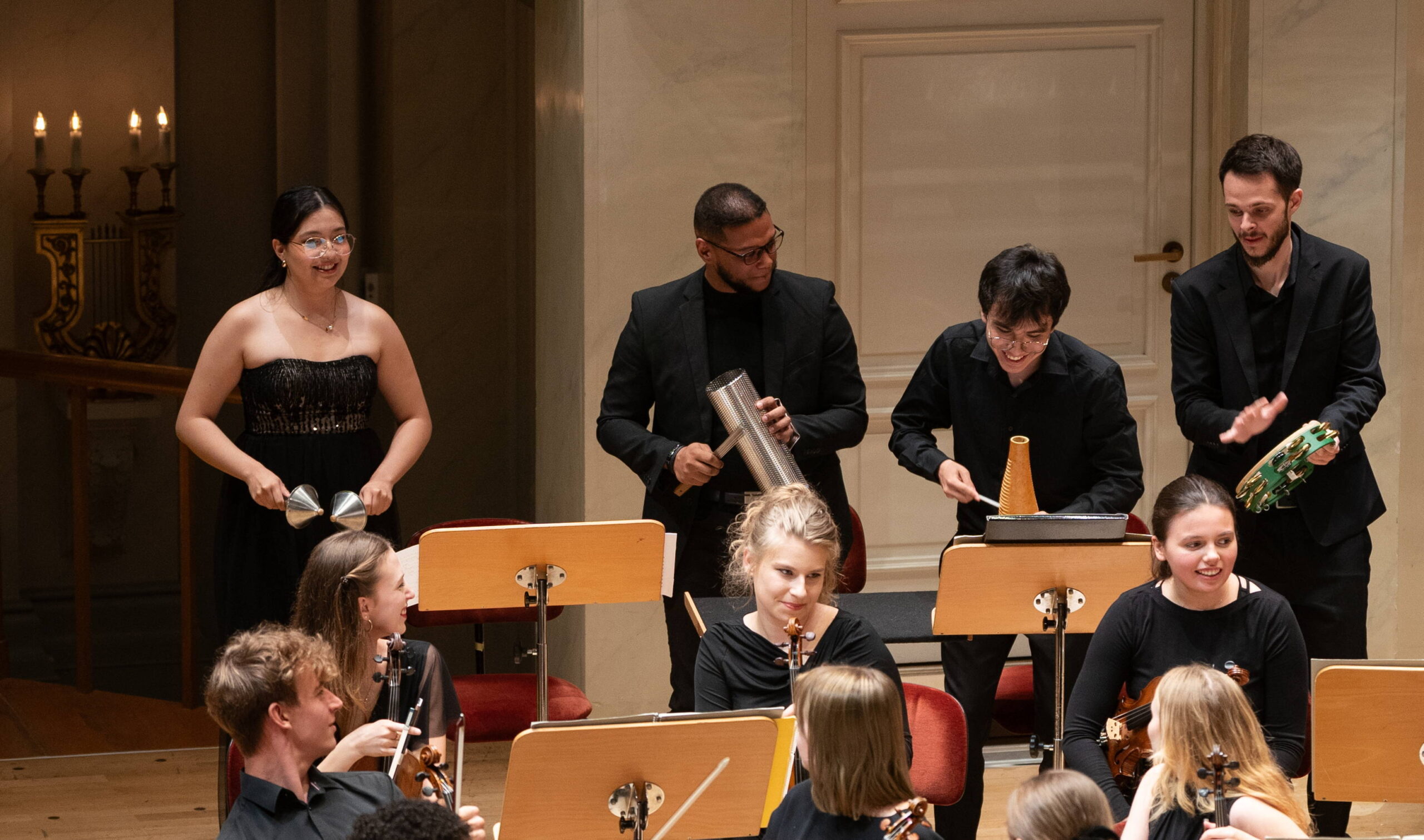 Prieto also briefly explains Antrópolis by Gabriela Ortiz (°1964). The title is a neologism in which antro, the Spanish designation for bars and nightclubs, resonates and refers to the sound of Mexico City and the energy of an urban, nocturnal world – a musical journey through the dance halls and nightclubs where different styles come together.
What immediately strikes us is how much Ortiz transforms the orchestra here into almost a dance band. The percussion section has an impressive arsenal – in addition to timpani, including bongos, marimba, vibraphone, drum set, claves, cowbell, maracas, güiro and vibraslap – while the strings lay a rhythmic foundation and wood and brass place short, energetic exclamations and melodic fragments above it. The timpani get a striking solo role at the beginning and subsequently function as a link between the sections. The music constantly changes shape, but never loses its coherence anywhere.
After the orchestral glow of Brahms and the explosive rhythm of Revueltas, Antrópolis is no easy follow-up, but a further acceleration: a contemporary language in which dance, nightlife and urban rhythm flow into each other. The German premiere thus becomes something irresistible – again with much rhythmic energy, but always sustained by precision rather than pure display.
Young talent without borders
Young Euro Classic presented here not simply two youth orchestras that happen to share the same stage, but a situation in which young musicians actually need each other. It is also telling that the program does not end with Brahms, but with Ortiz: the European tradition is the starting point, not the endpoint. Penderecki and Brahms open the evening, Revueltas brings Mexico inside, and Ortiz shows how a contemporary composer continues with that history.
For me, that thought found its most restrained form in Penderecki, its most surprising in Brahms, its most festive in Revueltas and its most dancing in Ortiz – four very different musical worlds, carried by two youth orchestras whose musicians had only really gotten to know each other a short time before. That is precisely where the significance of this evening lay: two orchestras that were not simply merged, but found one shared voice.
Before this concert, four young musicians from both orchestras already spoke about their collaboration and the program – you can read that interview here: https://klassiek-centraal.be/musici-uit-heel-amerika-en-europa-een-klank-orchestra-of-the-americas-en-penderecki-youth-orchestra-vinden-elkaar-bij-young-euro-classic/
You can read an interview with conductor Carlos Miguel Prieto here: https://klassiek-centraal.be/muziek-is-een-absolute-barometer-van-het-leven-in-gesprek-met-dirigent-carlos-miguel-prieto/