
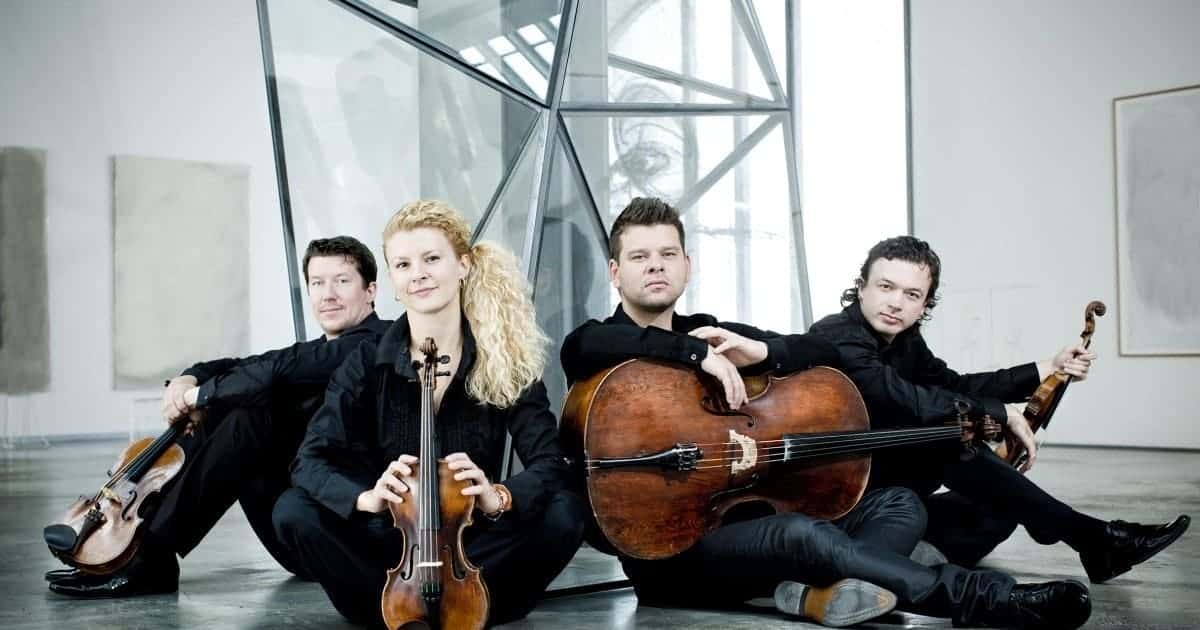
Since my first encounter with the Pavel Haas Quartet two years ago at the Novecentofestival in Leuven, they have been firmly noted as one of my favorite performers. Add pianist Boris Giltburg to that, and with these five fantastic musicians you almost have a guarantee of a great concert. Yet the five proved through their choice of works that the whole is not always better than the sum of its parts.
With an entirely Shostakovich program, Giltburg chose, according to his own account, "timeless music". A strange statement, for Shostakovich's music is precisely inextricably linked to the Soviet period. In his oeuvre you immediately notice how the Russian evolves from a state composer kept under control to a musical rebel who gives hidden criticism of the Soviet Union in his music. By building the program in reverse chronological order, we first encounter this maverick.
A gift for the Pavel Haas Quartet. The Czech quartet makes a splash especially when it indulges in Eastern European music: Bartók, Dvořák, Smetana and of course Pavel Haas himself. Well, the expressive character that typifies these composers is also found in Dmitri Shostakovich's string quartet in F-sharp minor. Veronika Jarůšková and her colleagues immediately grab your attention. The many staccatos in the first movement, which emphasize the wrenching harmony, are executed on point. Even when Shostakovich's work becomes quieter in the lento section and the quartet can rely less on their typical fiery performance, they shine with a beautiful melancholic, at times almost piercing execution of the minimalist melodic line. The final movement, allegro, is a textbook example of what makes this quartet so incredibly good: lightning-fast, expressive, loud and passionate they tear through the third movement of the string quartet. This was the Pavel Haas Quartet at its best.
Unfortunately, this was also the concert at its best. In Shostakovich's trio in E minor, piano, cello and violin continually take turns as the lead role, so that ultimately not one of the three musicians, but the collective strength of the trio deserves the applause. In principle a perfect piece to put such accomplished musicians together on stage without overshadowing each other. Yet this resulted in rather too orderly a handover between the three. No one dared to fully throw themselves into their role as leader when that was needed. From the strings I especially missed the energy they had displayed in the final section of the first work. Boris Giltburg shone briefly: in the second movement, the allegro con brio contains a virtuosic passage where the pianist fully displayed his qualities. Though immediately afterwards he could not really convince with the beginning of the largo. Those chords must carry weight, and they were played too lightly.
With the quintet in G minor we went further back in time, and the greatest problem with the program became clear. It is not the musicians who are to blame for the declining arc in this concert, but rather the choice of works. Both the expressive Pavel Haas Quartet and the nimble-fingered Boris Giltburg do not come fully into their own with these relatively classical pieces. By working backwards towards an increasingly conservative Shostakovich, the musicians no longer have the full opportunity to display all their qualities. Not that it becomes bad afterwards, far from it. They remain five wonderful musicians. Simply a shame that the peak was already reached after a short quarter hour.
- WHAT: Klara-festival
- WHO: Boris Giltburg & the Pavel Haas Quartet
- WHEN: 10 March 2018
- WHERE: Brussels, Flagey
- Photo: m.t.