
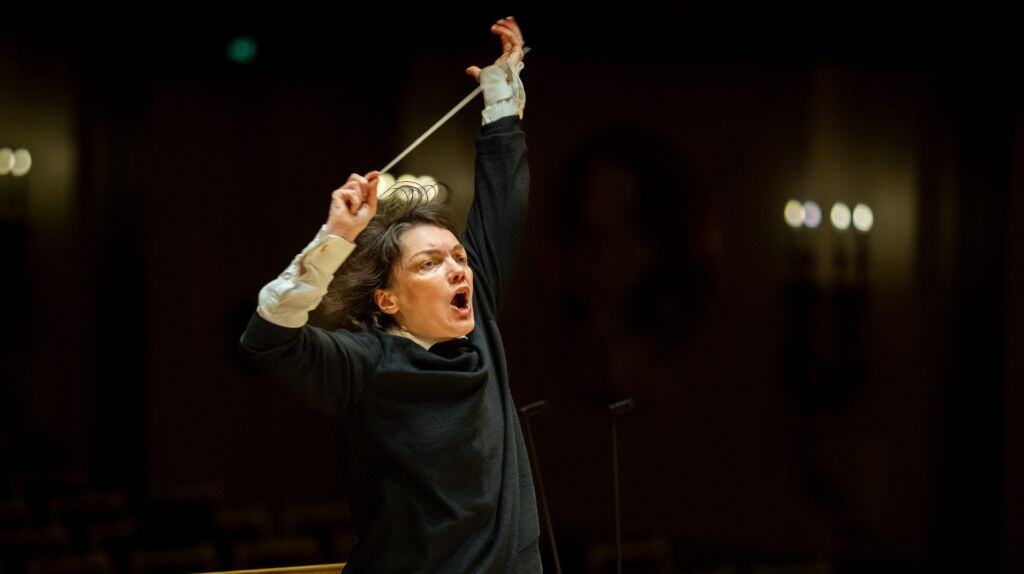
On Saturday, September 20, 2025, the London Philharmonic Orchestra, conducted by Ukrainian conductor Natalia Ponomarchuk, delivered a concert laden with such rare weight at Concertgebouw Brugge. More than a performance, it was an act of conscience…
There are evenings when music sounds. And there are evenings when it breathes — not nestling in the ear, but in the flesh, in time, in the moral space of the present. The concert in Brugge belonged to that second, rare kind: not a collection of works, but a dramatically and thoughtfully constructed whole, in which sound, history, and conscience interlocked like threads of a single fabric.
Through the doors of Concertgebouw wafted a fresh, yet layered musical wind: an evening that stirred old souls and explored new paths. Not a casual program, but a powerful aesthetic and moral statement. On the program were Lyatoshinsky, Berg, Neyrinck, and Sibelius – not an obvious choice, but a deliberate and courageous statement. Four composers, four worlds, yet brought together in a gesture of urgency and insight.
At the center stood two Ukrainian artists: the refined yet unwavering conductor Natalia Ponomarchuk and young violinist Dmytro Udovychenko, who, since his triumph at the Queen Elisabeth Competition 2024, does not merely play, but testifies. Together, with the London Philharmonic Orchestra as their instrument, they brought an evening that presented Ukraine not as a geopolitical flashpoint, but as a cultural voice — deeply rooted, layered, and above all, alive.
Some concerts you listen to with your ear. Others with your heart. And then there are those evenings when music quietly settles in the soul — as a gentle but inescapable sensation. Because what was performed was more than notes: it was the past sounding in the present.
Between Epic and Actuality
The evening opened with Grazhyna by Borys Lyatoshinsky (1895–1968), a symphonic poem rarely heard in the West, but here it achieved shocking clarity. Conductor Ponomarchuk interpreted it not as program music, but as a mythic ritual, as a people's struggle against oblivion. Based on a text by Polish poet Adam Mickiewicz about a heroine who sacrifices herself for her people's freedom, this late-Romantic, epic-drenched score became an allegory of national identity — and deeper still: a ritual of remembrance.
The buildup was slow, almost ceremonial. Dark strings, particularly violas, rose from a silence that weighed heavier than dynamics could express, like voices from ancient soil. The brass section, sustained but never bombastic, sounded like a herald of a wounded land, alternating with sharp cries and stately funeral songs from the woodwinds. Balancing not to please but to testify, the London Philharmonic Orchestra under Ponomarchuk's controlled direction moved between lyric and restraint, between epic and grief.
Ponomarchuk measured the dramatic arcs with sharp narrative intuition: this was no overture, but a proclamation. No exaggerated gestures, no heroic chest-beating – rather, fire beneath ash. The conclusion, surrendering neither to triumph nor despair, sang of tragic necessity. Ukraine was not shown here as victim or battlefield, but as a cultural nation with deep roots and an indelible voice.
Raw Tenderness and Silent Resistance
At the heart of the evening resounded Alban Berg's (1885–1935) Violin Concerto, written in the last summer of his life and dedicated "to the memory of an angel" — Manon Gropius, the 18-year-old daughter of Alma Mahler and Walter Gropius. Not a classical elegy, but a penetrating, existential meditation on grief and transience, in which Berg combined his masterful twelve-tone technique with a fragile, transparent sound language. The concerto rang like a mirror of the soul: not gleaming, but marked by loss.
Dmytro Udovychenko, young Ukrainian talent and recent laureate of the Queen Elisabeth Competition 2024, took the stage as a sound-bearer, not as a virtuoso who plays, but as a suffering being approaching each note with tender caution. His violin whispered fragilely, almost shyly, as if each tone first had to breathe. The hesitant motifs and bitonal hue of the first movement did not let him bloom, but wither — a vulnerability that was not soft, but spoke volumes. Each glissando was a groping gesture toward the unsayable, a whisper of unprocessed pain.
The London Philharmonic Orchestra sang not to embrace, but to share in life. Under Ponomarchuk's controlled, refined direction, the orchestra breathed as one body: strings sang with closed mouths, woodwinds whispered broken lines. No domination, but space created — a silent dialogue of grief and remembrance.
The climax arrived with the Bach chorale Es ist genug. The violin floated above it, not as rest, but as a question of conscience: Is it enough? When does suffering end? In the hands of this young Ukrainian soloist, it rang not only as a universal requiem, but also as a sharp, contemporary indictment — not a cry of rage, but an intimate, inescapable plea that nested in the soul and confronted every listener with the human toll of conflict and oblivion. A sound monument for a people that refuses to be forgotten. Music as grief, and as moral stance.
Five Patterns
At the world premiere of Vijf Patronen, composed by Belgian composer Frederik Neyrinck (°1985) and written especially for this concert, more than just music emerged. The five-part composition — five miniatures as architectures of sound — created a moment of intense stillness. Not silence as emptiness, but as concentrated breath: a space where conventions faded and form developed into a new language.
The five patterns were not traditional forms or programmatic pieces, but abstract reflections: variations in rhythm, harmony and texture, that presented themselves like a labyrinth without ever getting lost. No linear narrative, no intrusive pathos — rather a search for direction in a world that continually shifts. The music reformed itself anew each time, like an elusive memory that keeps returning.
Neyrinck, who distinguishes himself in the contemporary Flemish composer landscape through his poetic and engaged approach, does not rewrite the past with nostalgia, but with urgency. Not as rupture, but as rewriting. His music is like a scar: it bears traces of what was lost and testifies to what must be reconsidered. Vijf Patronen sounded like the present being rebuilt — fragmented, but laden with meaning.
The ensemble was classical, the orchestra sharp and alert, but the colour palette contemporary. Rhythms pulse but remain unstable, textures are fragile, lines clear but breakable. Percussion functions not as effect, but as meaning-bearer. The music seeks no rest, but stability in motion — a fragile structure with a hard core, like a ruin that refuses to collapse.
Conductor Natalia Ponomarchuk led the London Philharmonic Orchestra with surgical precision, without distance. Her gestures created space for tension and breath in the silence. She found structure in the fragmentation and gave the work the suppleness it required — unerring, never dictatorial. Her leadership gave no direction, but oxygen.
Under her hands the orchestra sounded like a living organism: balancing between control and letting go, between sharpness and suppleness. Within that controlled form, moments of unexpected beauty emerged: a Brucknerian climax, massive as a cathedral, followed by a jazzy turn that gave the work air without losing weight. Sound became play, and play became seriousness.
Vijf Patronen functioned not as an intermezzo, but as a pivot in the dramaturgy of the evening — a bridge between past and future, between reflection and renewal. It challenged without imposing itself, and offered space for interpretation, remembrance and recommencement.
This work deserves a lasting place in the contemporary repertoire. It was, literally, a breath of fresh air: a restart of listening, a break with familiar patterns, and a call to embrace the sound of the future. Not music for the fleeting listener, but for those willing to wander, to search — and perhaps to rediscover something.
Closing of a moral arc
The transition to Jean Sibelius (1865-1957) felt not like a break, but as a natural extension of the musical space this concert embraced. Where the preceding work by Neyrinck unfolded in tight geometric lines, Sibelius spoke in the intangible of nature: clouds, wind, light – everything captured in a masterful, refined architecture. And then, as if the evening needed one last breath before it could close, his Fifth Symphony sounded. Not a break, but an inner culmination. A symphony that is not programme music, but sounds like a manifesto — born from the Finnish struggle for independence, completed in 1915 and revised to the definitive version in 1919. Tonight we heard the first, raw version from 1915, four movements and still pure, and precisely for that reason all the more gripping. Not merely a work about history, but a work that breathes history.
Sibelius wrote this music not to tell a story, but to feel a truth. His Fifth is the work of a hermit who hears the world, but only answers in echo. And yet: that echo is loud. In the slowly rising horn motifs. In the nervous rhythms. In the meaningful silences between the notes. This is music that balances on the edge of possibility – a hope that does not dare to express itself.
Ponomarchuk, herself from a country that today fights anew for its right to exist, read this symphony not as a Finnish pastoral, but as a universal testimony. She did not conduct from the north, but from the east – a bridge between two peoples who share the burden of oppression and the power of resistance. What she brought was not an interpretation, but recognition.
The first movement was not started, but born: from mist, from silence, from a waiting that slowly fills itself. The melodies rose like primordial forms, the strings spread like a landscape rediscovering itself after years of silence. The tempo choice was organic, the arc of tension refined to essence.
In the following sections timing became an art, and structure changed into suggestion. The variations came not as explanation, but as a process: the pizzicatos ticked like memories, the faltering rhythms like inner doubt. Woodwinds sang of melancholy without succumbing to heaviness. Ponomarchuk found rest in the disorder, without denying the tension.
The woodwinds stood out particularly: playful, delicate, but with a melancholic timbre that underscored Finnish melancholy without falling into gloom. A flock of clouds above a forsaken lake, translated into music.
And then – the finale. Sibelius' famous swan theme – inspired by the swans he once saw gliding across a lake – did not sound here as a metaphor, but as a prayer. No triumph, but surrender. A flight that does not escape, but endures.
The six closing chords often run the risk of descending into a caricature of themselves: too loud, too abrupt, too simple. But here they sounded like breath gasps of a world that refuses to disappear. Between the fifth and sixth chord: a silence that was not rest, but a shiver. The hall held its breath. Not out of awe for the grandeur, but out of awareness of the deeper meaning.
Through her interpretation, Sibelius suddenly sounded disturbingly contemporary. The echo of Finnish awakening resounded in the Ukrainian struggle. Two peoples, caught between power and identity, between tradition and survival, seek in sound their right to exist. What Ponomarchuk did this evening was more than conducting. She made Sibelius sing with the voice of Kyiv. And so the swan dreamed again – of a freedom that is still not taken for granted.
A cultural act of conscience
What made this evening unforgettable was not only the musical quality – which was beyond question – but the moral coherence. This was not a concert, but a cultural document. A composition in four movements, connected by the question: what remains when words fall short?
The choice of two Ukrainian artists – a conductor with inner strength and a soloist with rare depth – gave each work contemporary significance. Ponomarchuk, with her restrained authority, turned every gesture into a matter of conscience. Udovychenko, barely in his mid-twenties, proved that musical maturity does not depend solely on age, but on intensity of feeling.
Because sometimes music is not an answer, but the only right silence — a language in which the soul speaks and the conscience listens. So this evening sounded in Brugge: as an unforgettable dialogue between past and future, between sound and meaning, between heart and mind.
Together they showed us what music can do when it is not used to please, but to remember, to question, to heal. It was an evening of risks – of repertoire, of expression, of ethics. But the reward was great.
An evening that not only sounded, but resonated. Not for what was said, but for what was questioned.
Because sometimes music is not an answer, but the only right silence — a language in which the soul speaks and the conscience listens. So this evening sounded in Brugge: as an unforgettable dialogue between past and future, between sound and meaning, between heart and mind.