
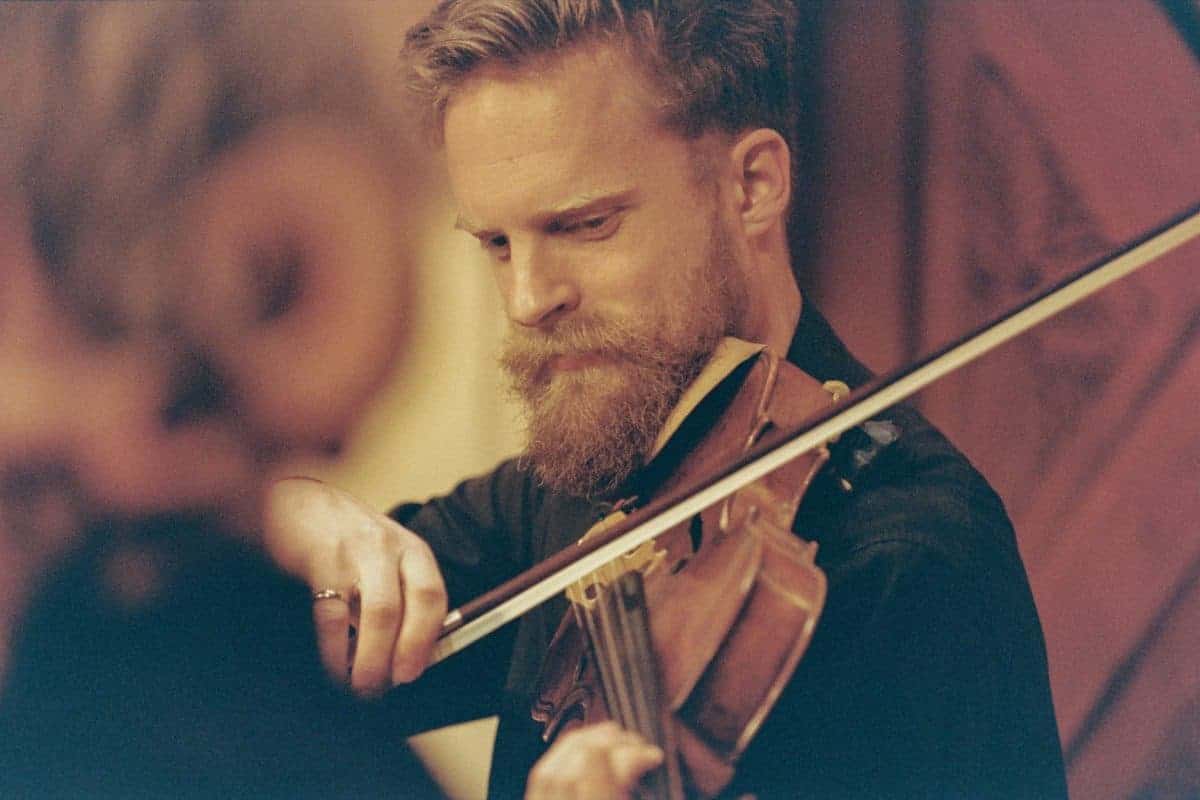
For the four Vikings of the Danish String Quartet, 2018 ended on a particularly positive note. Because last week the quartet received news that Prism I, their first recording in a five-part series for ECM New Series built around several fugues by Bach and the late quartets of Beethoven, was actually nominated for a Grammy in the category Best Chamber Music/Small Ensemble Performance. On 6 December, the foursome visited Antwerp for the first time: a fine St. Nicholas gift from deSingel. It was following this debut that Klassiek Centraal spoke with altoist Asbjørn Nørgaard about the importance of a coherent message, the interplay within a group between trust and freedom, and the Scandinavian national character. "We don't go looking for conflict. So if we criticize each other, we will always do it in a gentle manner."
Whether the Danish String Quartet can actually cash in on their nomination, we'll only know on 10 February. What is certain is that the string quartets of Beethoven hold a special place in both the hearts and the repertoire of these four likeable thirty-somethings. Under the banner The Copenhagen Cycle, the quartet ventured for the first time at the end of October to give an integral performance of this masterful oeuvre. And in Antwerp too, the composer graced the programme with the first of his Razumovsky quartets. The purpose of the concert at deSingel was to demonstrate that as a string quartet you can do very different things: not only keep the grand, romantic machinery of Beethoven running, but also (re)discover Haydn's pioneering creations and… sing folk songs. "When you take the stage, and you ask the audience to listen to you in silence for a certain amount of time, then you must know well why you want that attention and what you want to do with it."
The Danish String Quartet makes its debut at deSingel: what kind of ensemble does the quartet want to be; how do you distinguish yourselves from other string quartets?
Asbjørn Nørgaard: We've been to Belgium before, both at Flagey and at a number of other places, but this is indeed the first time we're playing in Antwerp. We don't really consider the Danish String Quartet as a project. We don't have a grand battle plan that determines how we want people to think about us. We are who we are. We didn't form the quartet to make a career, to tour and play concerts. We were already giving concerts together before we knew that we wanted a career in music. Actually, we're just very old friends, who have always played together, and who play the music we love. Fortunately for us, the audience seems to enjoy it too. And if they're willing to do that with us, then that's just wonderful.
Is there a person or event that has had a decisive influence on the quartet's career so far?
Nørgaard: In every life and every career there are of course events and people who have meant a lot. For us, it was one particular teacher in Copenhagen, Tim Frederiksen, who is still today associated with The Royal Danish Academy of Music as a professor of chamber music. He met me and my fellow players very early in our lives. And since our teenage years, we've had many lessons with him. He immersed us in the art of quartet playing. As young quartet players, we often lacked seriousness, but he taught us to take our profession seriously. To this day, we still apply many of his lessons in practice. In the development of our career, a number of competitions and individual concerts also had an important impact. In the summer of 2004, for example, we were in New York to take some lessons. On that occasion, we also gave a free concert at the Scandinavia House, which has a small concert hall. I think there were about fifteen people in the audience. We gave the concert, and afterwards went for a beer. It was as if nothing special had happened. But the next day there was an extensive review in The New York Times. It's moments like this where everything seems to fall into place, and all the good comes your way. It didn't mean our breakthrough, though. It took us a much longer time before we would perform more regularly in the US. But everything that has come our way there since has been connected in one way or another to that specific moment.
What makes playing in a string quartet so enriching and thus worth the effort?
Nørgaard: It's a bit of a cliché, but it's a good combination of playing in a group while at the same time maintaining great independence. On stage we are not alone. We work and travel together. And we also have colleagues and other people we can share all our experiences with. But at the same time we also have enormous influence. Each of us can make a difference at any time. In my opinion, playing in a string quartet is a good mix of life as a soloist and being part of an orchestra. We have a bit of the best of both worlds. Moreover, we are blessed with so much good music, and there is still much new and high-quality repertoire to discover. If we didn't have all those wonderful pieces, why would we bother with quartet playing?
What are the most important qualities a good string quartet must have, and is there perhaps one quality that stands out?
Nørgaard: It's not only applicable to the string quartet, but in one way or another you need to bring a coherent message. The story you tell as a group must be consistent. When you take the stage and ask the audience to listen to you in silence for a certain period of time, you must know well why you want that attention and what you want to do with it. For an individual musician it might be easier. You can't disagree with yourself. But in a group, everyone must tell the same story. Ultimately, that's the most important thing.
In a string quartet you try to sound as one, but at the same time you also have to maintain your independence and challenge your fellow players. How does this difficult balancing act work in practice?Nørgaard: I think you'll get a different answer from every group you ask this question to. For us, it's mainly a matter of trust. You have to be able to rely on the fact that everyone wants what's best for the group. You can't perform while being concerned that someone will do something that makes their part stand out very well, while the sound of the group suffers. But at the same time, you also lose a lot of quality if you force people to do something they don't feel completely comfortable with. And so we give each other great freedom: something we can do precisely because we trust each other to that extent. Less trust, in a sense, also means less freedom. We play so many concerts together that we know we can trust each other 100%. That's why I'm never afraid that one of my fellow players will make an ego trip out of it by thinking only of their own part. But if someone does something in the moment, I assume it's probably a good idea, because I trust my colleagues. But every group has its own way of dealing with these matters.
In an interview with the quartet I read that during rehearsals "we leave most artistic decisions open and don't talk so much. Normally things fall into place without us having to discuss every single thing we're doing." This sounds a bit counter-intuitive: isn't it necessary to have an idea about the music before you take the stage?Nørgaard: Of course you need ideas. And you can have quite a few of them. But when you sit on the stage, you can still choose to be guided by what happens in the moment. Because we don't want to limit ourselves, we try to rehearse in different ways, so that at any moment we might have ten possibilities to create the right atmosphere. For us, rehearsing is really about exploring those possibilities. During a concert, we then realize the option that seems most natural to us. That approach ensures that limitations only arise on stage, while we don't have to hold back in the rehearsal room beforehand. I admit that this is not without risk. We sometimes run the risk that it won't work out well. But on the other hand, we're fortunate that we play many concerts. It's not the last time we'll perform a work. It's part of a continuous learning process. And of course we want to present the highest possible level of ensemble playing during concerts. But we also think it's in the audience's interest that we question the music as we play it. It's a luxury to leave certain aspects open without losing too much in quality. I'm convinced that this approach adds a lot to the performance. I love to hear concerts where the musicians communicate with each other in the moment, so I can be the first witness to what exactly is taking place.
Following up on my previous question: how critical are the four of you of each other, particularly during rehearsals?Nørgaard: Over the years we've learned to talk to each other in order to optimize certain aspects of our playing. And we learn and inspire each other every day. But Scandinavian types are quite polite in their dealings. We don't seek conflict. So when we criticize each other, we always do it in a gentle way. Harsh criticism rarely makes anything better. Playing a musical instrument is so difficult that it's important to be confident and relaxed. Criticism undermines this. Besides, we know each other very well and rely on each other's integrity. If one of us sounds less good than usual, I know he knows that himself. It's very rare that one of us plays something and doesn't realize it didn't sound good. One way or another, most problems solve themselves.
[gallery columns="1" size="large" ids="eyJ1cmwiOiJodHRwczpcL1wva2xhc3NpZWstY2VudHJhYWwuYmVcL3dwLWNvbnRlbnRcL3VwbG9hZHNcLzIwMThcLzEyXC9Bc2JqXHUwMGY4cm4tTlx1MDBmOHJnYWFyZC1jLUZCLTIuanBnIiwidGl0bGUiOiJBc2JqXHUwMGY4cm4gTlx1MDBmOHJnYWFyZCAoYykgRkIgKDIpIiwiY2FwdGlvbiI6IiIsImFsdCI6IiIsImRlc2NyaXB0aW9uIjoiIn0="]
Is there a common thread in the programme you will be playing on 6 December?
Nørgaard: What we want to do is present the string quartet as a flexible ensemble. That is perhaps the most important red thread running through our programme. Put simply, Haydn was the one who invented the string quartet, while Beethoven brought string quartet writing to a level that was more than mere background music. He insisted that you could write string quartets that stand on equal footing with the greatest works of art in Western history. It is obvious that both composers belong to our DNA, but the same applies to the folk music we will perform. We want to demonstrate that you can use our four instruments to do very different things: discover Haydn's creations, study the grand, romantic machinery of Beethoven, but also sing folk songs. You can make the string quartet sound like whatever you want. Moreover, it is not an exceptional thing for folk music and classical music to exist side by side in brotherly fashion. Haydn did this regularly, and Beethoven also makes grateful use of Russian folk tunes in his Razumovsky quartets.
Cibrán Sierra, second violin of the Cuarteto Quiroga, compares Haydn's opus 20 quartets to the Magna Carta because of their impact on the development of the genre. What is your view on the importance of this cycle?
Nørgaard: I find the comparison to the Magna Carta very apt. For Haydn, his opus 20 was the moment when he truly realised what possibilities these four instruments actually offered him. It marked the beginning of a flood of inspiration. On the one hand, this series was so groundbreaking. With the way it is written, and the way the composer handles the material, he is looking fifty years ahead. On the other hand, in the second movement of the second quartet for example, he is also looking back. That slow section feels like baroque music. The finale, a fugue with four themes, is particularly difficult because it is difficult all the time in all four parts. It is a movement in which, because of the technical difficulties, we can barely do our own thing. But for once it is nice to play a Haydn quartet in which it is not only the first violin that does beautiful things, while the three others can read their part at sight, so to speak. It never gives complete satisfaction, because you always have the feeling that you could have done it just a bit better. That is precisely why it is a pleasant and challenging movement to keep working with.
The Danish String Quartet only performs music that it itself enjoys … What is so nice about Beethoven's first Razumovsky quartet?
Nørgaard: Apart from the musicological value of this quartet, it is a striking work full of emotion. It is a romantic epic that has everything. It has a grandly conceived structure – a gigantic edifice built from notes – that carries you along for forty minutes. But it also has tender and intimate moments where nothing seems to move. For a string quartet these are the works that are very special to perform. It is in moments like this that string quartet music can do something that no kind of pop music can achieve. You need classical music to get to that point.
A string quartet like this is particularly demanding because of the many different characters you must evoke, both within and between the four movements. How do you manage to switch from exuberant playfulness to utmost intimacy as a quartet?
Nørgaard: It is certainly a challenge. For a musician these kinds of character changes are always the hardest. But at the same time, they also make the music most worthwhile for the audience. It is very difficult to train this kind of transitions outside the pressure of a concert setting. Of course we try to rehearse as if there are listeners present, but it is particularly difficult to deceive yourself in that regard. In a sense you need the audience to push your boundaries, particularly in a work like Beethoven's.
What is your view on perfectionism? To what extent is this a goal for the quartet? Is it necessary to strive for musical excellence?
Nørgaard: No, and we never do (laughs). But it is necessary to keep trying. It also depends on your personality. Some musicians cannot enjoy any performance if there is even something that sounds out of tune, while others are more forgiving. In a sense it must be perfect enough so as not to disturb anyone. We spend a lot of time playing better, working on intonation and other aspects of quartet playing, because that is so important. On the other hand, it is physically impossible to be completely perfect, particularly because we are four. As a string quartet you constantly struggle with achieving a beautiful harmony. But when it works, the ensemble gains that extra dimension that only the human voice and string instruments can have.
Last question: playing in a string quartet is hard work. But it also gives a great deal of satisfaction. Can you recall one of those unforgettable moments that the ensemble has experienced together in recent years?
Nørgaard: Last week (the interview was conducted on October 31st, editor's note) we performed our very first Beethoven cycle in Copenhagen. For six consecutive days we performed all of his string quartets (October 22-27). On the penultimate day we played opus 130 and 132: monumental works that have always meant a great deal to us. I had the feeling that this was a very special concert because it took place in our hometown, in a concert hall that we find very special, and because we were surrounded by our parents, wives and other friends and people we love. That evening there was a real connection. Everything fell into place. From time to time you experience a concert like that where everything becomes very easy. On these kinds of special evenings you can dine out for the rest of your life.
- WHAT: Interview with Asbjørn Nørgaard, viola player of the Danish String Quartet, on the occasion of the quartet's concert debut at deSingel, Antwerpen, on Thursday, December 6, 2018. The program featured, in addition to Haydn (opus 20 no. 2) and Beethoven (opus 59 no. 1), a selection of folk songs from the albums Wood Works and Last Leaf.
- WHO: Danish String Quartet [Rune Tonsgaard Sørensen and Frederik Øland (violin), Asbjørn Nørgaard (viola), Fredrik Schøyen Sjölin (cello)]
- WEBSITE: https://danishquartet.com/
- PHOTOS: Facebook page Danish String Quartet | © Caroline Bittencourt