
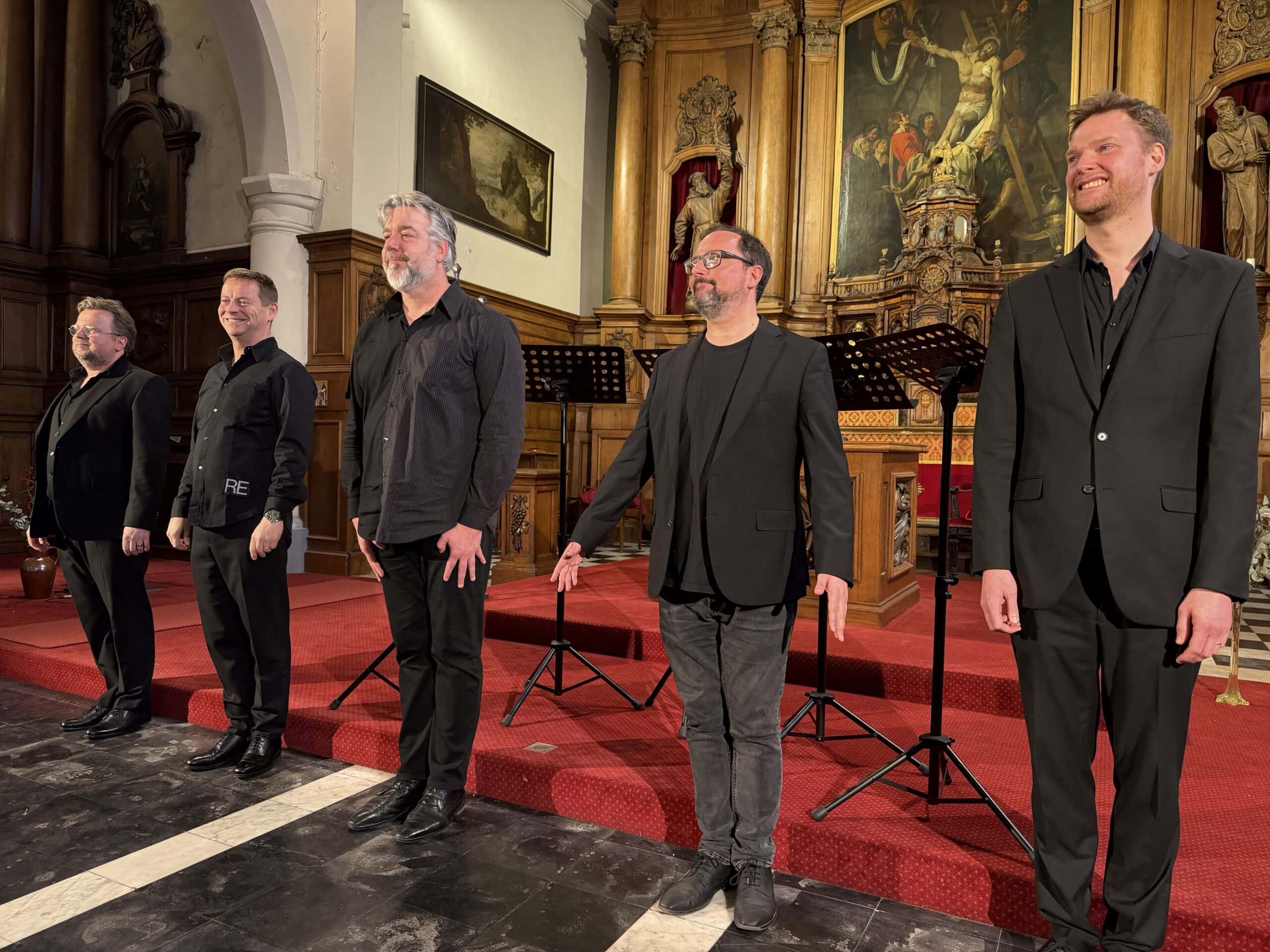
On 29 March at 4 p.m., the vocal ensemble Dionysos Now! performed the St. John Passion by Adriaen Willaert in the Capuchin Church in Oostende.
An ensemble with a distinctive profile
Dionysos Now!, founded by Tore Tom Denys, has developed over recent years into an ensemble with a highly recognizable signature sound. Their tone is characterized by transparency, precision, and a pronounced attention to text and diction, making the music not only audible but also emotionally palpable. The singers, each with a strong international reputation in the polyphonic repertoire, form a cohesive unit in which individual qualities are entirely in service of the collective result.
A central pillar of their work is the revaluation of Willaert's oeuvre, the composer born in Roeselare who played a key role in the development of Renaissance polyphony. With this St. John Passion, the ensemble seamlessly aligns with that mission: it is music that is rarely performed, but that deserves a convincing place within the repertoire.
A passion between tradition and innovation
Willaert's St. John Passion demonstrates strikingly how the Renaissance style emancipated itself from the monophonic Gregorian tradition. The composer opts for a polyphonic setting that remains remarkably clear through the use of homorhythm: all voices move together on the same text, allowing the narrative to remain comprehensible and direct.
The evangelist is sung in four voices and carries the narrative. Christ is given a three-voiced sound, while figures such as Pilate, Peter, and the Handmaiden appear in two voices. The people are originally composed in six voices, but were realized with five voices in this performance, without any loss of impact.
What makes this passion particularly special is how the voices constantly interlock, support and complement each other, creating a tight musical fabric in which the passion narrative unfolds with sober yet penetrating expression. The fact that in the past the work was attributed to Cypriano de Rore can be understood from the strong stylistic affinity between master and pupil. Today, musicologists are virtually unanimous that the passion originates from Willaert himself.
A performance that convinces
In this performance, the accumulated experience of Dionysos Now! fully came into its own. The voices merged seamlessly and created a clear and balanced sound in which each line found its place without imposing itself. The care for text and diction ensured that the narrative naturally found its way to the listener, without emphasis or effect-seeking.
Franz Vitzthum, Bernd Oliver Fröhlich, Tim Scott Whiteley, Simon Whiteley, and Tore Tom Denys sang with remarkable cohesion, as if the music unfolded in a single shared breath. The strength of the performance lay not in great contrasts, but in the constant tension and trust in the music itself, which was never overburdened and precisely thereby retained its intensity.
A refreshing alternative within the passion tradition
In a period in which the St. John Passion and to a lesser extent also the St. Matthew Passion by Johann Sebastian Bach take center stage year after year, a performance of Willaert's earlier St. John Passion provides a refreshing and valuable alternative. With this choice, Dionysos Now! demonstrates not only courage but also vision, and deserves sincere appreciation for it.