
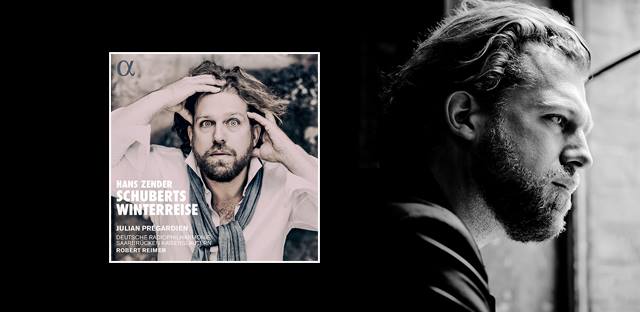
***** This new recording by Julian Prégardien offers an unusual interpretation of Schubert's Winterreise, this absolute masterpiece of the song literature. Recognizable, yet simultaneously disconcerting. And above all bittingly fascinating. Bittingly and simultaneously fascinating, I mean. The Deutsche Radio Philharmonie under the direction of Robert Reimer is the perfect partner in crime.
Hans Zender (°1936) is undoubtedly one of the important contemporary composers. He writes in various genres (piano, chamber music, orchestra, song, the opera Stephen Climax, and so on) and occasionally lets himself be inspired by the work of predecessors (Haydn, Schumann). His "composed interpretation" of Schubert's Winterreise dates from 1993. High time, then, that a talented singer attempts it for a recording, and surrounds himself with an excellent chamber ensemble.
The beginning of the cd creates tension immediately. The music starts so extremely quietly that it is a matter of waiting for anything to be heard. Then follows a sharp walking rhythm, in plucked strings. The "Wandern" plunges us immediately into a dry, harsh atmosphere. The tone for the barren journey through the wintry landscape is set. After about four minutes comes the "recognizable" sound of Schubert's Winterreise, the foundation on which the singer enters: Gute Nacht, with the telling phrase "Fremd bin ich eingezogen, fremd zieh ich wieder aus." Then the hardness and anger in the voice predominates, coupled with the orchestration, which joins in the hysteria with glissandi in the strings and brutal percussion effects. The bitterness of this first song permeates the entire "interpretation" of the song cycle. Even the hopeful beginning of Die Post writhes in the echo into poignancy.
Schubert's intensity in a new form
The texts in the cd booklet help one understand the "re-interpretation". In this "komponierte Interpretation", Zender attempts an identification with the composer Schubert so thorough that his own creative power flows with the same breath. He experiences Schubert's piece with an equally great intensity, but in a completely new way. His composition is an attempt to grasp loneliness just as intensely, but articulated in modern terms, expressing the afflictions of our present time. He composes magical sounds, not directly as the voice of Schubert, but as an expression of a deep awareness of our human existence. The voice of the "composing interpreter" is a spontaneous reaction to Schubert's stylistic means. The music reflects how the composer Zender feels Schubert's Winterreise.
Zender's version does not at all change the character of the original music, nor is it a variation on ornamentations. It distances itself from the period of old through a mode of expression of the present time. The original must not be damaged or falsified. Zender thus succeeds perfectly in making audibly apparent what Schubert's cycle is about: the loneliness and harshness of existence. The piano accompaniment is thereby transferred to an instrumental ensemble that expresses the emotions in the various instruments. There are harsh effects (Der stürmische Morgen) alongside beautiful string sounds and soft woodwinds at the beginning of Auf dem Flusse, where in the finale the image is literally torn apart by blaring brass. Throughout the entire composition we hear sounds that make the story apparent. With an ending that sounds shrill with pain.
Julian Prégardien has an ideal flexible tenor voice for this interpretation. He adapts completely to the new tone, with respect for the substantive power of Schubert and Zender. Highly credible is his assertion "Ich fühle und singe". It seems to be the essence of his approach.
Zender makes his "komponierte Interpretation" of Schubert's Winterreise into a compelling wandering, which can only deepen our understanding of this eternally meaningful cycle. With performers such as Julian Prégardien and the Deutsche Radio Philharmonie, the journey is a recommendation and a discovery for every song lover. At least if he is willing to cope with the strangeness of the sounds, even if it costs some effort.
- WHAT: Schubert's Winterreise, a composed interpretation for tenor and small orchestra by Hans Zender
- WHO: Julian Prégardien (tenor) – Deutsche Radio Philharmonie conducted by Robert Reimer
- RELEASE: Alpha Classics 425
- PHOTO COPYRIGHT: © Marco Borggreve