
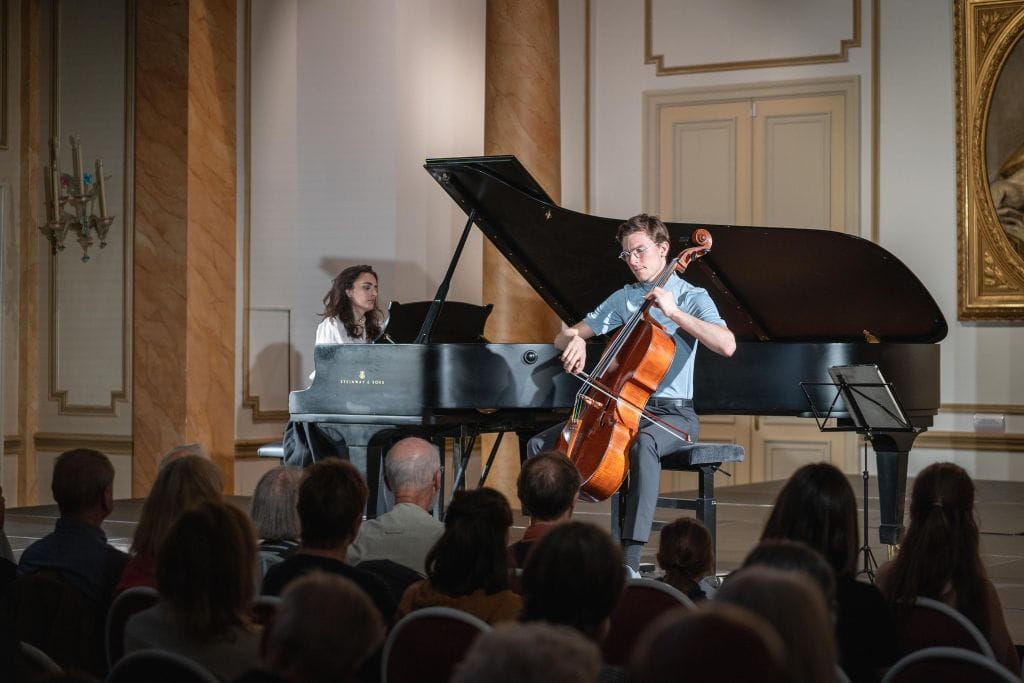
Brighten up your lunch break with mini-recitals by a range of artists whose reputation is either already established (think of Marie Hallynck, the Taurus Quartet, the Baroque ensemble Les Folies françoises, flutist Juliette Hurel) or just emerging. And at a mini admission price. You'd do Brussels for less. What is 'maxi' are the venues. Since renovation work in the coming years will make the familiar concert hall of the Conservatoire completely inaccessible, the church O.-L.-V. Ter Zee on the Zavel (28.07 to 29.08), the Cercle Gaulois (02.07 to 18.07) and the Egmont Palace (22.07 to 25.07) opened their doors.This brought us to the impressive décor of the Cercle Gaulois. There Pierre Fontenelle and Ninon Hannecart-Ségal recreated the early 20th century music scene.
Pierre Fontenelle is a dynamic all-round cellist. The life of this 26-year-old 'Namurois' unfolds between his self-taught start in Seattle (U.S.) and his Belgian roots. Between his studies at the Conservatoires of Mons, Luxembourg, Paris and the Namur IMEP (Institut Supérieur de Musique et de Pédagogie) and the French Conservatoire Jaroussky, where he met pianist Ninon Hannecart-Ségal. Between specialization with Han Bin Yoon and Anne Gastinel and a host of national and international prizes. Between the certainty of the great classics and the challenges of popular and contemporary music.
And indeed, with the progressive sounds of his first CD "Roots" still in our ears, we were now immersed in the gold, the stucco, the mirrors, the chandeliers of the venue and the elegant post-romantic impressionistic aesthetics of the twenties. Typical of "les années folles" there was dancing. There was a refined "Danse lente" by Joseph Jongen. And there was an intriguing "Pastourelle" by Albert Huybrechts, a student of Jongen and grand-nephew of the illustrious cellist Adrien-François Servais. There was also mourning. For the war, which inspired Debussy in 1919 to write his Sonata for cello and piano to, as he himself said, "prove that thirty million Germans cannot destroy French thought". In Fontenelle's interpretation there was a multitude of feelings and emotions, ranging from poetry and melancholy to sarcasm, exoticism and Mediterranean joie de vivre. Not only here, but also in the other works, it was striking how fitting the contribution of the versatile French pianist-harpsichordist Ninon Hannecart-Ségal was. She provided sonorous proof of Debussy's statement that "the pianist must never lose sight of the fact that he should not fight the cello, but accompany it". Ninon did this exemplarily efficiently throughout the recital. In classy black and white, like the piano, she was a pleasure for eye and ear in terms of presence and performance.
A fine programming choice was "Vieux Quais" by Georges Lonque. When Fontenelle asked who knew this Ghent composer, not a handful of hands went up among the roughly 250 people present. Strange, because this opus 9 is nothing but charm and melancholy, like the underlying poem by Georges Rodenbach. Whoever says "Fontenelle" says not only "cello, originality, pleasure in playing, commitment" but also "poetry". In the poem, which Fontenelle, who occasionally ventures into writing poetry himself, recited, terms like "heure exquise, parfums, lueurs, deuil, morne, agonise, catafalque, tristesse du soir" called for being set to music as nostalgically as Lonque did.
An encore was called for: an opportunity for the musicians to refer to the China tour that Pierre recently and Ninon made in 2023. It seemed as if the sonorous Nicolas-François Vuillaume made in 1860 was made for "Bifū" (Breeze) by Somei Satoh (°1947), in which the long drawn-out, languorous melody drifts like a breeze over the rippling waves of the piano.