
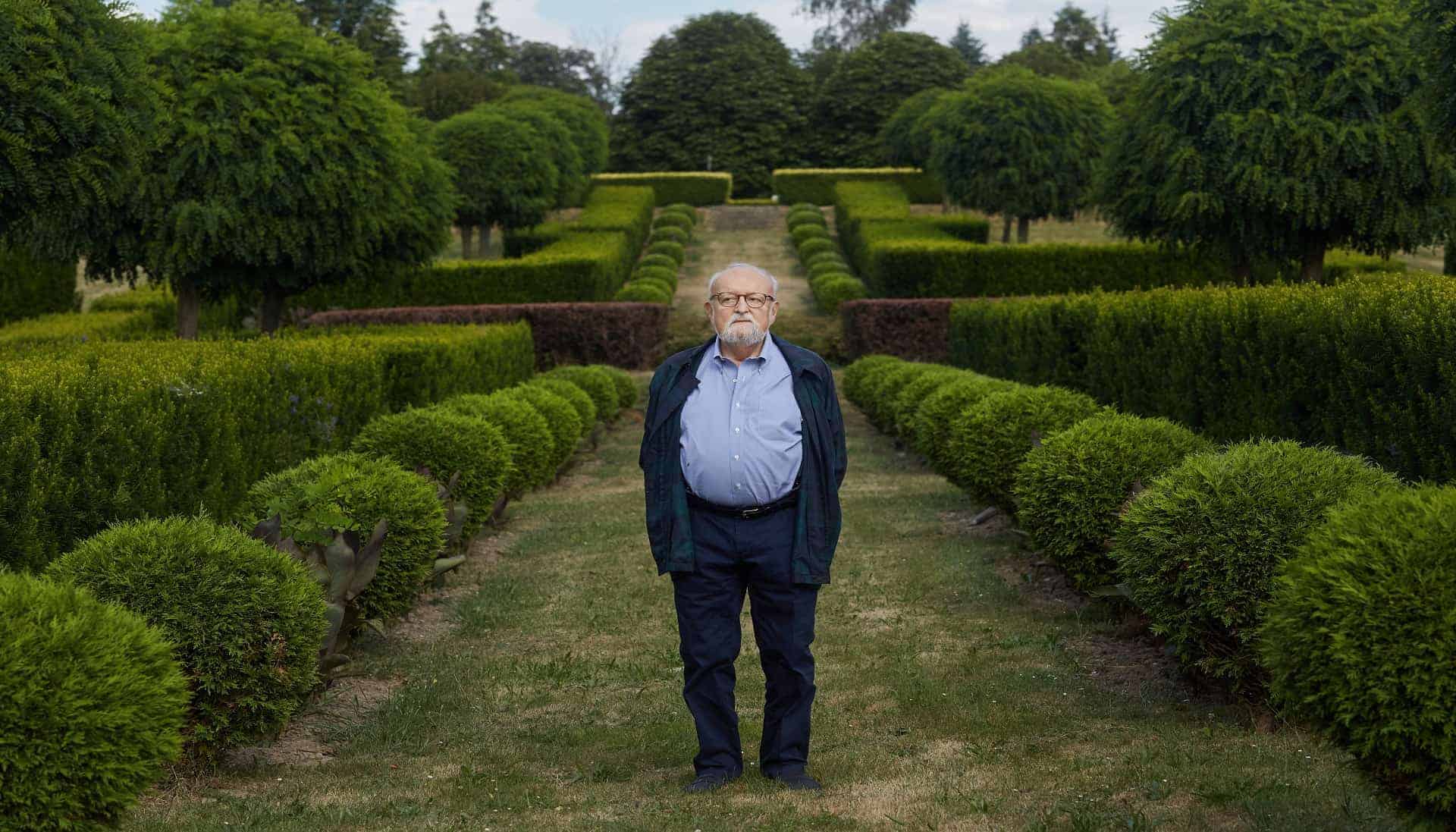
Krzysztof Penderecki was not only a leading composer of contemporary classical music, but also known for his groundbreaking garden designs. The Polish Adam Mickiewicz Institute has now created an online Penderecki's Garden, combining his two greatest passions – music and flora. The result is a compelling overview of his life and work, through beautiful animations and audiovisual highlights.
Penderecki (Dębica, 1933 – Krakau, 2020) made his name through innovative use of traditional instruments in a non-traditional guise. This created new sounds. His compositional style sits between avant-garde and late-classical. He also made use of tone clusters, microtones, and alternative music notation. His musical language is accessible and open, with an expressive and colorful use of blocks, masses and sound surfaces.
Garden as Leitmotif
Penderecki's Garden is a digital project, not only aimed at commemorating the composer, but also at his character. It also reflects on his influence on contemporary world music and other art forms. The 'leitmotif' of the project is one of Krzysztof Penderecki's greatest passions: the garden.
In the virtual space, visitors can listen to his works and discover his artistic and personal biography. The website is not only a source of knowledge, but also a place where other artists inspired by Penderecki's work are featured. Thus the public gets an impression of the diversity of Penderecki's life. The project aims to do justice to the various genres of Penderecki's work, such as film, rock, jazz, classical and electronic, but the emphasis is on his classical work.
The website is divided into seven sections, four of which are now online:
The Maestro's Manor - thoughts and reflections by Penderecki and memories from family, friends, colleagues and students. The visit takes place via bullets that reveal more, such as an interview with cellist Arto Noras, pianist Szymon Nehring who mentions that the composer gave him unprecedented freedom in interpreting his pieces, or about his stay in Sicily.
The Park - a walk with descriptions of trees and plants, photos of including the chapel and mausoleum, quotes and anecdotes. Along the way you can listen to the Violin Concerto No. 1 (also available in the other sections).
The Music Salon – here are twelve works, with brief explanations, such as Horn Concerto 'Winterreise', Polish Requiem, Sinfonietta No. 2 and Stabat Mater.
The Amphitheatre – in this section until the end of December 2021 there are two concerts: String Quartet No. 3 'Leaves of an unwritten diary' and Tribute to Krzysztof Penderecki by Max Richter, Hania Rani and the Atom String Quartet.
The remaining three sections – The Labyrinth, Garden of Memory and The Studio – will come online in the coming months.
Smuggling tree stumps
Penderecki's garden actually exists, in the city of Lusławice, 100 km outside Krakau. It is an extensive park of 30 hectares with an arboretum of 15 hectares containing approximately 1,500 species of trees and shrubs from all over the world, carefully produced and collected by the composer over more than 45 years of travel abroad. He smuggled some tree stumps into Poland in his suitcase.
The more than 4,000 trees in the garden were planted by the composer himself, which he compared to composing a piece of music. He once said: "Let us look at the tree; it teaches us that a work of art must be rooted – in the earth and in the air. No creative work can stand without roots." Each tree then found its place on a plan maintained by him, including dates and species, drawn with the same precision as writing a score.
The complex is considered a symbol of his (unwritten) ninth symphony. Apart from the arboretum, Italian and Japanese gardens, there is an immense and complex labyrinth, consisting of 14,000 hornbeam plants and 3 kilometers of paths.
Penderecki took the design from a 13th-century book. He once said he would send his harshest critics into his labyrinth as punishment. The labyrinth was also personally symbolic for Penderecki as a metaphor for the process of seeking and finding, which he saw as an integral part of the composing process.
Open spaces
The compilers of the website have thoroughly explored the relationship between the botanical and compositional process. For example, we learn that his Symphony No. 8 is largely based on texts by Polish and German poets he encountered in tree handbooks. In his garden designs, Penderecki deliberately left some spaces open as long as he did not know exactly which tree should be planted there. The same applied to composing: he only worked out certain chords when he was absolutely sure what it should be. Until then it remained an open space in the score. It is also interesting to see again that he was involved in architecture. The bridge in the Japanese garden, the mausoleum and the chapel were designed by Penderecki himself. But here too he did not let himself be confined to one box. The chapel is multifunctional and ecumenical, and therefore as unbound as his music. "To be honest, I have more confidence in my abilities as a tree specialist than as a composer," he once said.
- WHAT: Penderecki's Garden
- WHO: Adam Mickiewicz Institute
- LINK: https://pendereckisgarden.pl/en/the-maestros-manor
- PHOTOS: Barttomiej Barczyk, Mudra László, Krzysztof Wójcik