
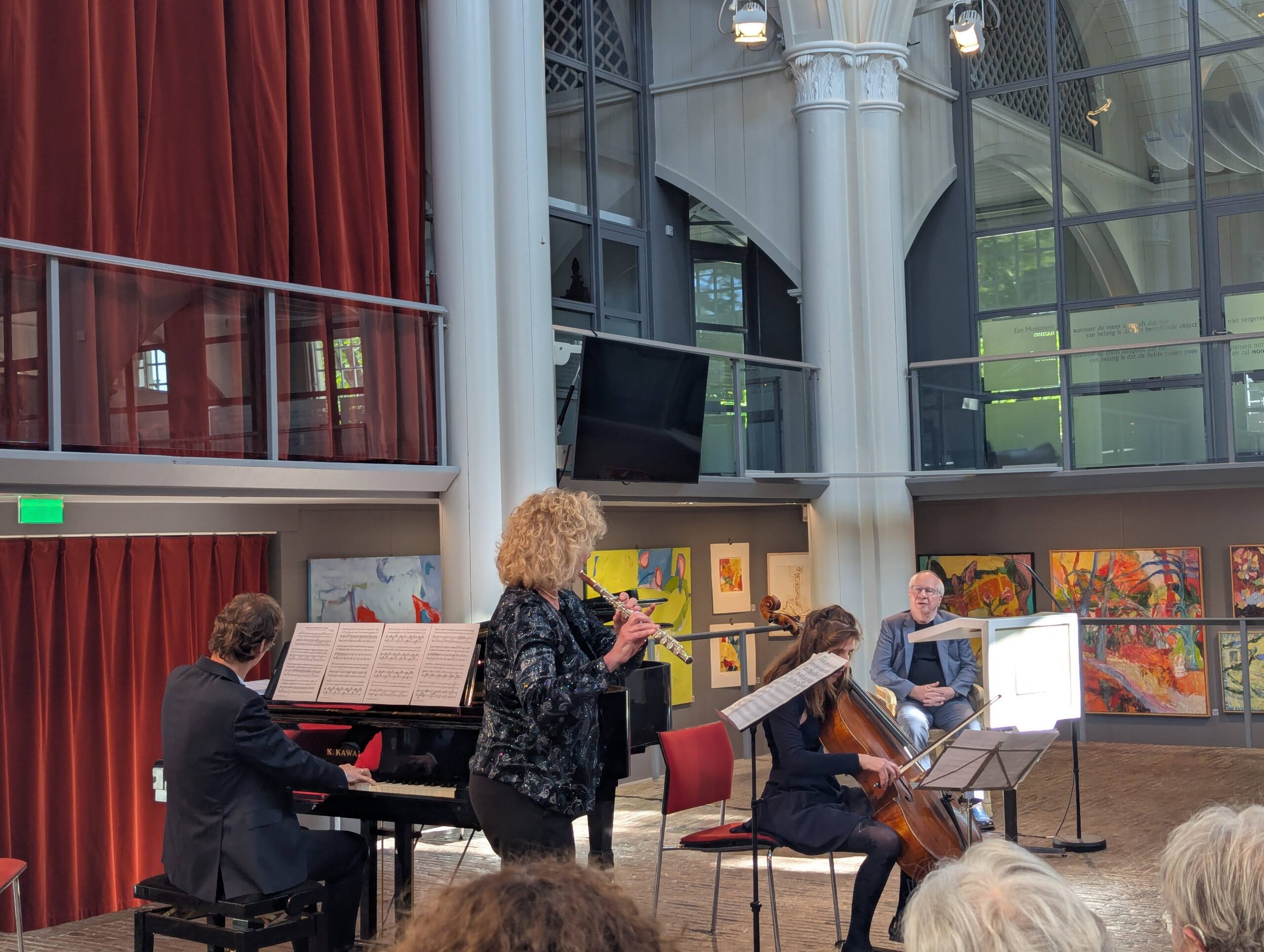
"It's that time of the year again," the people of the Leo Smit Foundation say to each other around this time of year, according to flutist and recently appointed artistic director of the foundation Eleonore Pameijer, at the beginning of this concert, on Saturday, May 2, in the Amstelkerk in Amsterdam. The time of year is the beginning of May, with May 4 being the national Commemoration of the Dead in the Netherlands and May 5 Liberation Day. Then they are called upon to perform memorial concerts everywhere. The foundation is committed to ensuring that those composers and their music and the events of that time are commemorated throughout the year rather than just then. And with a long tradition of events and publications, the foundation has been quite successful in this. The foundation is named after Leo Smit, who was murdered in the extermination camp Sobibor in 1943 at the age of 42.
The foundation has now existed for 30 years and focuses on the musical legacy of Dutch composers or composers living in the Netherlands whose music was banned by the Nazis. Some of these composers perished in the concentration camps. For some time now, the foundation has also focused on composers from the former Dutch East Indies who were interned in Japanese camps.
These are events that Basia Jaworski, who passed away at the end of last year - see her music blog Basia con Fuoco - always looked forward to. When she could no longer attend them due to illness, she asked others to write about them. Basia Jaworski herself came from a partly Nazi-murdered Polish-Jewish family. Following my previous article for Klassiek Centraal about the Dutch premiere of Die Passagierin by one of her beloved composers, Mieczysław Weinberg, a composer whose family was also murdered, this review is in a sense a second posthumous tribute to Basia.
Thanks in part to the foundation, the work of Henriëtte Bosmans is now regularly on the repertoire, Arthur and Lucas Jussen have recorded works by Leo Smit, and Dick Kattenburg and for example also Theo Smit Sibinga (who spent the war in Japanese captivity) can be heard regularly on the radio.
Of Henriëtte Bosmans, four works are now in the public top 400 of the NPO Klassiek station. And apart from the fact that an old recording exists of her second cello concerto with the BBC Philharmonic, in recent years the German CD label CPO has released her two cello concertos and her complete work for cello and piano, with Rafael Wallfisch as soloist and the BBC Scottish Orchestra with Ed Spanjaard as conductor and Ed Spanjaar as pianist respectively.
The sold-out concert began with one of those works by Bosmans that are in the Klassieke Top 400, Nuit calme from Trois impressions for cello and piano, from 1926. Cellist Lidy Blijdorp fluctuated beautifully between emotionality and restraint, beautifully serene accompanied by Tobias Borsboom on piano. Tobias Borsboom, the new artistic director of the foundation, as Eleonore Pameijer steps down. A work that should also move on to the major repertoire is the sonatina from 1959 by Fania Chapiro (1926-1994), who was actually a real leading figure in her time.
She was the daughter of a Russian-Jewish father and a Dutch mother and was born in Surabaya. As a pianist, she was a child prodigy. The family moved to Paris to give her the opportunity to continue her studies. There she took lessons from, among others, Nadia Boulanger and Wanda Landowska, no less. Meanwhile, she was already giving major concert performances. In 1939, the family settled in The Hague. During the war, they went into hiding. But they survived. After the war, she resumed her career as a pianist with great success, also in the United States, and she continued to compose. Later she also became a respected teacher. Dutch composers Joost Kleppe and Martijn Padding studied with her, as did Eleonore Pameijer. Notably: she was also one of the first in the Netherlands to focus on the fortepiano, and she also made recordings, including of concertos by Dussek and Schobert.
French influences can be heard in her music, but gamelan influences also come through in the piano sonatina and in my opinion also those of Sergei Prokofiev (1891-1953); in any case, she had previously dedicated some of her works to Prokofiev. The sonatina for flute and piano from 1962 is also lovely. Spectacular, partly due to surprising rhythmic effects, and spectacularly performed, was the final movement, Danza. Vivo. Actually, Chapiro has never really been forgotten, but it is clear that her life would have taken a very different course if World War II had not happened. That is true for each of these composers. And for so many others. They should really rediscover Chapiro in France and the US as well.
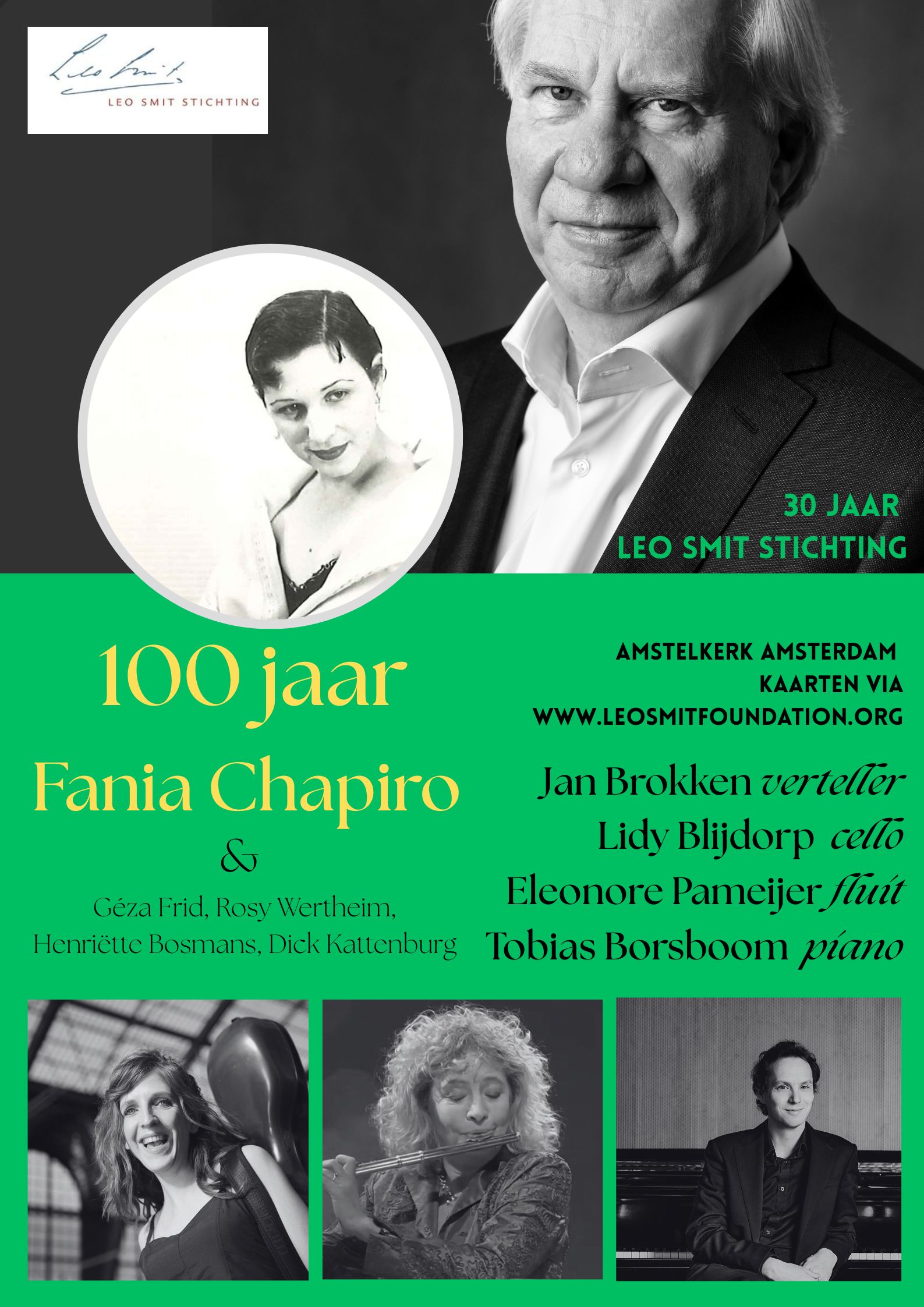 The Hungarian-Jewish Geza Frid (1904-1989) was undoubtedly a major figure in his time. He had studied with Béla Bartók (1881-1945) and Zoltán Kodály (1882-1967). In 1927 he fled to the Netherlands due to growing antisemitism in Hungary. From our country he began a nationally and internationally successful career as a pianist and composer. But from 1941 onwards he was forbidden to perform in public. He joined the artistic resistance and managed to survive the war. After the war he became once again one of the most performed composers in the Netherlands. But he too subsequently fell into oblivion, perhaps partly due to the rise of avant-gardism, but perhaps also because as an originally Hungarian person (and Jewish?) he no longer quite belonged? There is a beautiful photograph of Zoltán Kodály visiting him in Amsterdam in 1966. And shouldn't Hungary actually rediscover Frid? (And Romania since he was born in the Hungarian-speaking part of Romania.)
In the 'Sonate in vijf stukken' for cello and piano from 1931, his Hungarian roots ring clearly through. Blijdorp and Borsboom also play this piece with daring, but also in a controlled and intense manner.
Rosy Wertheim (1888 – 1949), from a banking family, worked as a teacher at the Amsterdam Music Lyceum and led several children's choirs, including the choir 'Eilandenkinderen' from an Amsterdam working-class neighborhood, and also several women's choirs, including that of the Religious Socialist Union. In 1929 she moved to Paris, where she would stay for six years. She received composition and orchestration lessons from Aubert, composed there and wrote about Parisian musical life for the Amsterdam socialist daily Het Volk. In her residence she received Dutch artists and also Honegger, Ibert, Milhaud and Messiaen were guests there. Returning to the Netherlands she went into hiding during the war. She survived, but died four years after the war from a serious illness. In her Trois Morceaux from 1939 surprising optimism rings through. As a flautist, Eleonore Pameijers already has a long connection with the piece. Her CD recording of it with pianist Frans van Ruth dates from 1995, a year before the establishment of the Leo Smit Stichting. Particularly striking is how you, as a listener, thanks to the work of the foundation, have meanwhile become truly familiar with all these composers and their music. Is there room for the rediscovery of Wertheim in France?
During his short life Dick Kattenburg (1919-1944) was sometimes influenced by jazz, but the piece now performed, Roemeense Melodie for flute, cello and piano from 1942 is somber and stately. The title should actually be Hebreeuwse Melodie, but that was considered too dangerous, even when these pieces were only performed during secret concerts. Kattenburg, who had studied in Antwerp and The Hague before the war, was in the resistance during the war. He was betrayed a couple of times and each time escaped, but eventually he was captured, in 1944. Via Westerbork he was deported to Auschwitz and he was murdered there or died from exhaustion, which given the circumstances was also a form of murder.