
In exactly four weeks, the Pieter de Somer auditorium will be packed for the opening concert of Festival 20·21. The annual high mass for music from the 20th century onwards. But the deeper we stand in the 21st century, the further we move away from that starting point. Is that a challenge for the programmers? What will we be presented with this year? We spoke with artistic directors Maarten Beirens and Pieter Bergé.
As we progress further into the 21st century, the distinction between the former Novecento and Transit becomes increasingly clear. How do you as programmers deal with that?
Maarten Beirens: The two parts of the festival have a different approach. I see it as follows: Transit is about developing and discovering, 20·21 is about rediscovering, combining, confirming, putting into perspective.
Transit is focused on creation, on new works whose ink has barely had time to dry and thus also on experiment. The other part of Festival 20·21 departs more from the idea of repertoire - both repertoire that has already been established and 20th-century repertoire that we believe deserves to be cherished by music lovers just as much as, say, Bach or Schumann. That's why we've also included some concerts this year that highlight the continuity of this 20th/21st-century repertoire with tradition.
Working with new music is both investing in the development of new things and thinking about the place that can (or hopefully will) take in the whole of the repertoire. Hence also the tagline "the classics of the future". Gradually, 21st-century works also acquire the status of "classics" and earn their place in the broader 20·21 series.
You speak of Transit as a creation festival, but the programme features quite a few composers that a loyal Transit visitor would already know. Is that the first step towards such a canon of the 21st century?
Maarten: It's important to know that in all cases these are creations or works that have not yet been performed in Flanders. Transit features new names and relatively young composers every year, but is not limited to them. It's important to present that work alongside the new works of established names, hence this year Poppe, Finnissy, Steen-Andersen or Dillon.
The concept of Transit remains to show a selection of fascinating things that composers are now working on, which also includes reputed composers of different generations. For each concert, we also look for a good combination of works and composers. There's certainly no lack of new names: there are works by 12 different composers on the programme this year who have never appeared on Transit before.
Festival 20·21 has had a tradition for several years of programming 'unknown masters'. What should festival-goers know this year about, for example, Weinberg and Bacewicz?
Pieter Bergé: They don't really need to know anything about them, just come and listen. That alone makes it so fascinating to programme unknown composers. You surrender yourself to the unknown. It's the thrill of discovery that counts. The awareness too that we only know a fraction of all the good music that exists. Of course, there's nothing wrong with repeatedly listening to pieces we love, but we must also continuously nourish our love with the unknown.
Where does this choice for noble unknowns come from?
Pieter: There really is an incredibly large amount of excellent, unknown music, but it is rarely programmed. Famous names simply sell better. Although many music lovers might have difficulty distinguishing certain quartets by Shostakovich from those by Weinberg, you'll still sell four times as many tickets for a Shostakovich concert.
For Festival 20·21, that priority is very clear: it's not the name of the composer that comes first, but the quality of the piece. So a good piece by Bacewicz rather than a lesser piece by Prokofiev, for example, even if he's more famous. For an organizer, there's nothing more beautiful than the gratitude of a listener when they've discovered a new piece. That's partly what we do it for.
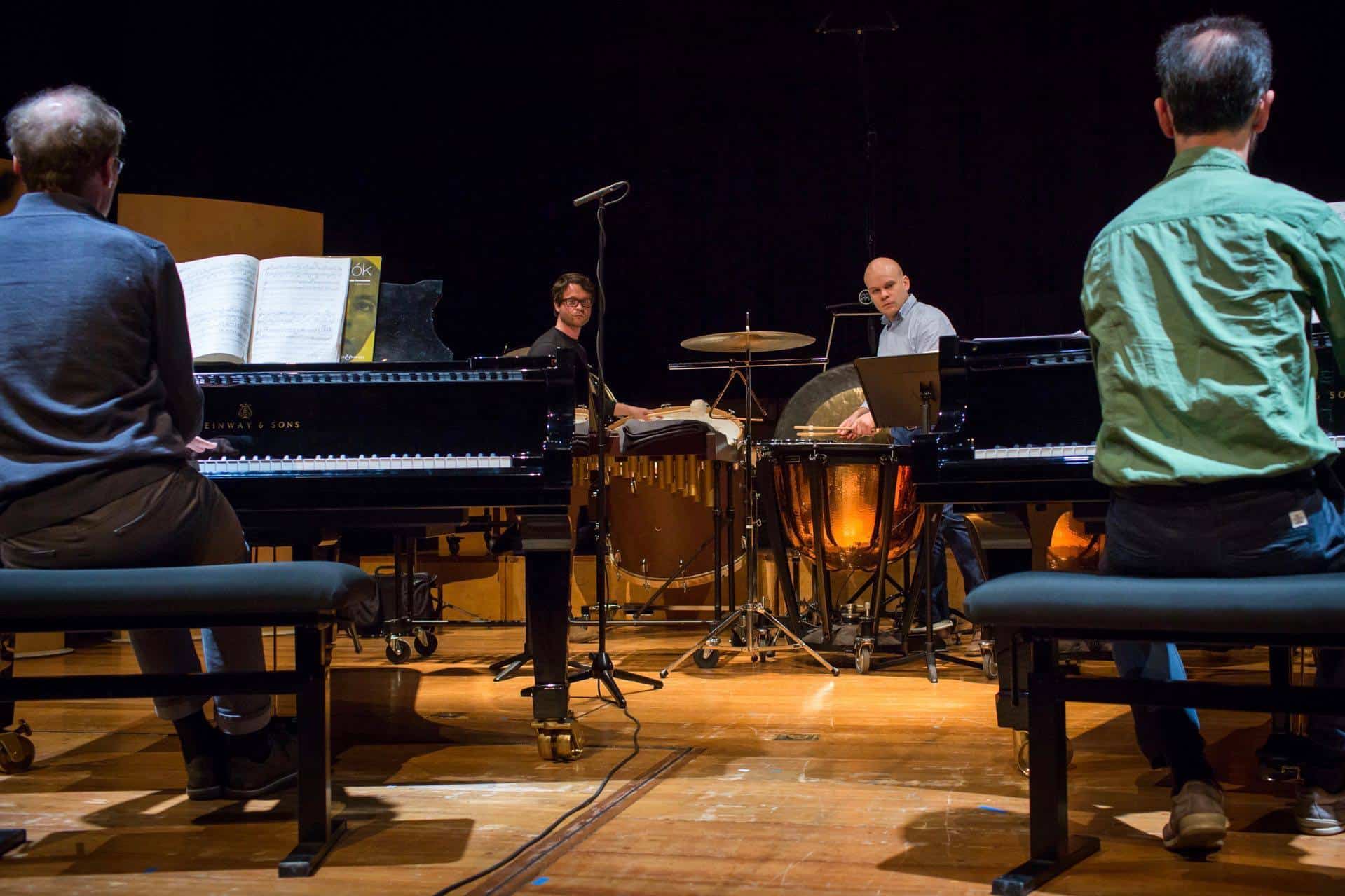
The festival opens with one of the most iconic works of the 20th century, Le Sacre du Printemps, but in a piano and percussion arrangement. How can you still conjure up the energy of the original in that instrumentation?
Pieter: I find arrangements a very interesting phenomenon. When you go from a large to a small ensemble you always lose something, you shouldn't be coy about that. Especially when it comes to such a drastic reduction as with Le Sacre. But if an arrangement is well made, there can also be 'gain': there is often more transparency, details come to the fore more clearly, structures can become clearer. You could compare it a bit to an X-ray: part of the original disappears, but an invisible part of it comes into sharper focus. Maarten: It's certainly different from the symphonic original, but it certainly won't lack energy. The stamping rhythm and brutal dissonances might even stand out more on the pianos than with the orchestra. Energy is not the same as mass, by the way. That symphonic version is of course sublime - but Stravinsky himself made a version for 2 pianos, so for him it was possible. Now there's a little more colour and variation thanks to the percussion.
Lore Binon, one of the new stars in Belgian classical music, is programmed twice, and then of course comes the dreaded question: If you had to choose yourselves, which of the two concerts would you pick and why?
Maarten: Oh, you wouldn't ask a parent to choose between two children either. Besides, I mainly see the second concert as one by Jan Michiels, with Lore Binon only joining in for Satie.
Pieter: That's of course an impossible question. Fortunately we don't have to choose. For the rest it depends entirely on your priorities, and those can be very different. The performance 'Laatste woorden' with music by Cage, Satie and the very late Liszt will be a kind of search for silence, which I hope and believe will generate a great deal of intensity.
- WHAT? Festival 20/21 (Festival van Vlaanderen, Vlaams-Brabant)
- WHERE? Various locations in Leuven
- WHEN? Concerts between 24 September and 25 October
- WEBSITE Festival20/21