
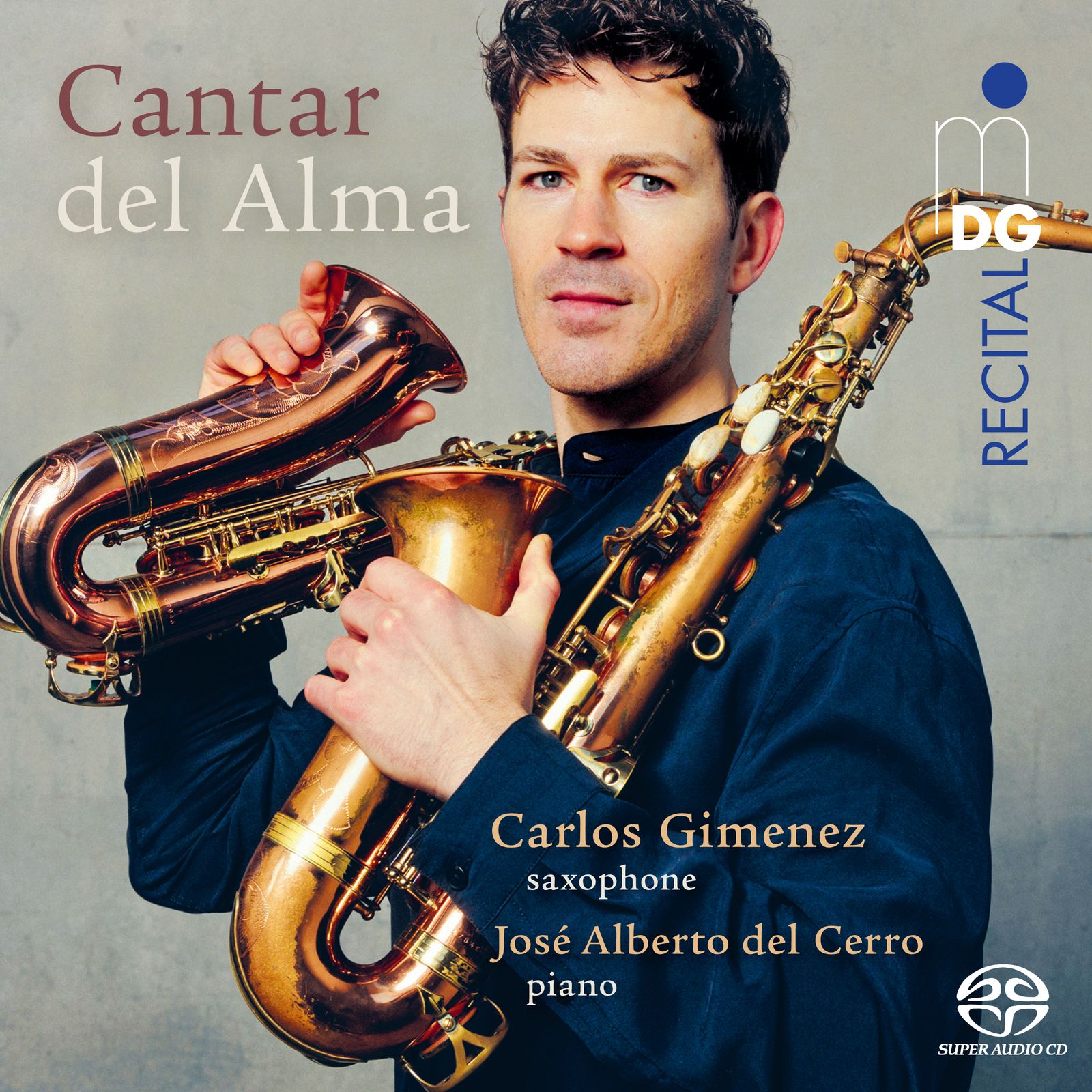
Some recital CDs impress through virtuosity, others stay with you because they place a familiar musical world in a new light. Cantar del Alma undoubtedly belongs to that second category. Saxophonist Carlos Gimenez and pianist José Alberto del Cerro present a programme that nowhere seeks to display the possibilities of their instruments, but instead convinces through its natural musicality, refined ensemble playing and thoughtful structure.
An arranger who must make good on his own transcriptions
The key to this recording lies not so much in the choice of repertoire as in the way it came about. Carlos Gimenez himself was responsible for virtually all the transcriptions on this CD: from Cantar del alma by Federico Mompou (1893–1987) via the Sechs Romanzen op. 38 by Sergei Rachmaninow (1873–1943), the Cinco canciones negras by Xavier Montsalvatge (1912–2002) and the Auszüge aus „Tristan und Isolde" by Richard Wagner (1813–1883) to the Canciones clásicas españolas by Fernando Obradors (1897–1945).
That is far more than a practical intervention. Whoever plays his own transcriptions cannot hide behind the choices of another arranger. Every breath, every transition, every moment when the piano takes the lead because the original vocal line literally has no more breath, is an interpretative decision that Gimenez first had to make as an arranger and then must make good on again as a performer. Precisely because of this, nothing on this recording sounds like a makeshift solution or an attempt to simply replace the human voice. The transcriptions depart from the idiom of the saxophone itself and let the instrument speak with its own voice. Gimenez knows the possibilities and the limitations of his instrument and seeks no gratuitous effect anywhere, but always musical conviction.
Incidentally, Gimenez is no outsider to this repertoire. His Valencian background – he was born near Benimodo – perhaps helps explain why especially the Spanish and Catalan pages seem to breathe so naturally. The rubato sounds nowhere learned, but feels like a musical mother tongue.
Piece by piece
The title track, Mompou's Cantar del alma, deliberately opens the record as a motto: barely three minutes, but Gimenez lets the first phrase emerge almost without vibrato, almost speech-like, only gradually adding colour carefully. Immediately that special sonic world emerges that will characterize the entire CD: del Cerro's contemplative piano sound set against a saxophone that does not declaim but seems to reflect. The listener's attention is thereby inevitably drawn inward from the first bars. With Mompou, where silence is often as important as sound, that restraint proves not to be a lack of expression but rather a form of intensity. The saxophone becomes here not a replacement for the human voice, but an instrument that tries to approach her inner silence.
The Sechs Romanzen op. 38 by Sergei Rachmaninow form the most intimate part of the programme and reveal an unexpected vulnerability in this instrumentation. del Cerro is given full scope here to display his pianistic qualities, without ever losing sight of the dialogue with the saxophone. The many hushed moments are built with an impressive matter-of-factness, while Der Rattenfänger acts as a welcome outlet, briefly bringing all the drama to the surface. The following Der Traum works all the more stilling and takes on an almost timeless quality. Against the closing A-oo! Gimenez seems to let all the brakes loose: the saxophone is finally allowed to sing fully, without the musical line ever being lost sight of. It is precisely this continual balance between control and surrender that makes this cycle so convincing.
The Cinco canciones negras by Xavier Montsalvatge are undoubtedly among the greatest surprises of the record. They are every one of them miniatures, little musical pearls in which Gimenez and del Cerro fully demonstrate their stylistic flexibility. Especially Canción de cuna para dormir a negrito testifies to an irresistible sense of colour and rhythmic suppleness; for a moment as a listener you almost feel like moving along, but Montsalvatge immediately opens up space for stillness again. Thus unfolds a sampler of what both musicians have in store. When Canto negro finally bursts forth, it does so not from a desire for effect, but from carefully built tension that works irresistibly captivating.
And then Wagner. The Auszüge aus „Tristan und Isolde" form the artistic centrepiece of the CD. Purists may wonder whether precisely this music can be detached from orchestra and vocal line, but Gimenez proves how fruitful a successful transcription can be. The saxophone proves surprisingly close to the human voice and manages to make the yearning, despair and ultimately the madness of Wagner's love drama palpable in a compelling way.
Especially the Vorspiel ranks among the highlights of the entire recording. Gimenez nowhere opts for effect-seeking, but lets the tension grow from an almost fragile simplicity. His tone is warm, intense and at the same time remarkably restrained, allowing the famous harmonies to retain their irresistible attractiveness. The following Liebestod perhaps does not quite achieve the same concentration as the Vorspiel, but remains an interpretation that moves through its honesty and musical integrity.
The closing Canciones clásicas españolas by Fernando Obradors are perhaps the finest discovery of this CD. His songs prove to lend themselves wonderfully to this instrumentation and show once more how effortlessly Gimenez switches between dark melancholy, lyrical songfulness and almost folk-like lightness. The dark, almost velvety tone in Con amores, la mi madre contrasts beautifully with the lyrical character of Del cabello más sutil, two highlights within a cycle that continually breathes songfulness. Piano and saxophone seem here completely merged with each other, giving these songs a matter-of-factness that makes any thought of a transcription fade away.
Balance, not bravura
What strikes throughout the duration of just under an hour: this is a programme that deliberately builds no climax after climax. Wagner is in the middle not by accident – everything before it builds up to it, everything after lets it settle. That is a dramaturgical choice not every recital album dares to make, where often the most spectacular piece serves as the closing apotheosis. Here one chooses to linger rather than applause.
The balance between the two musicians also deserves a word. del Cerro is often – rightly – praised for his chamber musical sensitivity, but that must not obscure how equally he co-determines tempo and colour here. He is not an accompanist who adapts, but an equal conversational partner who helps shape the architecture of each work. Each cycle highlights a different colour of the instrument, without the programme ever feeling like a demonstration record. On the contrary: the thoughtful programming shows how versatile the saxophone can move within chamber music, from almost vocal introspection to exuberant rhythm.
The hybrid SACD recording from MDG does what MDG always does: no artificial closeness, no studio gloss, but an acoustic in which the instrument gets breathing room without becoming blurred. Especially in the quietest passages of Vorspiel and Liebestod, where the instrument fades to almost nothing, you hear how much that space contributes. The sound doesn't dissolve into vagueness, but instead gains meaning through the silence around it.
The recording also supports the authentic musicality of both performers. Gimenez possesses an exceptionally refined tone, warm without becoming sentimental and always deeply felt. del Cerro joins in exemplarily, not only as accompanist, but as a musician who continually adds new color nuances and helps shape the melodic lines.
The echo of a successful recording
This is not an album for those who still view the saxophone as a curiosity alongside the "true" chamber music instruments. Nor is it a demonstration of what the instrument can do. Carlos Gimenez and José Alberto del Cerro above all show how good transcriptions can give familiar music a new perspective. After listening, you almost inevitably listen differently to the original songs and orchestral works: with more attention to their melodic core and their intimacy.
Cantar del Alma is moreover a recital that never bores for a moment. The alternation between the different stylistic worlds, the intelligent programmatic structure, and the high artistic level of both musicians make this recording a recital to which you gladly keep returning. Not because it wants to impress, but because it reveals new nuances with each listen and repeatedly knows how to move you. You can hardly give a recording a better compliment than that.