
American composer John Adams never writes an opera with just a casual story. For him, opera must not only touch the emotions, but above all denounce injustice; it must strike not only the heart, but especially the conscience. Girls of the Golden West is no exception. Together with his regular director Peter Sellars, who also wrote the libretto, he succeeds in this, although the impact does take some time to make itself felt.
The idea for the opera actually came from director Peter Sellars when he was directing Puccini's La Fanciulla del West. He sensed that the opera dealt with an episode that could be considered a dark page in California's history. He wanted to conduct further research into the events during the Gold Rush period in the 1850s, with the aim of exposing the brutal mistreatment of "native Americans" by settlers (mainly blacks and Mexicans). His proposal to John Adams to compose an opera on the subject found immediate resonance, especially as the composer lives in the beautiful nature of the California Sierra Nevada. As a resident of the region, he wanted to convey the message about the atrocities that had taken place there. That in the meantime the problem of Mexican immigrants in the US became topical was an additional trigger. Sellars also titles in the magazine of De Nationale Opera: "This opera also carries the DNA of our time in it". The source for the libretto is mainly the letters of Louise Amelia Clappe to her sister. She lived as the wife of a gold digger in the area and wrote about the harsh and brutal life among the gold diggers, a gang of adventurers driven by greed. As Dame Shirley, she is the main character in Girls of the Golden West. In the opera, she has come to the Sierra with Fayette, a dull doctor (no singing part), whom she married only to be able to travel as a woman in those times. She lives in the harsh male world, where exploited settlers are beaten – sometimes to death – men drink, women prostitute themselves and Indians are killed like savages.
Austere Appearance
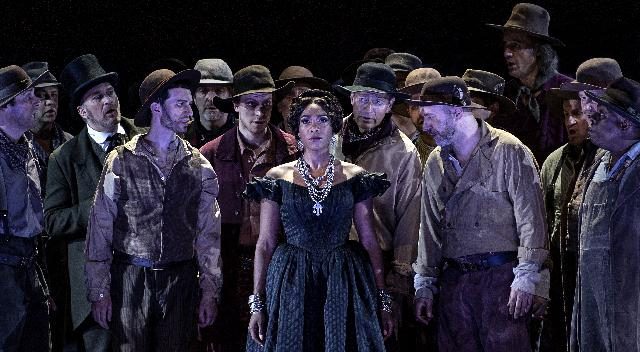
The decor of the opera is very austere. On the large empty stage are tall rust-brown strips that look like fabric but turn out to be pieces of wall, sometimes with doors in them. A large old black-and-white photograph of the California Sierra Nevada is also sometimes shown. Against that background, changing scenery and props are moved: chairs, a suitcase but equally well a bar in the first act and in the second act a black rock block, which serves as a sort of platform. A second piece of rock stands steeply upright. I find those rock blocks rather ugly decor. Yet they provide the most beautiful image of the opera at the end of the piece, when ultimate tragedy has struck and Dame Shirley, despite everything, has the courage to admire the California mountain landscape: with a reference to the "Gold Rush," they are lit to a beautiful golden sheen. The costumes are faithful to the period, with the male choir in gold digger's gear and the ladies sometimes in elegant couture dresses.
Deferred Tension
The opera certainly has a story that can be moving – and as it progresses, it does. What I find a pity is that there is no continuous storyline in it, so you don't follow any character in an evolution towards tragedy. The opera is divided into short episodes that almost follow each other like a "number opera". It begins with the arrival of Dame Shirley and her companion Fayette, which is not a compelling piece at all and with the mounted mule that is ridden onto the stage, even borders on the ridiculous. We get to know Ah Sing, the Chinese prostitute. In the next scene, Josefa, a beautiful Mexican woman, is almost raped by the drunken Joe. Ned, an Afro-American guy, discusses the increasing brutality in the community and spoils Shirley with a fictional dinner, a scene you'd best take as funny to avoid finding it ridiculous too. So in the first act we have already met the most important characters and gotten a feel for the atmosphere, but experienced nothing that moves us further. In the second act there is pace, and that's where the events that bring tragedy and increasing tension occur. At least after the Fourth of July party, and so after the foolish dance steps of the majorettes (perhaps to be interpreted as irony on American chauvinism?) and the bit with Dame Shirley as Lady Macbeth, who theatrically holds the strings for a moment and prophetically alludes to a murder. The Fourth of July celebrations are seized upon by the American gold diggers as an extra excuse to drink, sing exuberantly, and humiliate anyone not white. In this second act, the cruelties escalate. First there is the arrest of the Afro-American Ned, Shirley's friend. Then there is the death of Joe, who tried to rape Josefa, but in her defense against him she stabbed him. Shirley stands up for her in a beautiful duet. Josefa then has a magnificent scene – the most beautiful of the entire opera – in which she defends herself, but she is nevertheless executed. Then follows the epilogue by Dame Shirley.
Suggestive Value
If the story is rather thin and drags on somewhat, the simplicity in Sellars' direction has a positive counterpoint, namely the suggestive value. In this way he evokes more than he directly shows. To name just a few examples: Sellars avoids nudity in his direction to show sexuality, when someone is beaten you only see arm movements, no sticks or whips. The execution of Josefa by the rope is more suggested than depicted. Also in the confrontation between Dame Shirley and Ned or Ah Sing, there is more suggestion than reality. It not only feeds the imagination of the spectator, but also seamlessly aligns with the suggestive music of John Adams, who with a wonderful palette of instrumental sounds achieves an auditory impact and penetrates deeply. While you can regularly escape from the story, you can never escape from the music – it keeps you continually engaged with all sorts of rhythmic pulses. Certainly not "ordinary" repetitive music, but far less monotonous and of a fascinating complexity. Conductor Grant Gershon performs wonders with the once again fantastic Rotterdams Philharmonisch Orkest, which not only plays super-dynamic moments but also lyrical passages here and there. You hear tones in the brass, basses or percussion that you've never heard before and that wonderfully match and accentuate the emotion.
The singers are excellently cast. Julia Bullock is a warm and charismatic Dame Shirley with both strength and softness in her voice. Absolutely brilliant is the performance of J'Nai Bridges as Josefa. Not only does she perform her role as an indignant and self-assured Josefa with pride, but she also sings it with incredible persuasiveness. Her final scene just before her execution is truly moving and equals the strongest bel canto aria. Ned Peters (Davóne Tinnes) has a few beautiful convincing solo passages and in the duet with Julia Bullock he is warm and engaged. Ah Sing gets a veritable coloratura soprano in Hye Jung Lee and Joe Cannon is powerfully performed by Lucas van Lierop, a singer from De Nationale Opera Studio who replaces Paul Appleby in this production – and with brilliance! The Choir of De Nationale Opera gets ample share with the songs of the gold diggers, for which the librettist draws on authentic songs from 1850. In their gold digger attire and with pickaxe and hatchet, the Choir performs them with verve. Let us finally mention that sound effects were created by Mark Grey, the composer whose opera Frankenstein is currently running at the Munt.
Thanks to the stronger second act, this Girls of the Golden West is ultimately a compelling production that did not quite reach the strong impact of The Death of Klinghoffer for me, the opera by John Adams that was created in 1991 at the Munt theatre in Brussels. I also briefly thought back to Gershwin's Porgy and Bess, different as it may be: coincidentally, just as at my previous visit to De Nationale Opera in Amsterdam, I saw an opera with a strong connection to American society and a critical perspective on discrimination.
- WHAT: Girls of the Golden West | John Adams (°1947)
- DIRECTION: Peter Sellars
- VOICES: Julia Bullock, Davóne Tines, Lucas van Lierop, Hye Jung Lee, J'Nai Bridges, Elliott Madore
- ORCHESTRA: Rotterdams Philharmonisch Orkest & Choir of De Nationale Opera conducted by Grant Gershon
- WHERE: De Nationale Opera, Amsterdam
- WHEN: Sunday 17 March 2019
- PHOTOS: © Petrovsky & Ramone