
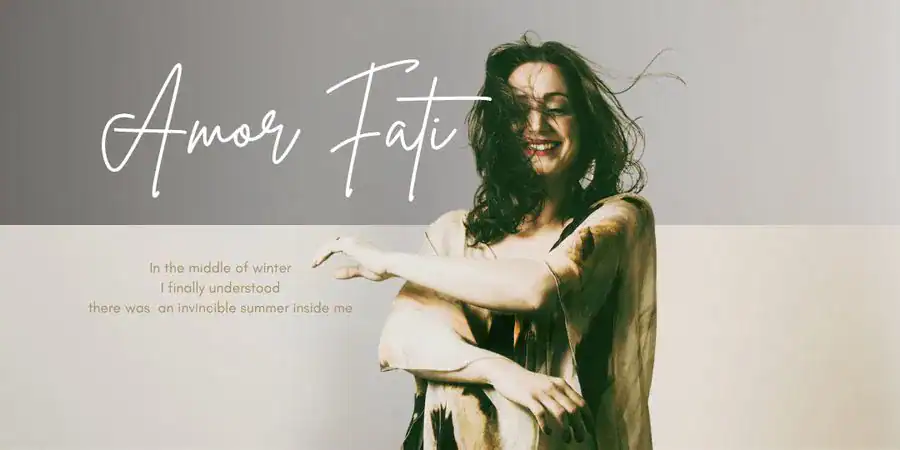
'Amor Fati' is a two-part concept. The word 'Amor' means love, and 'Fati' means fate. Love can be both soothing and disruptive. It can provide security or seem frightening.
Dancer/choreographer Isabelle Beernaert surveyed her own life and tested it against the philosophy of Nietzsche and the eight types of love according to Greek philosophy: Eros (passionate love), Philia (friendly love), Agape (selfless love), Storge (familial love), Mania (obsessive love), Ludus (playful love), Pragma (practical love) and Philautia (self-love). During the rehearsal period, she also allowed her dancers to contribute their experiences through improvisations. All of this crystallized into successive songs/tableaux in which different aspects of love are addressed.
Stage image
The performance is played with an open curtain. The backdrop shows a warm color palette with sand, terra and orange/red tones. The soothing sounds of a bass guitar and oboe fill the space. It feels like drifting in the mother's womb, the womb of mother earth. A projected text invites reflection and stillness: "Here you will calm your soul. Here we are at home and will find the comfort you seek. Here you will be healed again". A quarter of an hour before the start of the performance, as the hall gradually fills with spectators, the dancers present themselves in a calm manner, one by one. They walk slowly to the middle of the stage, sit for a few minutes, eye to eye with the audience, and then disappear again.
Musical source of strength
The beautiful music in a broad palette featuring compositions by G.F. Händel, J.S. Bach, Jeff Neve, Pietro Mascagni, Nina Simone, Roberta Flack, Chi Coltrane and others, instrumental and sung, touches you to your deepest core like a sounding board of the human soul. It was an aha-experience. It remains a mystery how emotional and musical currents reach an audience. Isabelle Beernaert personally selected the songs but entrusted the reworkings to Kristiaan Deruytter (stage name Kristo) and Nicolas Thys. Kristo is a multi-instrumentalist, but here plays mainly electric guitar and piano. He also possesses a powerful and beautiful voice which he uses with as much verve and fluidity as his instruments. His musical maturity testifies to purity and restraint. A unique universe. The spirituality in the music also resonates. The music has structure, but does not impose itself. It is full of fine nuances. It accumulates, but in a calm way and carries meditative impulses. With an extraordinary mastery, he makes the songs his own in a wondrous harmony. The compositions are rich in detail, atmosphere and vibrating power. Inspired music that makes you completely zen. He is assisted by double bass player and bass guitarist Nicolas Thijs and Taiko percussionist Bert Gits. With their live playing, they form the beating heart of the performance and accompany the choreography to deeper layers and emotional intensity.
Kaleidoscope
Scenographically and visually, a balance has been sought between music and dance. The instrumentalists are part of the whole, appearing and disappearing again. The large back wall also slides apart from the beginning and becomes modular, positioned differently for each song or musical piece. The warm colors of the beginning transition to gray and broken white tones but come alive again towards the end. Five male dancers and three female dancers give their best. Each dancer gets the opportunity to perform a solo. In addition, there are numerous duets of attraction and repulsion and beautiful synchronized ensembles.
To the ancient composition 'Air' by J.S. Bach, the entire ensemble performs a fresh, playful dance. Impressive is the intermezzo with taiko percussionist Bert Gits assisted by Kristo and Nicolas Thijs during which the dancers perform an exuberant physical, almost ritualistic dance. They then collapse exhausted. Smoke is produced. Their bodies seem to steam from exertion. Then they disappear into the wisps of mist. Beautiful and impressive at the same time. It reminds us of our mortality. Also clever is the scene in which three walls are pushed towards each other. Who doesn't know the expression 'the walls are closing in on me!' and a man emotionally loses control. He is approached carefully and tactilely by another man. That he is not alone, that there are shoulders to lean on, gradually lifts him up. Tenderness, selfless love is given a face here. Seduction is addressed in a refined piece of tango.
Isabelle Beernaert demonstrates in this performance a stylistic versatility and has sharpened the expressive potential. Technically, the dancers display a whole palette from tenderness to breathtaking acrobatics. The intensity of the music does something to you. It wraps a warm blanket around the world.
However, one point of criticism. At the end, the dancers present themselves one by one and receive well-deserved applause. But no, the performance is not over yet. On a dark stage, the grand piano is rolled out surrounded by lights. Kristo plays and sings one last song 'Help me through the night' by Gladys Knight while the dancers one by one take a light and disappear into the audience. While beautiful in itself, but too much of a good thing!