
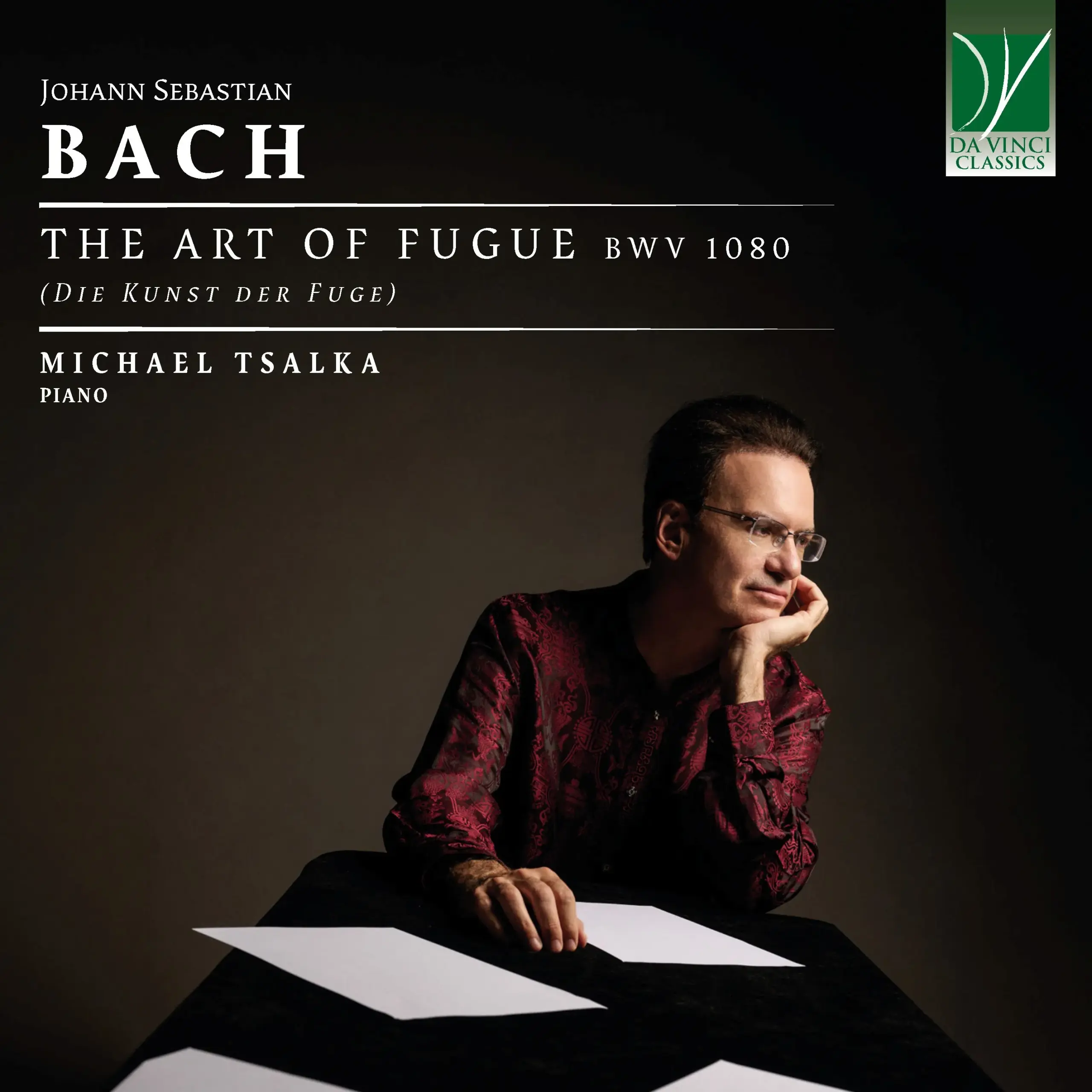
There are works that one does not so much listen to as enter into, and Die Kunst der Fuge BWV 1080 is the ultimate example of this. It is perhaps Bach's most paradoxical creation: a monument of absolute musical mastery that simultaneously ends in a question mark, a work that seems organized down to the smallest detail and yet has deliberately remained incomplete. Johann Sebastian Bach (1685-1750) left no indication upon his death in 1750 regarding instrumentation, order, or even whether the work was intended for performance or silent contemplation. Whoever ventures into this contrapuntal labyrinth must therefore be not only a musician, but also something of an archaeologist. Michael Tsalka, with this new double CD on Da Vinci Classics, proves that he is both.
Tsalka, affiliated with the School of Music at the Chinese University of Hong Kong and a sought-after soloist on both the modern grand piano and historical keyboard instruments, chose the piano for this recording – a choice that may seem unsurprising at first glance, but proves to be precisely the right one upon closer listening. The piano offers no romantic expansion of Bach here, no attempt to draw the music toward a later aesthetic, but rather a particular clarity: each voice receives its own color and breathing space without the work falling apart into separate lines. Where some performances let the fourteen Contrapuncti and four Canons sink into academic greyness, Tsalka consistently allows the dancing pulse to shimmer through – a pulse that Bach, despite all his learning, never lost sight of. Musicologist Nicholas Smith rightly points out in the extensive accompanying text that this work should not be understood as a dry didactic treatise, but as a celebration of life itself.
Particularly notable is the ordering that Tsalka employs: not the sequence of the posthumous first edition from 1751, but an arrangement that follows recent insights from Reinhard Goebel among others and reflects the structure of the Goldberg Variations – four groups of fugues of increasing complexity, each interrupted by a canon. This is a reading that is dramatically convincing: one no longer hears merely a series of contrapuntal experiments, but a journey in which Bach leads the listener ever deeper into his musical universe. From clarity to density, from play to mystery, the tension grows step by step, up to the incomplete Fuga a 3 soggetti.
In it, Bach writes his own name in notes – B-A-C-H, where the German note names represent the pitches B-flat-A-C-B – just before illness and blindness prevented him from continuing the work. Later tradition transformed this moment into the symbolic image of a composer etching his own name into music once more, as if he wanted to entrust himself to eternity. Tsalka concludes, rightly, with the organ chorale Vor deinen Thron tret ich hiermit (BWV 668), allowing the work to end as Bach himself left it: not as a rounded final chord, but as a prayer.
What particularly distinguishes this recording is that Tsalka does not pursue the illusion of a definitive interpretation. He himself says that he has studied this work for decades without ever fully "grasping" it – and it is precisely this humility that one hears reflected in his playing. His piano sound is crystal clear and honest, without ever becoming cool or merely analytical. The voices in the counterpoint are weighed with great care, while the considered tempi give the music a natural repose. Tsalka rushes nowhere for effect; he allows the fugues to breathe and creates a performance that does not overwhelm through monumentality, but convinces through concentration. An almost contemplative calm emerges, not because the music loses its complexity, but precisely because each line finds its place within the larger whole.
No bravura, no need to make an impression on the listener, the outside world, or – as he himself describes it – posterity. Instead: attentive, almost prayerful listening to what the music itself asks for. The dedication of this recording to the late Prof. Aminadav Dykman gives the whole an additional layer of personal devotion, which translates into the way each voice in the counterpoint receives breathing space without losing the architecture of the whole.
Is this a recommendation for those who still need to get to know Bach? Probably not – Tsalka himself would be the first to admit that Die Kunst der Fuge is not an introductory work. But for those who have grappled with this piece for years, with this music that, no matter how often one returns to it, never fully lets itself be grasped, this double CD offers a guide that does not pretend to have the complete map of the labyrinth. Perhaps the true completion of Die Kunst der Fuge lies not in adding a missing measure or an invented ending, but in every new attempt to listen to what Bach has left us: not a closed monument, but a living question. And perhaps that is, for a work whose creator never got to finish, the most honest form of tribute.