
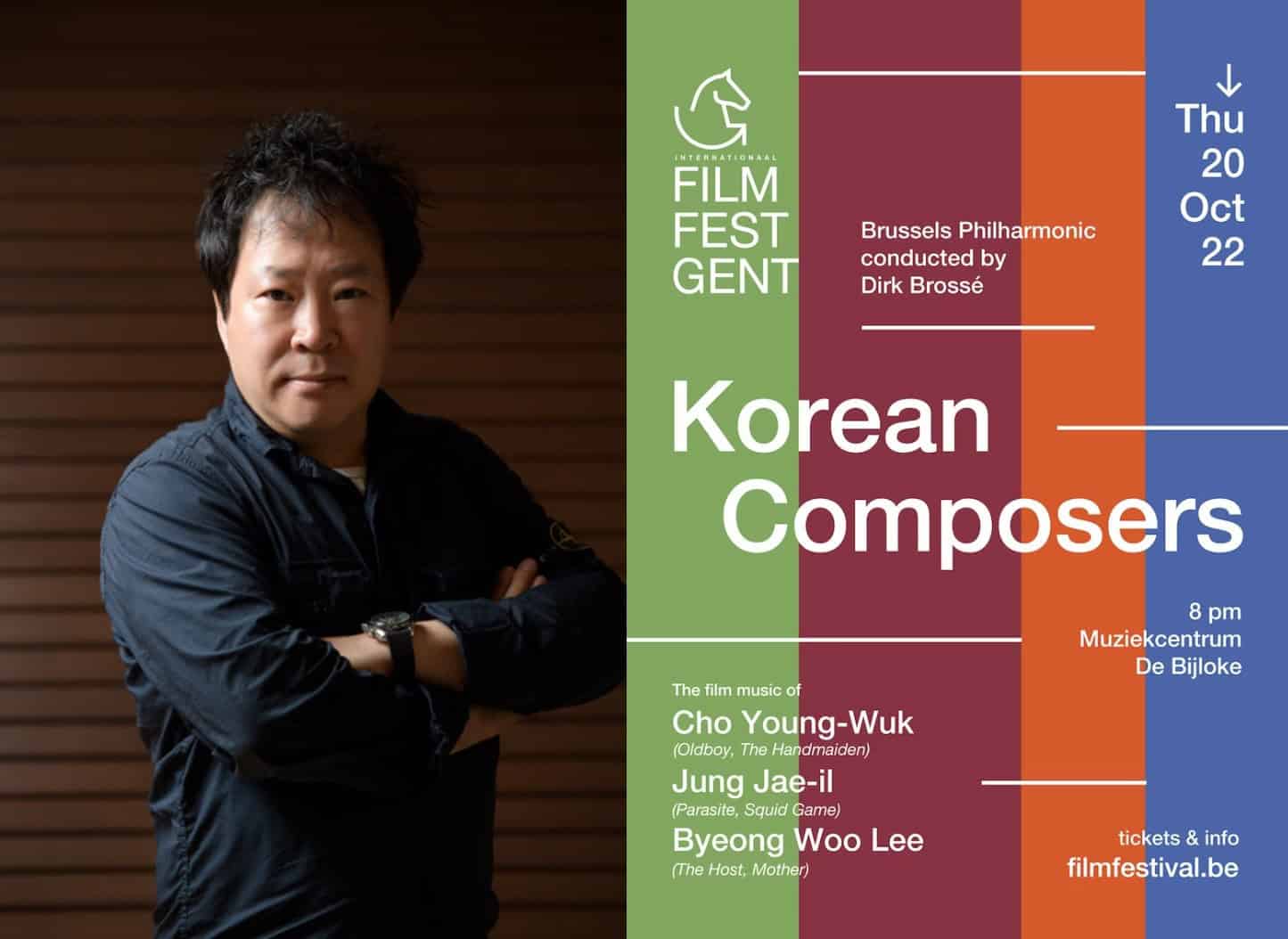
Meeting your heroes doesn't happen to you every day. Fortunately, our country has a film festival, the largest in Belgium, which has been focusing exceptionally on film music for decades. This year, Film Fest Gent focused on the flourishing South Korean cinema, and there was therefore special attention for the film music inextricably linked to it. Thus, at De Bijloke, the crème de la crème of Korean film music was showcased during the concert Korean Composers. But first there was that meeting…
In South Korea, he is absolutely a well-known figure, the interpreter assured me after the conversation. Someone who would easily be recognized and accosted on the street in Seoul. The young South Korean woman, living in Gent, also found it a unique opportunity to meet the man in person. As is often the case with those Asian names, it is no easy task for the ignorant Westerner to arrive at a correct spelling or pronunciation. Here too, the friendly translator lent a hand… Young-wuk Jo (born 1 January 1962) – the surname is pronounced as "Cho", and is therefore often (albeit incorrectly) written that way – has for many years been the regular composer of his compatriot Chan-wook Park, director of acclaimed films such as Oldboy (2003), part of the so-called Vengeance-trilogy, and The Handmaiden (2016). The intense collaboration between the two men can now safely be compared to that between Alfred Hitchcock and Bernard Herrmann – a composer Jo holds in high regard – or Federico Fellini and Nino Rota. Park's most recent film, Decision to Leave (2022), is currently playing in cinemas and again Jo is his musical mainstay. At the Cannes film festival, the film was awarded earlier this year with the prize for best director (prix de la mise en scène). Park thus adorns the same list as, among others, Mike Leigh, David Lynch, Michael Haneke and our brothers Dardenne.
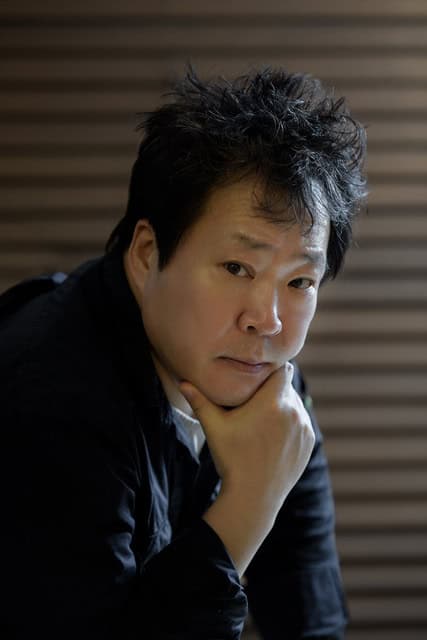 Young-wuk Jo's track record is already quite full, although the accolades were mainly limited to his own country. A consequence of the fact that he has never collaborated with a European director? It does nothing to detract from his merits, which are certainly remarkable for a self-taught musician. Yet a good-natured Jo will emphasize several times during our interview that what he does is actually teamwork. Besides him, the composer can count on four other talents, he tells us, and judging by the young man who alternately listens in during our conversation and taps on his mobile phone, there are some very young guys among them. "Next time you might be here for him," he says as something of a father figure. But what is certain in any case: it is hard to imagine a better apprenticeship for the aspiring film composer. Jo has been in Belgium quite frequently of late, specifically at Galaxy Studios, the place in Mol where the postproduction took place for his latest score for the film Hunt by Jung-jae Lee. He was assisted in this by maestro Dirk Brossé, the conductor who will once again mount the podium this evening during the Korean Composers concert at De Bijloke. "A great honor and something I look forward to with great enthusiasm," the composer says about it. For what turns out: his music has never been performed in a South Korean concert hall. It is hard to believe, just like the explanation Jo gives for this and which once again confirms the extraordinary Asian work ethic. Apparently, with all the hustle and bustle of so much work, it has never come about.
Obsessive
According to his own account, the sixty-year-old Young-wuk Jo excels on no instrument whatsoever, yet he has already written dozens of film scores. What does he consider, setting aside all praise and awards, to be his most successful music? The interpreter does her work diligently, after which the man throws both hands in the air laughing, as if it were an impossible question. Of course, he names his most recent production for Decision to Leave. "Because when I look back at my past films, I always stumble upon small mistakes. But with the music for Decision to Leave, I haven't yet had the time to critically examine my own work," he says with a quip. According to his own account, Jo looks up to Western music – as a teenager he was especially passionate about rock. It is something he grew up with in South Korea and that almost obsessively forms part of his personality. As an example, Jo refers to The House of the Rising Sun, . Today he is a fan of Collegium Vocale Gent and far from the only one on the peninsula with an interest in classical music. Partly due to the dictatorship in his own country following World War II and subsequently the Korean War (1950-1953), the native tradition was wiped out and what came from Europe and the United States was for a long time regarded as more modern and thus 'better'. This also applied to music. "Traditional Korean music is also not very suitable for the films that are made in one's own country. With classical music, on the other hand, you can express much more emotion."
Jo is a great lover of woodwind instruments, something that is exemplified beautifully, for instance, in "Fatality",
. How did he put this and other music such as "The Last Waltz" – – on paper? "Oldboy is a film with quite a few brutal action scenes. The slow, dancing music is meant as a pleasant contrast and to connect those different moments with each other. That's why there are many waltzes in the score." It is an approach that seamlessly aligns with the film composer's motto: "Never complete an image with music by showing what you see on the screen." Separate the visual and the auditory from each other. It seems counter-intuitive, but you should know that the music for Oldboy was already there before a single frame of the film was shot. "Fatality", on the other hand, is apparently a track that doesn't immediately ring a bell with its author. Fortunately, I have it on my phone, and we listen together to the beginning. "For Lady Vengeance, I wanted the opposite of Oldboy: something more emotional, with influences from Baroque music, but also from traditional Korean music." The music builds up in layers, with each group of instruments being introduced one by one. At this moment, the final touches are being put on the soundtrack for The Sympathizer, an HBO miniseries again directed by Park and starring Robert Downey Jr. in the lead role.Korean Gala Concert
That same evening, Dirk Brossé and Brussels Philharmonic make their appearance in the concert hall of De Bijloke for the gala concert Korean Composers, a tribute to Jo and some of his composing countrymen. The program notes demonstrate what he had emphasized earlier that day. Without exception, each of his six pieces lists a second composer by name. For the compelling "" from The Handmaiden, for example, that is Dae-sung Hong (b.1982), and once again the theme is first presented by a combination of woodwind instruments. With "" from Oldboy, written together with Ji-soo Lee, we get as the final number one of the other waltzes from that score: first on piano alone, then by a full orchestra. By that time, there had also been music from Decision to Leave ("Seorae"), A Taxi Driver ("Beyond the Darkness", 2017) and Thirst ("Under the Light", 2009), while the portrait began with the thrilling theme from the Netflix series Narco-Saints (2022). Or more precisely, with a brief conversation with a somewhat emotional and overwhelmed Young-wuk. The entire concept of this concert beautifully demonstrated how varied South Korean film music is: from the classically symphonic "" by Jae-il Jung, a work from the tragicomic award winner Parasite (2019) that was brought to life with some fine dialogues between several orchestra leaders, to the intoxicating sound of the daegeum, a traditional bamboo transverse flute, during "" from Sopyonje (1993) to the stimulating guitar music of Byeong-woo Lee, the other guest of honor present who also took to the stage as a performer. Lee stood out not only for his distinctive glasses and a pointed, acoustic guitar that James Hetfield of Metallica would certainly be jealous of, but also for his delicate picking in pieces such as Dance and Lullaby. The audience, present in large numbers, enjoyed it all with pleasure.
WHAT: interview with South Korean film composer Young-wuk Jo on the occasion of the concert Korean Composers
WHERE: Cultuurcentrum De Bijloke
WHEN: Thursday 20 October 2022
MUSIC: Jae-il Jung, Young-wuk Jo, Byeong-woo Lee, Hye-seung Nam, Soo-chul Kim, Mowg
PERFORMERS: Brussels Philharmonic conducted by Dirk Brossé
ORGANIZATION: Film Fest Gent
© Jeroen Willems
© Jeroen Willems
© Jeroen Willems
© Jeroen Willems
© Jeroen Willems


Read more
Jonny Greenwood, Nicholas Britell and Billie Eilish among the winners at the 22nd World Soundtrack Awards
24 October 2022
Korean composers at Film Fest Gent
22 October 2022