
With a mix of historical works, contemporary compositions and illuminating lectures, the Komponistinnenfestival her:voice in the German city of Essen has once again put together an extremely compelling and strong edition for the second time. Both in the old and often forgotten works and in the contemporary, there were many discoveries to be made, and we can only hope that they will secure a permanent place in the concert repertoire, also outside Germany.
One of the questions that arose during the lectures and debates – the supplementary program that also makes the Komponistinnenfestival so interesting – was about Neue Stoffe: what themes does contemporary music theater long for, especially in order to remain relevant in these times? In any case, there was no shortage of topical and relevant themes during this second edition of the Essen festival. Both Missy Mazzoli and Kaija Saariaho stirred emotions with subjects that are not self-evident for opera.
American Dream
Missy Mazzoli (1980) may not be a household name in our regions, but she is one of the most sought-after contemporary composers. She has already received two commissions from the Metropolitan Opera, as one of the first women, and in 2022 she was Musical America's Composer of the Year. She wrote, among other works, the opera Breaking the Waves (2016) based on the film of the same name by Lars von Trier. Last year, the New Yorker already made an impression at the Komponistinnenfestival in Essen with River Rouge Transfiguration, a short but powerful work inspired by the (defunct) industry in Detroit. We were therefore eagerly looking forward to a larger work by her: The Listeners (2021,
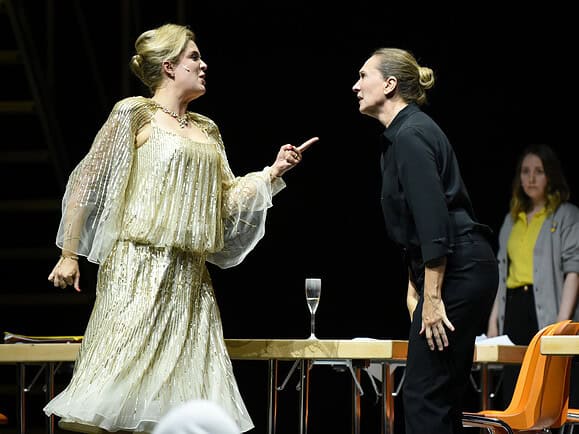
), a two-act opera for which she traveled to the festival herself.The Listeners is the second part of a trilogy in which Mazzoli reflects on the dark sides of the American Dream. Together with her trusted librettist Royce Vavrek (known to us from his opera adaptation of Fanny and Alexander, the recent De Munt production directed by Ivo Van Hove), she illustrates in a gripping way how charismatic leaders abuse vulnerable people in their desperate search for understanding and connection. Claire suffers from sleepless nights due to a deep, permanent hum that drives her to madness. Together with Kyle, one of her students who also experiences this imperceptible tone, she seeks solace in a community around the charlatan and manipulator Howard Bard. Finally, they think they have found a hearing (!) for their complaints, until it becomes clear that they have actually ended up in a cult.
Suppressed potential
Mazzoli is also interested in what happens when female potential is suppressed. Where does their strength go when women (have to) suppress their dreams and what they consider their calling? The corset of husband and child and even her job as a teacher is too tight for Claire. You also wonder how it is with all those other listeners in the clan: is the maddening hum they hear the cause or consequence of a deep unease?
And yes, The Listeners is also a reflection on the Trump era, Mazzoli confirmed when asked. According to her, opera and (music) theater are in any case the most appropriate genres to respond to the zeitgeist, even if they sometimes lag behind by a few years due to the long production time – she started working on The Listeners during Trump's first term in office. Incidentally, she notes with satisfaction that young people can still be attracted to the genre precisely through such topical themes. Which is also hopeful for the future of music theater. In New York, the composer-performer, as she calls herself, also founded the Luna Composition Lab with which she offers mentorship to young girls and non-binary people in their first compositional steps for opera.
(In)nocence
For another work with a contemporary theme, we headed to Gelsenkirchen, 30 km further away, where the opera Innocence (2021,
) by Kaija Saariaho (1952-2023) had its premiere earlier this season at the Musiktheater im Revier. As part of the Komponistinnenfestival, the production had its final performance there (just like The Listeners). It was not without emotion and justified pride that the very international cast looked back in a post-show discussion on the intense experience for themselves and for the audience.Besides the by no means simple music of the Finnish composer, that lasting impression had much to do with the multilingualism of the piece. Saariaho and her fellow Finnish librettists Sofi Oksanen and Aleksi Barrière (also her son) gave each of the various characters in the piece their own language. So it is sung and spoken in Finnish, English, German, Swedish, Spanish, Greek, Romanian, Czech and French. This multilingualism also immediately stands for the entirely unique way in which the characters deal with the events. And yet that linguistic diversity feels very natural. Contemporary life as it is…
The story takes place simultaneously in two locations. On the one hand, there is the wedding of a Finnish young man with a Romanian woman. The bridegroom's brother killed eleven people in a shooting at an international school ten years ago, but the bride is kept in the dark about this. She believes she has found herself in a warm family and a non-violent rule of law. At the same time as the wedding-without-guests, young people and their teacher commemorate the ten murdered classmates and a teacher. It is clear that for each of the bereaved, also in the family of the perpetrator, the traumatic event continues to have an impact. How do they deal with loss, memories, but also with (in)guilt? For is everyone really innocent?
Bewilderment
By a fateful chain of circumstances, the mother of one of the victims is a servant at the wedding. Particularly clever how the two narrative threads thereby interact and the tension gradually builds up. Or how the past catches up with the present in a shocking way. No one remains unmoved by it, and the audience watches with increasing bewilderment. And yet life goes on: 'Let it go'… A true Greek tragedy, Greek chorus included.
Also at the Semperoper in Dresden this opera is currently on the bill (until April 11), albeit in a different production. It is noteworthy in this regard that Venla Ilona Blom, who sings the vocally unique role of victim Markéta in Dresden, jumped on the train early in the morning to replace the singer with the same role in Essen who had fallen ill the night before the last performance. And then quickly back to Dresden for the next performance in a completely different staging… Actually, we are inclined to jump back on the train. To see that version, but also to be able to concentrate extra on the music this time. Because that is indeed a sensitive point in contemporary productions: there is so much to experience that it is impossible to grasp both the story and the music in one go.
In any case, the full halls in Essen and Gelsenkirchen prove that the audience is open to it, despite the observation by Anna-Sophie Mahler, dramaturg of The Listeners in Essen. During the debate on Neue Stoffe, she said that in her experience music venues still show great reluctance towards contemporary themes because they fear the audience won't be receptive to them. Yet they are.
Charlotte 'Charles' Sohy
From Kaija Saariaho we also heard her atmospheric Ciel d'hiver during a Sinfoniekonzert, which took us completely into Nordic realms. Color Field by English composer Anna Clyne (1980), inspired by a painting by Mark Rothko, also made us drift away.
This does not mean that the Komponistinnenfestival focuses exclusively on contemporary work. On the contrary. After French composer Louise Bertin (1805-1877) with her completely forgotten opera Fausto was the most talked-about discovery on last year's programme (read here, also performed again during this edition), this year we could get to know Charlotte Sohy (1887-1955). Or Charles Sohy, because to have a better chance of recognition, this Parisienne usually put a male name on her scores. From her we heard La grande guerre – yet another topical theme?…
Sohy began this work in 1914, just at the time when her husband Marcel Labey, also a composer, conductor and advocate of her work, was called up to the front. During her lifetime, La grande guerre was never performed or published. Only a century later (!) did the work resurface. Hopefully it will not disappear into oblivion again after this performance.
Alma Mahler
Furthermore, the Komponistinnenfestival gave much attention this year to Alma Mahler (1879-1964), the woman who was hardly known and defined by her own work, but primarily in relation to famous men: Gustav Mahler, Walter Gropius, Franz Werfel, Alexander von Zemlinsky, Oskar Kokoschka. Her relationship with the latter is illustrated until June 22 through the exhibition Frau im Blau in the Folkwang Museum, which for the first time in 30 years brings together all the paintings, fans and a fresco that Kokoschka created during the period when he was (sickly) obsessed with Alma.
The flamboyant Viennese woman's own work has been preserved with 17 songs and is fairly modest. Nevertheless, they received ample attention during various concerts. A Wiener Salon also offered the opportunity to get to know Alma's contemporaries, such as Mathilde Kralik von Meyrswalden (1857-1944) and Evelyn Faltis (1887-1937).
Heavenly sounds
Even more work to (re)discover was offered by the concert of the Belgian B'Rock under Andreas Küppers. Under the title Seraphim we heard a selection of religious and contemplative-tinged songs: from the almost unavoidable 12th-century abbess Hildegard von Bingen, but also from more or less unknown composers such as Vittoria Aelotti (1575-1620), Caterina Assandra (ca. 1580-1618), Francesca Caccini (1587-1640), Chiara Margerita Cozzolani (1602-1678), Isabella Leonarda (1620-1704), Maria Xaveria Perucona (?-1709), or the 'younger' Louise Farrenc (1804-1875), Lili Boulanger (1893-1918) and Ruth Crawford Seeger (1901-1953). Ein Engel by the recently deceased Sofia Goebaidoelina (1931-2025) fitted wonderfully into this collection of heavenly sounds. We hope that B'Rock may repeat this programme with mezzo-soprano Lucile Richardo, which could also be heard in De Bijloke a few days earlier.
Even more discoveries are sure to be offered by the Komponistinnenfestival during its third edition from 12 to 15 March 2026. It is already marked in our calendar.
This article also appeared on the blog notities.vrouwaandepiano.be.