
On this Sunday morning we did not go to church for a mass, but for a high mass of beautiful music. The Hoogstraat 12 is packed again, not a single seat remains empty.
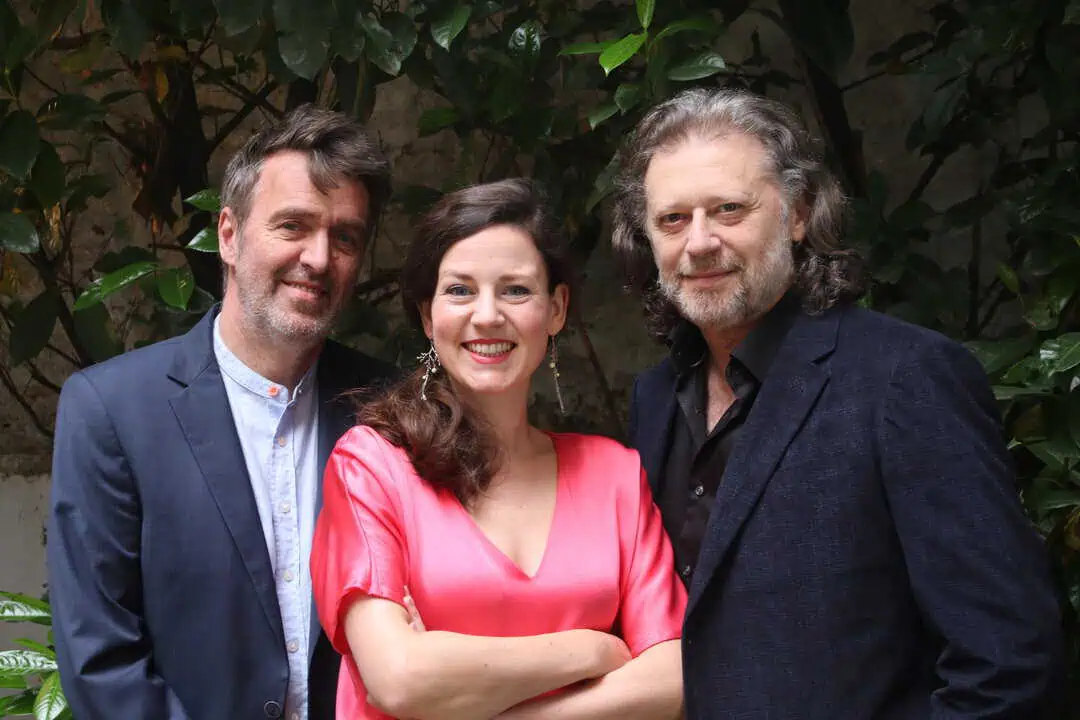
The format Belcanto and bella musica has more to offer than just classical music. Hostess Lissa Meyvis put together a beautiful palette of songs with her guest, baritone Hans Peter Janssens, which they paint with piano accompaniment by Alex Roosemeyers, sometimes with pastel tones and sometimes with fiery colour accents. From the broad range of music, this time the focus is on musical theatre. Hans Peter Janssens is a singer who has earned his spurs in the genre. He performed on stage both inland and even more abroad, including West End in London – the mecca of musical theatre – in leading roles such as Valjean in Les Misérables. Lissa Meyvis does not want to be pigeonholed. She feels like a fish in water in all types of music. They put together various medleys. The most beautiful, magical and most moving melodies from various musicals are featured. Before the interval, the older repertoire is presented. They are accompanied by keyboardist Alex Roosemeyers.
Lissa Meyvis starts sweetly with 'Play A Simple Melody' from the musical comedy 'There's Now Business Like Show Business' from 1946, composed by Irving Berlin and filmed in 1954, followed by the duet
'Let's Call The Whole Thing off', a song by George Gershwin with lyrics by Ira Gershwin, a number written for the musical 'Shall We Dance' from 1937 starring the legendary Fred Astaire and Ginger Rodgers. Bickering about pronunciation and idiom. Lissa and Hans Peter, two sparkling performers, who fully measure themselves against each other. The songs combine energy and melody, two complementary elements, so they reinforce each other.
Then three songs from the musical 'Kiss me Kate' based on Shakespeare's 'The Taming of the Shrew'. Hans Peter Janssens shares his disappointment about marriage in 'Where is The Life That Late I Led'. Lissa Meyvis highlights the other side of the coin in 'I hate man'. She does this not grudgingly but very subtly, making it even more dangerous. A relationship is give and take. The swords are no longer crossed and this medley ends with the duet 'Wunderbar'. A few seconds later, however, peace is disturbed and the hatchet is dug up in 'Anything You Can Do' from 'Annie Get Your Gun', a work that Irving Berlin composed in 1946 for Broadway. In this playful duet, sharp shots are exchanged. Like two poles of a magnet that attract and repel each other. The superlative is the final victory here. Lissa's voice goes up like a skyscraper! Her range equals that of a coloratura soprano.
Then a choice was made for one of the pearls from the rich Hollywood musical history with a medley from 'My Fair Lady', based on the play 'Pygmalion' (1912) by Bernard Shaw. The story is romantic and simple. Poor girl Eliza Doolittle is picked up by the elitist professor Higgins and trained to become an aristocratic lady. The world premiere of the musical took place in 1956. Julie Andrews played Eliza Doolittle, British actor Lex Harrison took on the role of professor Higgens. In the film version of the same name from 1964, which won eight Oscars, Lex Harrison was also present but Julie Andrews was replaced by Audrey Hepburn. In 1986, the Royal Ballet of Flanders brought the musical to the stage with Linda Lepomme and Hans Peter Janssens in the leading roles. In four songs, a curve is drawn from beginning to end. He opens with 'In de straat waar je woont'. Lissa joins in with a delightful Antwerp folk dialect with 'Zou dat niet zalig zijn'. Then Hans Peter again with the opportunistic 'Als het effe kan'. It ends with 'Het Spaanse graan'. Mission accomplished. Lissa not only sings, she is an extraordinarily expressive and ravishing performer. She knows how to draw every song towards her, without exaggeration however. With the two of them, they know how to charm and enthuse the audience.
Then three songs that have a link with classical music. Lissa brings 'I feel Pretty' from West Side Story from 1957, music Leonard Bernstein, lyrics Stephen Sondheim and transforms from one character to another. A free adaptation of Romeo and Juliet. The story takes place between Polish-American and Puerto Rican street gangs in the Upper West Side of New York. Tony and Maria fall in love with each other, even though they belong to rival gangs. A girl who is in love and also feels desired. Is there a more blissful feeling? Her empathy causes butterflies in the stomach. Hans Peter Janssens joins in with the ballad 'Some Enchanted Evening' from the musical South Pacific written in 1949 by Joshua Logan, the music is by Richard Rodgers and Oscar Hammerstein. Andrew Lloyd Webber describes it as the best number ever written for a musical. If someone like that says it, we'll take it as truth. The warm, sonorous voice of Hans Peter Janssens wraps you like a soft blanket. As the last number in this series, a duet 'You're Just in Love' from 'Call Me Madam'. Premiere in 1950. Composer Irving Berlin is said to have sought his inspiration for this classical counterpoint duet from Bach. A piece in which soprano Lissa Meuvis can really let loose.
Before the intermission, the audience receives a Mary Poppins Medley. A Disney musical fantasy from 1964 based on a story by Pamela Travis. The story came to life with Julie Andrews and Dick Van Dyke in the leading roles. Lissa performs 'A Spoonfull Of Sugar'. Hans Peter Janssens 'It's A Jolly 'Oliday' and 'Chim Chimeree'. Particularly beautifully and fragile, Lissa interprets 'Feed the Birds' and it concludes with the no nonsense word and song 'Supercalifragilisticexpialidocious' which stands for exceptionally good. With these two words, the first part of this 'Magical Musical Memories' can also be described.
After the intermission, more recent work is featured. Hans Peter Janssens opens with the number 'Sunset Boulevard' from the musical of the same name by Andrew Lloyd Webber from 1990. In terms of diction and articulation, an extremely difficult number, but it is performed flawlessly. Lissa brings a number from the musical 'Chaplin' 'All Falls Down' a song with depth. Just like the two following songs from the musical 'Tarzan' in which Hans Peter Janssens played the leading role of ape leader. Love in all its facets is sung about herein. The male ape does not want to raise a human child. First there is the duet 'Als de maan bij de sterren' in which they sing their love. But then there is reality. He uses his common sense and does not want to raise the child. He explains why in the song 'Het moet, het moet' and thus abandons his partner when reason speaks and not the heart.
We linger a while longer in the animal kingdom with the beautiful 'Memory' from the musical Cats by Andrew Lloyd Webber from 1981. Elaine Page first gave the role of Grizabella form in the West End production. There is also a beautiful piano part woven in.
A musical in which Hans Peter Janssens excelled, first as Valjean one of his signature roles, later as Javert, was 'Les Misébables' based on the work of Victor Hugo from 1862. The author's social criticism was not appreciated at the time. 'Stars' is one of the two most important numbers that Javert performs solo. Lissa Meyvis brings the beautiful 'On My Own' of the girl Eponine. Again interpreted in her own subtle way.
Then a medley from 'Phantom Of The Opera' in which Hans Peter Janssens played the leading role in Antwerp and London.
Lissa starts with the beautiful 'Think Of Me'. 'Music Of The Night' is right up his alley and Lissa ends with 'All I Ask Of You'.
It concludes with two songs from the musical 'Love Never Dies' a musical by Andrew Lloyd Webber as a sequel to 'The Phantom Of The Opera', Tim Rice wrote the lyrics, and two from 'The Lion King'. 'Till I Hear You Sing' is a beautiful duet with an aria woven into it. 'Love Never Dies' is one of the most beautiful love songs. The voice of Hans Peter Janssens is at times caressingly soft as velvet but he also switches effortlessly to head voice. Soprano and baritone, two voices that perfectly complement each other with singing that makes your whole body tingle.
As a finale, two songs from the musical 'The Lion King', based on the Disney animated film from 1994 with music by Elton John, Tim Rice and others. Eclectic music with influences from classical music, pop, rock, gospel and other genres. Lissa and Hans Peter perform 'Can You Feel the Music Tonight' and as the closing number 'Hakuna Matata'. It is an expression from Swahili and means: don't worry for the rest of your life. The fantastic piano accompaniment by Alex Roosemeyers completed the picture. The two soloists do not seek pathos and excessive bombast, but weave a well-balanced soundscape and yet allow themselves to communicate the different stories in a nuanced manner and charismatically. Our mental mood and happiness hormones: serotonin, dopamine and oxytocin were certainly strongly charged, just like the rest of the audience. Culture, a golden lining around a dark world. We left again in an excellent mood.