
This 'Tour de France' was a successful marriage, to stay in the spirit, between pure-bred classical French art song repertoire and chanson. Paris is THE city of love, that sentiment was the thread running through the concert.
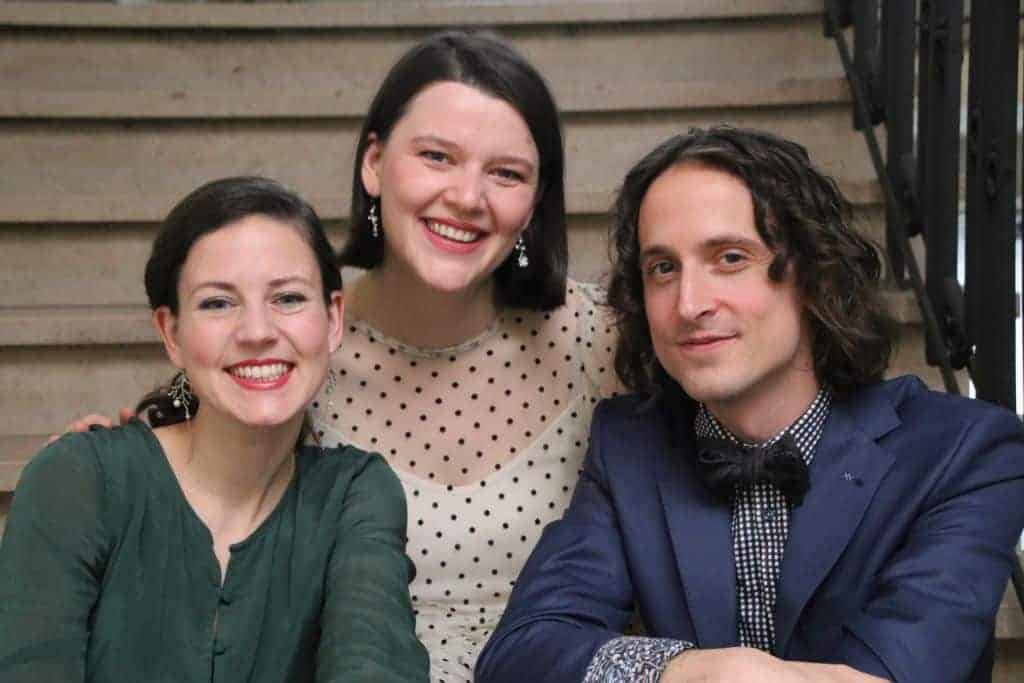
The two sopranos Lissa Meyvis and Lisa Willems put together an unconventional programme. The artistic energy flows abundantly. They did not opt exclusively for the well-known repertoire, but also unlocked lesser-known works with many gems. In the bittersweet texts, love for a person or nature resonates. Classical pianist Lester Van Loock takes on the serving role of accompanist who, with a dry remark in between, provides the cheerful note. Twice he also brings a piano solo with transparency, bravura and mastery. This trio takes the audience along on a journey into a world full of ear-caressing, delightful music.
Lisa Willems opens with a yearning song from Erik Satie's belle époque 'Je te veux'. Followed by Lissa Meyvis with 'La diva de l'empire'. It stems from Erik Satie's café-concert period, when he was a pianist at the cabaret Le Chat noir. He wrote it for Paulette Darty. It is simple but effective in style and not free from some frivolities. Lissa Meyvis sings with body and soul. An expressive body language and mime that speaks volumes. Eyes that can tempt and equally well spit fire. She projects her seductive arts onto a few older gentlemen. Blissful! She knows how to captivate the audience completely by colouring in the charm and whimsicality of a diva. Lisa Willems continues with 'Hymne à l'amour' by Edith Piaf based on a composition by Schumann. There are a few interpreters with such great originality that you can hardly match them. The dark, deeply felt timbre of Piaf's voice was unique. As a soprano interpreting that ballad is a gamble and I did not find it entirely successful. Whereas Lissa Meyvis opts for 'La vie en rose' one of la Môme Piaf's best-known songs. Meyvis masters the art of drawing a song to herself, making it her own in an unaffected and transparent way and extracting its essence. It creates a beautiful moment of silence. She does this too with 'La mer' by Charles Trenet. He wrote the lyrics at age 16 and later composed a composition around it. Together with 'La vie en rose' by Edith Piaf, they are the best-selling French songs of all time.
After all the vocal work, time for Lester Van Loock. He chose 'Arabesque No. 1 ' by Claude Debussy. The name refers to lightness and ornamentation. With bravura in terms of empathy and playing, he reveals the narrative power of Debussy.
Lisa Willems joins in with 'Prose lyrique – De Rêve' also by Claude Debussy. He wrote both the text and the music and it deals with the rustling of leaves. Vocally/technically a demanding song. Since the programme was given the name 'Tour de France', a song about a bicycle could not be missing. Francis Poulenc's oeuvre is not always very accessible but in 'Fêtes galantes – Bicyclette' he does show a different and more spirited side of his talent. In terms of articulation it is pure fireworks. Lisa Willems delivers an impressive rendition twice.
Lissa Meyvis deploys all her acting talent again for 'La Coccinelle' by George Bizet. A man wants to kiss a girl but is distracted by a ladybird. She portrays this as an ingénue, mischievous and engaging. Lisa Willems chose the aria 'Habanera' from the opera Carmen by Georges Bizet, composed for mezzo but as a soprano she also performs it brilliantly. Carmen enforces love. The high notes are impressive. The impact is so great that I have to wipe away a tear. Lissa Meyvis chooses challenging songs and switches effortlessly between moods. As also in 'Les filles de Cadix' by Léo Delibes. With the accompaniment of piano and castanets, the Spanish atmosphere comes fully into its own. The first part concludes with the beautiful 'Flower Duet from the opera Lakmé' by Léo Delibes. Their voices blend perfectly.
The second part cannot be called purely French. It is more a network of artists who once washed up in France and stayed there for a shorter or longer period. Starting with Kurt Weill. Lisa and Lissa perform 'Youkali'. After Weill escaped Nazi Germany, during his two-year stay in Paris he tried to write successful songs. Lisa also performs the resolute 'Je ne t'aime pas'' by Weill, as well as the world hit by Nana Mouskouri 'Coucouroucoucou'. Lissa Meyvis chose a number by the Armenian singer who found his second home in France: 'Par gourmandise'' by Charles Aznavour. This mix leads to engaging, funny, moving and atmospheric moments.
Lester Van Loock again demonstrates his mastery in the 'Second Hungarian Rhapsody' from a series of nineteen Hungarian Rhapsodies by Franz Liszt. Breathtaking and thrilling to watch and listen to. Lisa Willems throws herself into the 'Vilja Lied'' by Franz Léhar from his operetta "Die Lustige Witwe". Another number from the operetta 'Lippen Schweigen'' is performed in a subtle way that plays out the sexual attraction between the two women.
Lissa Meyvis performs an aria from the tragic opera Orpheus and Eurydice by Christoph Willuck Gluck 'J'ai perdu mon Eurydice' once translated into French. Followed by Lisa Willems with a song that perfectly fits this time of year 'Les feuilles mortes' written in 1946 by Jacques Prévert, music Joseph Kosma. Yves Montand made it a classic. Lissa Meyvis ventures into the signature song of the black icon Josephine Baker 'J'ai deux amours'. Lisa continues with 'A Chloris' by Reynaldo Hahn, a French composer, conductor and music critic. He moved to France at the age of three from Venezuela.
In the final part Lissa Meyvis presents the cheerful aria 'Air des bisous' by Jacques Offenbach. And as a finale, a duet between Lisa & Lissa also by Offenbach 'Barcarolle – Belle Nuit' from The Tales of Hoffmann.
Once again a successful matinee where the promise of an exciting and rewarding musical experience was fully delivered. Everyone left with a dose of oxytocin and dopamine.
- PRODUCTION: Bellissama
- VOCALS: sopranos Lissa Meyvis and Lisa Willems
- PIANO: Lester Van Loock
- WHERE & WHEN: Fakkeltheater Antwerpen, 12.11.2023