
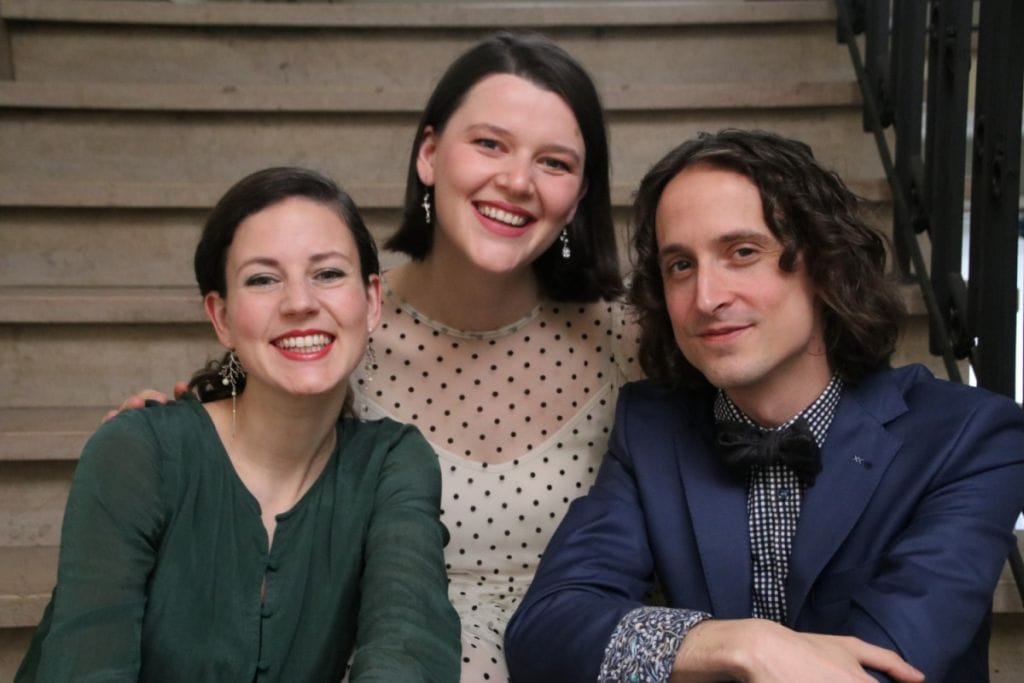
Spring, nature explodes in shades of green, yellow and white. This edition of 'belcanto en bella musica' is also full of drive and colour. For the many loyal subscribers, it has become an almost monthly ritual on the second Sunday of the month. A moment of rest and relief in this topsy-turvy world.
Under the patronage of Herman Van Hove, all efforts are combined here to let the beauty of the world shine and to give young talent a platform. Richly filled from diverse styles. Hostess Lissa Meyvis had to be absent this time. Companion, soprano Lisa Willems, takes the honours. At the piano keyboardist Lester Van Loock and a special guest is promised.
The first song, performed by soprano Lisa Willems, 'Both Sides - Tears and fears' a classic by Joni Mitchell does not sound entirely convincing. Perhaps her voice was not fully warmed up at this early hour or she was suffering from stage fright as she also had to take care of the presentation. In any case, the lyrics are beautiful and deal with the cycle of love: from the first butterflies in your stomach to emerging doubts.
The second number comes from experimental American composer George Crumb. One of the 'Three Early Songs' composed in 1947 to texts by Robert Southley and Sara Tessdale was chosen. In this number the experiment does not peak but the piano accompaniment sounds still quite ordinary, feather-light and sparkling and the singing is perfect.
English composer, pianist and conductor Benjamin Britten arranged quite a few Irish Folksongs for piano and voice. Lisa performs the melancholic 'The Last Rose of Summer' to a poem by Irish poet Thomas Moore. A blend of sweet and bitter, in the setting subtly classical in style.
Then the big surprise is introduced: young cellist João Pedro Gonçalves with Portuguese roots (born in 2000). He studied among others at the conservatory of Brussels. Currently in residence at the Musikkapel Koningin Elisabeth. No small fry. He was fortunate to work with some of the world's leading conductors such as Lorenzo Viotti, Gustavo Dudamel and Giancarlo Guerrero. João has already added a string of first prizes to his portfolio. He treats the audience to Bach's 1st Cello Suite. A challenging work. It demands exceptional virtuosity from the performers.
Bach wrote these Suites during the period when he lost his first wife. Variations in different tempos with different atmospheres that everyone experiences in his life journey. A sort of cycle. Music of overwhelming beauty, pure and unfiltered. A goldmine. The audience watched and listened mesmerized by his impressive performance. The notes are the same at each performance, but each performance sounds different through the interaction with the audience.
There are extroverted and introverted interpreters. João Pedro Gonçalves knows how to grasp the soul of the composition, masters the score and plays his instrument in a masterful way, cello built by Tanguy Fraval. On loan from the Strings For Talent Fund of the King Baudouin Foundation. In his controlled interpretation he knows how to convey emotional depth and despite his young age, adult intensity. He plays with confidence. The instrument surrenders to his body, his touch. Each variation, each of Bach's thematic transformations brings about a different movement. Shifts from minor to major, joy and sadness. The sonorous sounds immediately evoke something. They settle on your mind.
Lisa Willems, accompanied by Lester Van Loock, also brings the beautiful song by Henry Purcell 'When I am laid in the Earth' which tells of the tragic love of Queen Dido of Carthage for the Trojan hero Aeneas.
The second part of the concert opens with Lisa and Lester 'Send in the Clowns' a song written by S. Sondheim for the musical 'A Litttle Night Music' from 1973. It is one of his best-known compositions and was high on the hit lists. The melody is and remains an earworm.
With an associative ability, these three performers have searched for compositions to give everyone as much attention as possible. It becomes an immersion in the cello repertoire. João and Lester are to be admired in Dvorak's 'Silent Woods' for piano and cello. This work from 1875 knew many arrangements. Was originally composed for cello and orchestra. It is lyrical and evocative. The peace of the forest with the storm raging through it as a contrast. Two sensitive performers give it their all. The two instruments follow their own course but also converse and thus give the music a refreshing epic quality.
The path of Liza Willems crossed that of cellist João Pedro Gonçalves for the first time during a Russian song recital. From this, she performs a number by Tchaikovsky 'None but the lonely heart'. Theme: an unfulfillable and therefore sometimes painful longing for an ideal.
Lester and João give each other wield in two nature-related numbers by Grieg 'Zur Rosenzeit' and 'Ein Traum'.
Then follows a classical arrangement of 'Somewhere over the rainbow'. Piano, cello and the velvety voice of Liza Willems result in a particularly beautiful version.
Liza Willems then demonstrates what she has up her sleeve with a beautiful and difficult aria from 'La Traviata' by Verdi. The opera is based on the book 'La dame aux camélias' by Alexander Dumas. It tells of the impossible love between Alfredo, a young nobleman, and the frivolous Violette, who suffers from tuberculosis. In those days, a starring role for opera diva Maria Callas. Liza actually needs a tenor as her counterpart, but that role is filled by the cello. She opens multiple stylistic drawers. With vocal virtuosity and effortless shifting from high to low, she captivates the audience. Her voice touches, unleashes something. The high, fragile notes even bring tears to my eyes.
A mesmerizing séance. The performers share a love for music. Simple in readability or just very complicated. Briefly summed up: skillful, refined, convincing. The audience never goes home disappointed, but charged with not one, but all the happiness hormones. As a finale, the enthusiastic audience was given one more treat: 'Elegie' by Jules Massenet.