
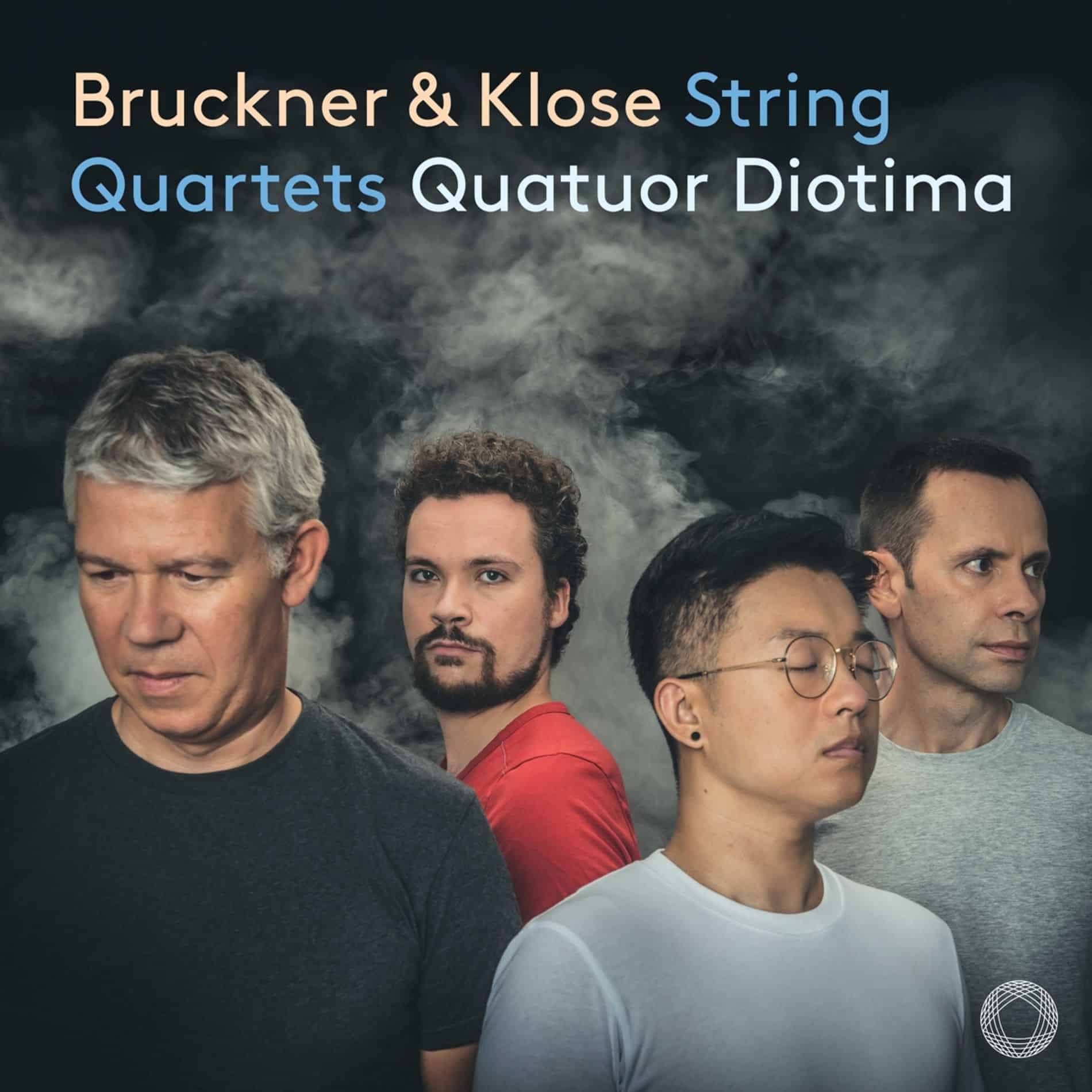
Bruckner: String Quartet in c, WAB 111 - Rondo in c, WAB 208 - Theme & Variations in Es, WAB 210
Klose: String Quartet in Es
Quatuor Diotima: Yun-Peng Zhao, Léo Marillier, Franck Chevalier, Alexis Descharmes
Pentatone PTC 5187 217 • 86' •
Recording: Feb. 2024, Mittlerer Saal, Brucknerhaus Linz
Bruckner wrote his (only) string quartet relatively early in his career as a composer: in 1862, when he was only 38 years old and at the beginning of his career as a symphonist. It is above all a study piece, thus included in the Kitzler-Studienbuch, dating from the time when Bruckner was still studying with Otto Kitzler. In it not only this string quartet, but also six unfinished Scherzos alongside the Theme & Variations in Es likewise recorded on this album and a Rondo ('in larger form') that was to serve as an alternative Finale (also a Rondo) of the string quartet.
Theme & Variations in Es, also created in 1862, is one of the first compositions that moves relatively far in form and content from the study pieces documented up to that point in the Kitzler-Studienbuch, although the chosen variation form does follow the classical rules neatly, in three-quarter time and consisting of two groups of eight measures each that are to be repeated consistently (there would be several more in this genre that year).
In 1862 Bruckner was still far removed from what was to come, including the expansive sound panoramas and the thematically expanding architecture in his symphonies and masses, and of which a striking example would also emerge in his chamber music: in 1879, in the string quintet in F. Little wonder, then, that there were critics at the time who referred to the piece with mockery as a 'symphony for five strings'. Those who showed enthusiasm for it when the ink of the four-part, almost three-quarter-hour-long work was still virtually wet was the Duke of Bavaria, to whom Bruckner had dedicated the opus. The dedicatee, however, thought very differently: a renowned violinist who found it an unplayable monstrosity.
The string quartet by Friedrich Klose (1862-1942) is certainly a fitting contribution within the given album framework, as he in turn studied with Bruckner. It is also Klose's only substantial contribution to chamber music, composed between 1908 and 1911, a work in which motivic and contrapuntal technique combines with a high degree of virtuosity. As if Klose wanted to draw on everything from his creative toolkit. The fact that Klose, like his great master, knew no theoretical limitations is made crystal clear on virtually every page of this string quartet. The subtitle the composer gave the work also points in that direction: 'Ein Tribut in vier Raten entrichtet an seine Gestrengen den deutschen Schulmeister'.
Heinrich Knappe (1887-1980), a music teacher and conductor from Munich, noted in his monograph on Klose:
'Mit sieben Jahren erhält er ersten Violinunterricht, doch „empfand er den monodischen Charakter der Violine als einen Mangel". Wagners ‚Lohengrin' und Bachs ‚Matthäus-Passion' hinterlassen unauslöschliche Eindrücke, und er schreibt ohne Unterweisung erste Kompositionen: Es „werden im Laufe der nächsten Jahre symphonische Dichtungen, Szenen, ja ganze Akte von Opern, zu denen er sich selbst den Text schrieb, fertiggestellt; sie sind der Niederschlag des Studiums der Klavierauszüge zum ‚Lohengrin' und zur ‚Matthäuspassion' und der Eindrücke, die Berlioz' ‚Fee Mab' und Liszts ‚Les Préludes' im Konzertsaal auf ihn machen." Vinzenz Lachner (1811-93), der jüngere Bruder Franz Lachners und konservative Lehrmeister am Großherzoglich Badischen Konservatorium in Karlsruhe, wird sein erster Theorie- und Kompositionslehrer…'
Klose did not achieve world fame. He was born in Karlsruhe on 29 November 1862 and died in the Swiss Ruvigliana on 24 December 1942. His music breathes the late Romantic period relatively early on, with the figure who left an enormous mark on German musical life in particular at the forefront: Richard Strauss, although there are also clear influences from Wagner, Berlioz and Liszt (Klose's symphonic poems alone speak volumes). The Mass in d (1889) Klose composed as a homage to Franz Liszt. In 1911 he completed Die Wallfahrt nach Kevlaar, a richly appointed ballad (the text is by Heinrich Heine) for recitant, three choirs, large orchestra and organ. The melodic and harmonic texture is quite densely woven and there are moments where theory seems to claim all attention for itself.
We hear something similar in Ilsebill, the fairy tale of the fisherman and his wife, to a text by Hugo Hoffmann, conceived by Klose in 1902 in the form of a 'dramatic symphony', although it has all the characteristics of an opera in five acts. The German record label CPO released a CD recording of it.
For Klose, three elements were decisive for his composing: 'inneres Erlebnis, seine künstlerische Gestalt-Annahme und die musikalische Inspiration'.
Neither the string quartet by Bruckner nor that by Klose has become a real repertoire piece. Although this may not be apparent from these interpretations full of expressiveness and technical refinement by the famous French Quatuor Diotima. This ensemble not only excels in twentieth-century music with incomparable playing, but also ranks among the world's best in German-Austrian expressionism. Thanks to this new album, Friedrich Klose is moreover given his due. The majority of his oeuvre has remained severely undernourished from a discographical perspective, and on our concert stage the name of Klose is rarely (if ever) encountered. There is more interest among our eastern neighbours, but that is also obvious, since Klose was after all a German by birth.