
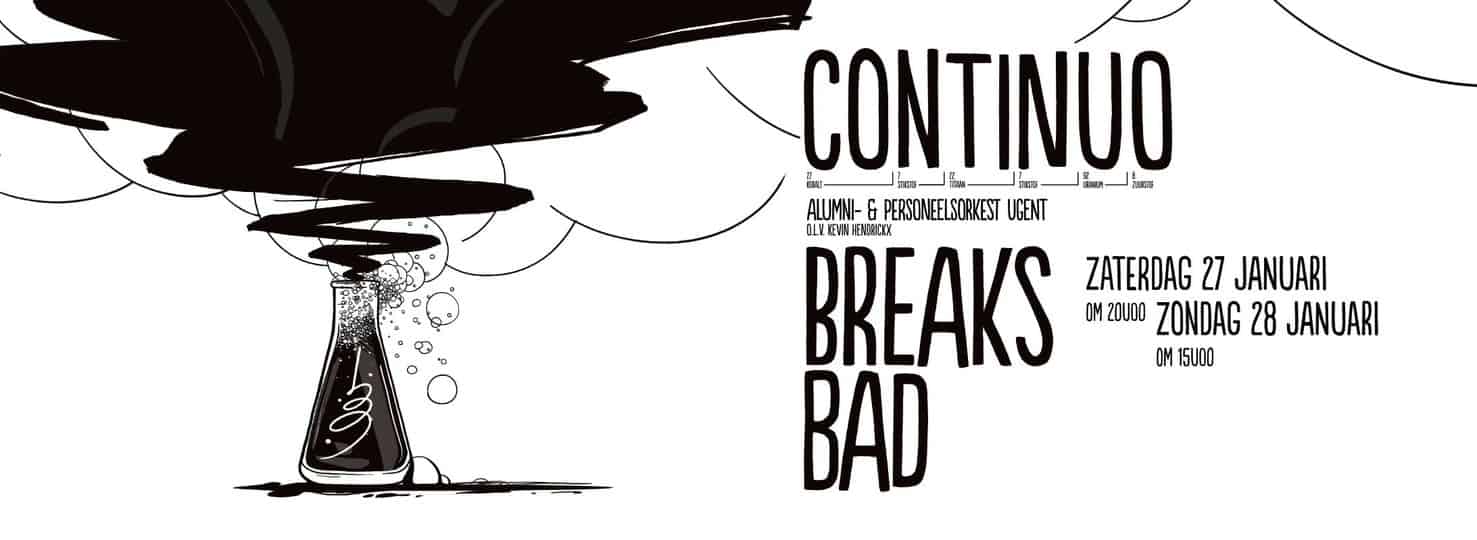
Symfonieorkest Continuo is the alumni and staff orchestra of Ugent. It stands alongside the Gent University Symphony Orchestra (GUSO), which consists mainly of students. With over ten thousand employees, Ugent is not only the city's largest employer, it also maintains various orchestras, in addition to a choir and a brass band. On 27 and 28 January, they performed a concert full of chemistry in the Gent Miryzaal. The title "Continuo Breaks Bad" refers to the TV series "Breaking Bad", in which a chemistry teacher starts a drug lab. Chemistry is the binding agent of the music and the performers. Composer Ward De Jonghe, whose concerto for percussion sounds in world premiere, is a chemist. Conductor Kevin Hendrickx is a chemist. Alexander Borodin, whose second symphony we hear after the intermission, was a chemist far more than a musician his entire life.
 They begin with Mozart, the overture Don Giovanni. Conductor Hendrickx is a professional who keeps his troops together well, but it could have been a bit more spirited and faster. Almost andante instead of allegro, Don Giovanni sounds here. As if he's just wandering around after the women, the libido on low heat. The strings sound somewhat thin in this concert hall, without the warm round tone of a professional orchestra. That doesn't detract from the dynamism, the joy of playing that can be read on the faces.
Have you ever heard of American composer Peter Schickele? A joker with a diploma from the Juilliard School in his pocket. In eine kleine Nichtmusik he turns Mozart's well-known serenade into a pastiche, weaving themes by Beethoven, Rachmaninov, Shostakovich, Tchaikovsky or Liszt through it. Light-hearted, witty, but also damn clever. The orchestra gets into gear.
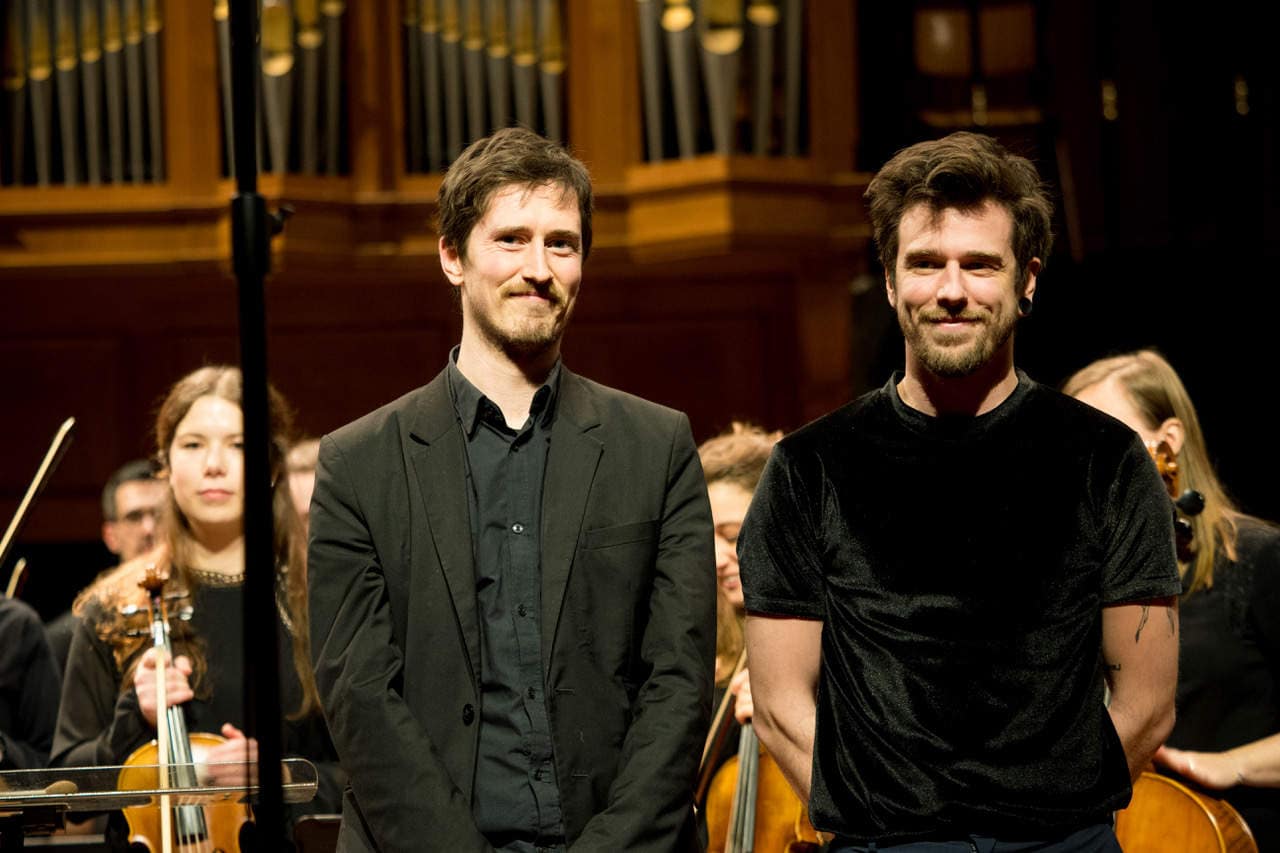 Ward De Jonghe is, besides being a chemist, above all a young composer who has already achieved quite a few prizes and honours. In 2020 he was selected for the SOV Composers' Academy. Concertos for percussion and orchestra are rare, and I had never heard one before. Se/Fe he wrote for his friend percussionist Wim Pelgrims, with whom he plays together in the ensemble Nemø. Se and Fe refer to chemical elements, Se stands for selenium, Fe for iron. As was also heard in his orchestral work Ansatz, De Jonghe creates a fascinating sound world, static music that combines sound masses with percussion techniques that squeeze everything out of the small and large drums and timpani, which are set up in front of the orchestra. Like a chemist, De Jonghe searches for unusual diffuse sounds. Fifty shades of noise. Percussion in this work is not just hitting, but also rubbing, scratching and scraping on the skin. Anyone who thinks you can only stroke a bow on the strings is mistaken. He has the string players bow on the scroll and on the wood of their violins. That gives the sound of soft wind. When we go from Se to Fe, from selenium to iron, Wim Pelgrims strikes away, as if he wants to awaken underground spirits, forging the iron while it's hot.
After the intermission, finally some romance in the concert hall. Borodin's Second is performed quite often. It has a rough Slavic character with which the musicians come across better than with the always delicate Mozart. You can see how the conductor urges them on in the wild passages, in which we have landed in the deep, warm Russia of the tsars.
There was chemistry in the hall and on the stage. With the concept "Continuo Breaks Bad", the orchestra has once again delivered an excellent example of public relations. Not just any program, but with Continuo you always get a concert with a total concept, a leitmotif, with a beautifully printed extended program booklet as well. That's not something you come across very often in the concert hall.