
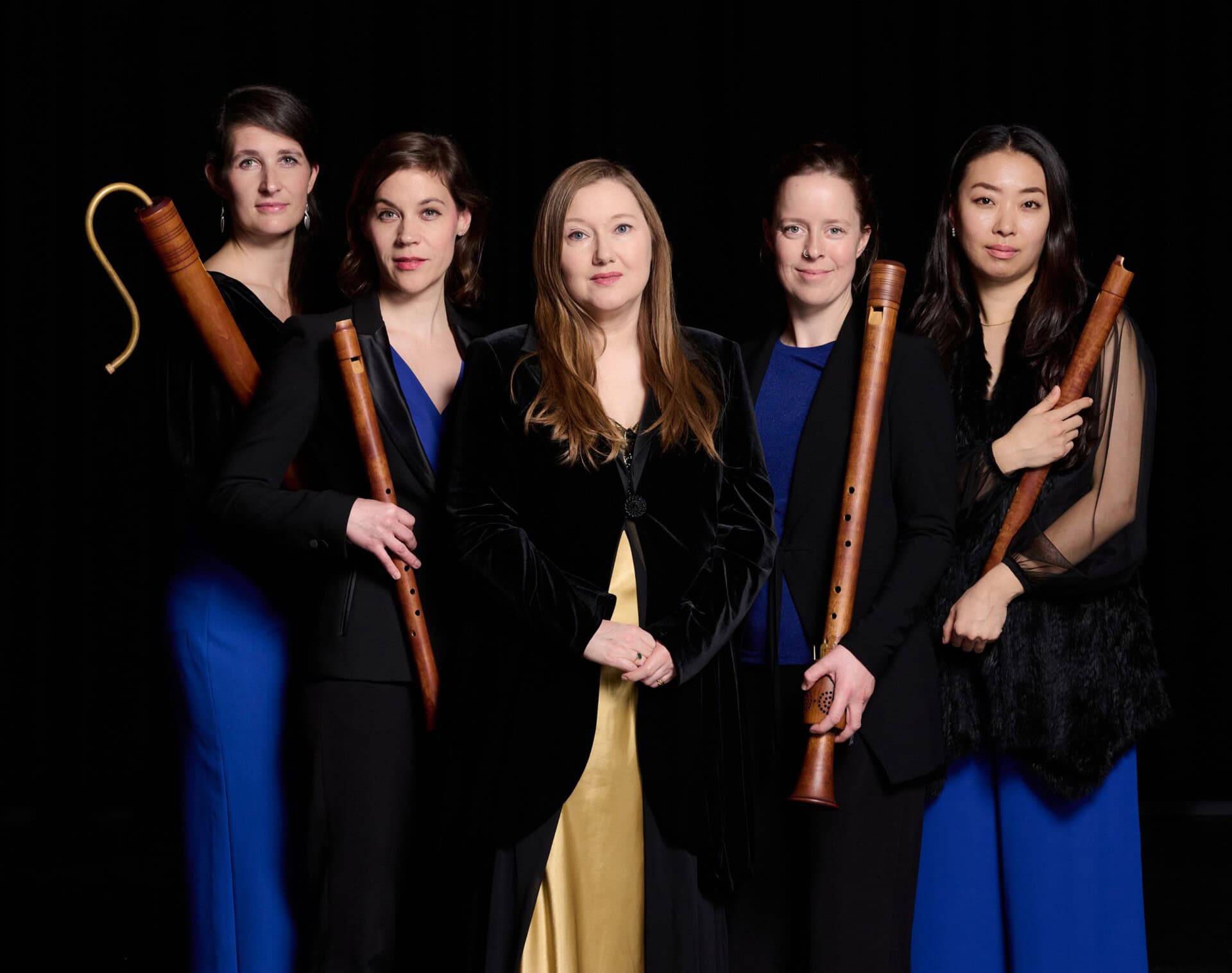
An interview with Elisabeth Champollion of Boreas Quartett Bremen
On Sunday evening, August 25, soprano Dorothee Mields and Boreas Quartett Bremen present the favorite songs of Margaret of Austria during Laus Polyphoniae. AMUZ spoke with Elisabeth Champollion of Boreas Quartett Bremen about this collaboration, the program, and their previous appearances at AMUZ.It's been almost ten years: in 2015 our audience could hear Boreas Quartett Bremen at work for the first time during Laus Polyphoniae and in 2017 you were guests at AMUZ again. Since then, the ensemble has had quite a journey.
It's been a while, but when I think about it, I can say that our performance in 2015 was a milestone for us. Since our first performances in 2006 or 2007 – we were still studying together at the conservatory – Boreas Quartett Bremen had always been 'the four of us', almost like four sisters who were always together. It took a long time before we opened ourselves up to collaborations. The Petrus Alamire Lab in 2015 (a variant of the International Young Artist's Presentation within the festival edition centered on Petrus Alamire, ed. note) was the occasion for us to develop something with a different artistic discipline for the first time. We worked with visual artist/designer Katharina Berndt, with the miniatures in Alamire's manuscripts as our starting point. In that sense, Laus Polyphoniae gave us as an ensemble a boost to think outside the box for concert programs.
This summer you are guests again with music from a manuscript by Petrus Alamire.
That's right. As a recorder quartet, Renaissance music is part of our core repertoire. When we were thinking about a new project in 2019, we decided to put together a program with the 'best of' Franco-Flemish polyphony. When searching for the best music for consort (instrumental ensemble) from that period, we remembered the Basevi Codex, which we received as a facsimile edition, instead of flowers, after our performance at Laus Polyphoniae in 2015. The music in that manuscript is actually already a 'best of': the greatest hits of the time when it was made (between 1505 and 1514 in the workshop of Petrus Alamire, ed. note). Because the Basevi Codex mainly contains songs that could be sung or performed instrumentally, we wanted to collaborate with a singer. And who was better suited for this repertoire than Dorothee Mields! We had known her for years, as she lives in the same city as we do, but we had never collaborated before. It was a very pleasant experience, and since then we have worked with Dorothee on another program featuring music by William Byrd, together with Hathor Consort.
The Basevi Codex does not contain an unambiguous score. It is not entirely clear how the music in it was performed back then. How did you deal with that?
Indeed. In some compositions the text is clearly indicated, in others only the incipit, one song has the note names as incipit, in still others only the composer is mentioned. This could show that many of the 'hits' of that time were performed purely instrumentally or with a singer, if they knew the text. That gave us a lot of freedom to work with it. The text or the incipit determined for us what character the performance should have. Based on that, we decided whether we would play the piece on our recorders in a higher or lower register, and which part Dorothee could sing. Because in polyphonic music with multiple voices, she – even though she is a soprano – does not necessarily have to sing the highest part. In Royne du ciel / Regina caeli by Johannes Prioris, for example, we chose to have Dorothee sing the lowest part, with us playing the three upper voices on three soprano recorders, which sound an octave above her voice, as if they form a little choir of angels. Through the choice of recorders and the relationship to Dorothee's voice, we were able to add many different colors to the program.
You made plans for this new concert program around the Basevi Codex in 2019, but then Covid-19 threw a wrench in the works.
Yes, so it wasn't immediately possible to perform the program, but fortunately we were able to record it on CD in the summer of 2020. That turned out to be a blessing, as the recording received rave reviews and even won the International Classical Music Award 2022 in the early music category (where recordings from, among others, Stile Antico, Ensemble Clément Janequin, Hespèrion XXI and Fretwork had to yield to the Basevi CD by Dorothee Mields and Boreas Quartett Bremen, ed. note). We are very pleased to be able to perform the program live now at AMUZ, where the seed of this project was planted, where it all actually began. We are always looking for concert programs that appeal to a contemporary audience. For us, it's not enough to perform a historically informed concert with every note in the right place: the program must be composed and structured in such a way that today's audience feels addressed. Actually, the Basevi Codex wanted exactly the same thing: the compilation of this manuscript in the circle of the court of Margaret of Austria was a selection of the favorite music of that time. For us, this program is a perfect combination of historical performance practice and the right dramaturgy, which appeals to an audience of five hundred years ago and today, without having to use modern tricks or drowning it in a cross-over sauce. This music doesn't need that, it is simply first-rate.
Robin Steins