
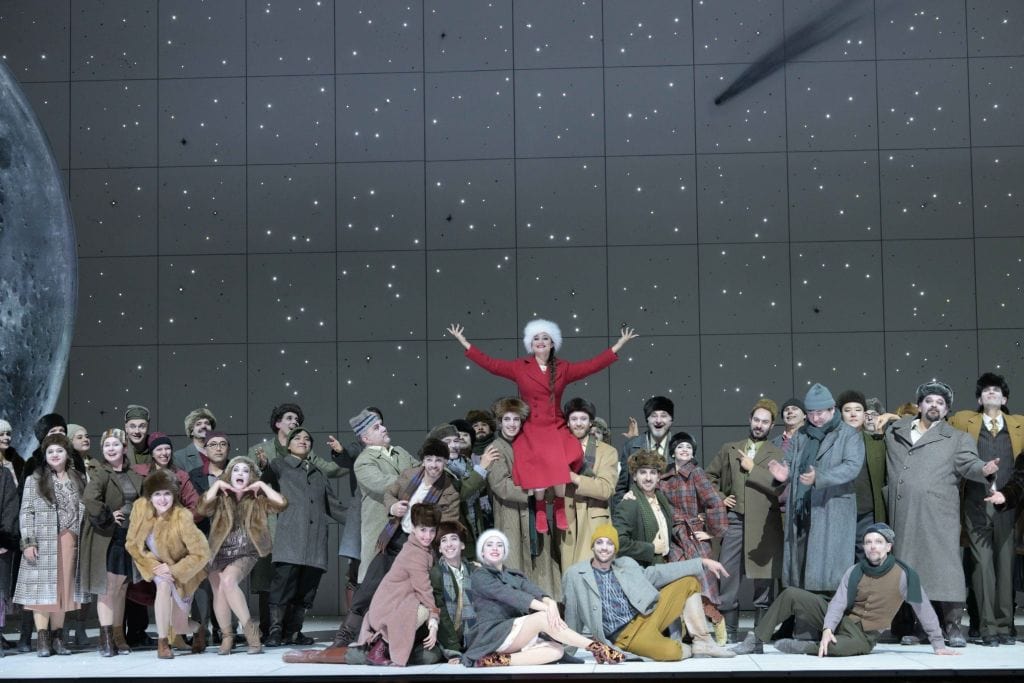
Nikolai Rimsky-Korsakow is perhaps best known for the popular "The Flight of the Bumblebee" and few people realize that it is a fragment from one of his imaginative operas, The Tale of Tsar Saltan. It is gratifying that the Muntschouwburg has both this opera and The Golden Cockerel in its repertoire, but we did not want to miss the opportunity to see The Night Before Christmas at the Frankfurt opera.
Naval officer becomes composer
Nikolai Rimsky-Korsakov was born in 1844 into an old but impoverished noble family. He was destined for a career in the navy. He receives training at the cadet school in Sint-Petersburg and music is a passionate pastime. He does receive piano lessons and in 1861 joins as the youngest member of the "Mighty Handful", which includes Modest Moessorgski, Cesar Cui and Alexander Borodin. After completing his naval studies, he travels around the world for about two years. On those journeys he is fascinated by all sorts of natural phenomena and cosmological occurrences. This has an impact on his opera narratives.
Fairytale fantasy and color richness are the two main characteristics of his work, whether it is the symphonic suite Sheherazade or his fifteen operas. In his operatic oeuvre we find historical drama alongside fairytale, magic play alongside legend and satire. He composes no opera set in realistic everyday life with intimate emotional events, as Peter Tsjaikowsky does in Eugen Onegin or Pique Dame. No passion, no exploration of psychology, but he chooses for a fairytale tone, the fantastic, nature painting and the mystical.
The Night Before Christmas, a fantastic love story
The Night Before Christmas is based on stories by Nikolai Gogol that contain motifs from Ukrainian folklore and blend events from everyday village life with fantastic elements. The story takes place on Christmas Eve. In the Ukrainian village Dikanka, the blacksmith Wakula is head over heels in love with Oksana, the daughter of a landowner. She will only marry him if he can give her the golden slippers of the tsarina. In despair, Wakula calls upon the help of the devil, who helps him fly to the capital, but of course has false intentions. But upon arriving at the tsarina, she gives him her most beautiful pair of slippers. Back in Dikanka, Oksana regrets her strict condition and realizes her love for Wakula. Now nothing stands in the way of their marriage.
Nikolai Rimsky-Korsakov interweaves Christian Christmas celebrations with pre-Christian customs of the winter solstice. Thus, behind the reality of village peasant life with its songs and dances appears a second archaic world. The Kolyada songs of the winter solstice give Rimsky-Korsakov the opportunity for colorful, vital scenes. Nature magic, conjuring of the supernatural and musical folklore – such as in the dance of the stars or the witch's ride – are a typical aspect of Rimsky-Korsakov's style, alongside poetry and drastic humor.
Chistoph Loy: once again a fantastic director
It is a perfect fit for director Christoph Loy. This production (in Russian) of Die Nacht vor Weihnachten in Frankfurt is once again proof that Christoph Loy understands the spirit of the work he stages and stages it with mad inspiration but always with respect! The curtain of the stage is for the occasion a cosmic scene with celestial bodies and stars. Loy thus refers to the natural phenomena that inspire Rimsky-Korsakov for the color richness and the play of light that he transforms into sound in his operas. It stimulates the fairytale fantasy with which the production is full. The characters who receive a characteristic intonation in the music, Loy portrays with the right diversity and fantasy, such as the simple Wakula and the complex witch, the delightfully attractive girl Oksana and the evil devil. And indeed the witch can fly on her broomstick and together with the devil traverse the airspace. There is no shortage of acrobatics, what a feat by the actors!
At the same time, the staging shows that Nikolai Rimsky-Korsakov is anything but a naive fairytale teller, for the wickedness of people also comes into play, for instance when Oksana's rival bewitches Wakula that he can never obtain the tsarina's slippers to have a chance at his bride. In the scene where the witch Solocha and the devil conspire against Wakula and repeatedly stuff the arriving guest in a sack, Loy fully exploits the story for mockery, humor and satire. Equally, the happy ending receives a delightful portrayal, funny and touching.
Compelling musicality
This production was first seen in 2021 in Frankfurt and was then lauded by Opernwelt as "production of the year". At this revival, young conductor Takeshi Moriuchi takes the baton and makes it a musical feast with the orchestra. Each scene receives its proper orchestral intonation, from exuberant to serene, from devilish to heavenly, with the accent on emotional cello in Oksana's beautiful love declaration. The solo parts are performed by singers from the ensemble of Oper Frankfurt and it speaks volumes about the wealth of talent present there. Polish soprano Monika Buczkowska-Ward sang Oksana with a crystal-clear voice, Enkelejda Shkoza was a chilling witch (Solocha), Georgy Wasiliev a moving Wakula. The folk scenes that Rimsky-Korsakov paints with musical color richness are delightful choral passages.
Let us turn to the important musicologist of Russian music Richard Taruskin: "Rimsky-Korsakov is a composer who is not easily transplanted. But for those who approach him with the proper openness, it can be the most exciting and compelling music in the world". In doing so, Taruskin calls upon intendants, dramaturgs and directors to bring his work into the spotlight!
[embed]https://youtu.be/9sRrmyU86eY[/embed]