
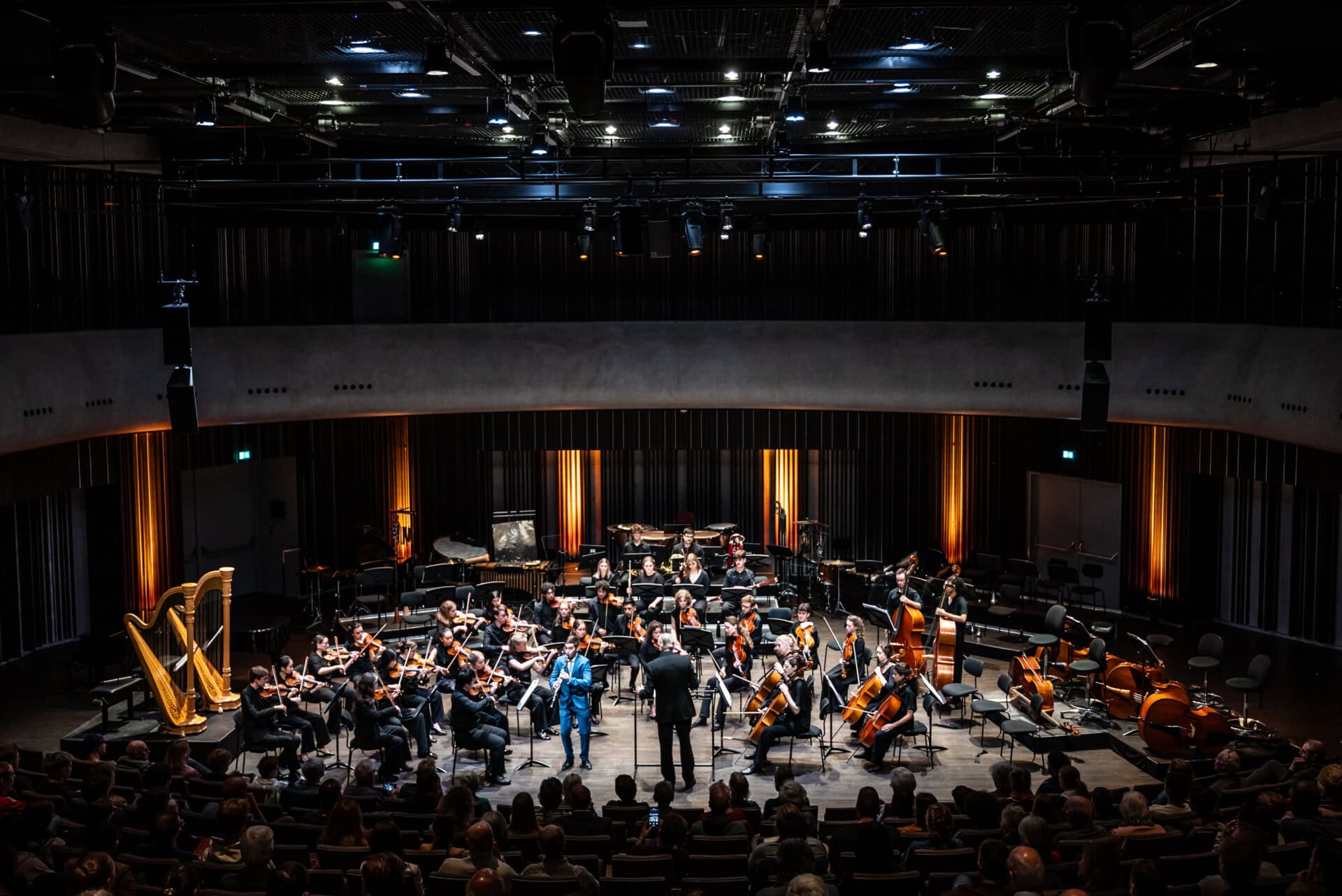
At Amare, The Hague, a concert took place on Friday, October 10 that was more than a program: Flame of Genius – an invitation to introspection, surrender and listening with open senses.
Under the inspiring direction of Jac van Steen, the Symphony Orchestra of the Royal Conservatory The Hague brought to the warm, cordial atmosphere of the Conservatory Hall a program that testified to courage and dramaturgical intelligence. No seduction through virtuosity or orchestral classics, but an invitation to listen – deeply listen.
The simplicity of the heart
The concert opened with the beloved Clarinet Concerto by Wolfgang Amadeus Mozart (1756–1791) – a work in which melody is not ornament, but revelation. In this last completed composition by Mozart, the music seems to encompass everything: joy and loss, surrender and comfort.
José Montero Mora, clarinetist and student at the Royal Conservatory, took the stage without bravura, but with a natural presence that immediately inspired trust. From the first measures it was clear: this would be no virtuosic demonstration, but a reading from within.
His tone was warm and bright, his phrasing gentle without dissolving. In the slow middle section – the captivating Adagio – his clarinet floated like a voice between heaven and earth: no pathos, no effect, only musical truth. Mora proved himself here as a musician who understands that Mozart demands simplicity, but never naivety. Also in the finale, with its dancing rondo form, he remained light-footed and lyrical – a dance that barely touched the ground.
The orchestra embraced the soloist with refined transparency. Woodwinds and strings breathed with the clarinet in a dialogue that felt natural and fragile. Thus emerged a Mozart that did not shine in order to shine, but whispered in order to touch.
Ritual of breath
After Mozart's human simplicity came Spiri I: Stained Ritual – the first part of a trilogy in which sound, breath and spirituality flow into each other. The South Korean composer Seung-Won Oh (°1969) departs from the primordial concept of spiritus – Latin for breath, life breath. From that stem spring words such as spirituality, inspiration and respiration – all expressions of life that moves between inhaling and exhaling, between beginning and end.
That principle forms the core of her trilogy Spiri: three orchestral works that together form one breathing cycle, but can also sound independently. The music does not merely want to sound, but to breathe – as a living organism that constantly changes, dissolves and is reborn.
A chaconne of five notes forms the focal point of the entire trilogy: a simple motif that transforms endlessly, each time from a different perspective. In Stained Ritual, that sound world is still being built up: the base tones of what will later flow together. The work is less a story than a process – a ritual of sound, time and transformation.
The title refers to a ritual that is not pure or unspoiled, but stained – marked by human experience, breath and fragility. That idea took shape in the bell motif, which sounds like a heartbeat through the score. The bell, with its natural resonance and slowly fading sound, became a metaphor for the arc of life: birth, adulthood, decay – and rebirth. Each bell stroke recalled the transience of mankind and at the same time the eternal cycle of existence. The bell moved from instrument to instrument, like a ritual echo of question and answer: sometimes anchored, sometimes unsettling, sometimes fragile and lyrical, then again startled by massive, dissonant outbursts.
After this hushed, almost meditative space, a contrasting section suddenly broke open: brassy, pulsating, almost dancing. Here the music seemed to draw from nature itself – from the overtones of resonance, from energy that passes into vibration. Van Steen led the whole with controlled intensity: the music was allowed to breathe freely, but lost its tension nowhere.
Slowly everything returned to the beginning: the bell, the breath, the ritual. Two chords found each other, harp, percussion and piano released their last energy, and the brass let a soft, melancholic chorale descend on a G major cadence – as a moment of enlightenment. What lingered was an echo, an aftermath that suggested both conclusion and continuation: the breath paused for a moment, but did not stop.
Louis Andriessen, her teacher in The Hague, once told her: "You don't know why you compose." That was a problem she had to solve at the time. Now it seems the answer has been found: Oh composes to listen to what lives between sound and silence – to the breath itself.
Her music builds a rare bridge between Eastern stillness and Western architecture, between ritual and structure, between contemplation and control. Spiri I: Stained Ritual proved to be an intriguing first step in a larger sound universe.
A composer to keep following – with growing interest.
Earth that breathes
Finally: Anton Bruckner (1824-1896). The First Symphony, in its Linzer Fassung (1866) – the original and most unvarnished version – is perhaps the purest expression of Bruckner's early spirit. No smooth revision, no later self-doubt, but a robust, sincere creation. The Linzer version shows the composer as a man of deep conviction, seeking structure, seeking direction – and yet already in contact with something greater than himself.
Jac van Steen understood this symphony as a growing organism. His choice for flowing tempos and breathing phrasing gave the music a natural tension, without the architecture becoming blurred. In his reading, the symphony was not a structure, but a landscape – with cloud formations, threats, refractions of light.
The opening immediately set the tone: C minor does not sound like struggle in Bruckner, but as a fundamental note. There is something earthy about this movement, something that slowly rises, carried by the brass players who sounded warm and majestic in this performance. The strings – lightly tense, but clear – gave weight to the inner conflict that runs through this early Bruckner.
In the Adagio, a kind of musical state of prayer unfolded – the orchestra did not play for the audience, but with the work. A soft violin line could expand into a chorale, a lonely horn could suddenly fill an entire space. In the Scherzo, something of storm, of nervousness, sounded for the first time – but van Steen tempered the rhythms without diminishing them. And then the finale: not triumph, but a slow ascent towards clarity.
Herein lay perhaps the most moving aspect of this performance: that young musicians played Bruckner without bombast, but with reverence. That they, guided by a conductor who understands what it means to build with sound, dared to slow down, to wait, to listen. In this performance of the Linzer version, not the master of later times came to life, but the man Bruckner – tender, wavering, great in his attempt at meaning.
Afterglow of a flame
Flame of Genius was not a spectacle, no sea of fire that stirred the hall, but a flame – fed by concentration, sensitivity and curiosity. A flame that did not burn exuberantly, but glowed: beneath the surface, quiet, inescapable.
Whether it was the crystalline simplicity of Mozart, the spiritual breath of Seung-Won Oh or the sacred breath of Bruckner – this concert proved that genius does not have to be loud. Sometimes it is a tremor in space, a silence between two phrases, a glance upward.
Not every section played flawlessly – the strings could still grow with Mozart – but the pleasure in playing and the dedication with which every orchestra member played made this an exceptional concert experience.
Thus the Koninklijk Conservatorium Den Haag showed itself not merely as a breeding ground for talent, but as a laboratory of the spirit. And that is perhaps the highest goal of arts education: not merely to learn to play notes, but to learn to carry music.