
"Die sieben letzten Worte unseres Erlösers am Kreuze", in English officially called 'the Seven Last Words', are the last words, actually seven short utterances, sentences, that Jesus is said to have spoken on the Cross. Joseph Haydn (Austria, Rohrau, 31 March 1732 – Vienna, 31 May 1809) received the commission to translate these words musically from the Spanish patron Don José Sáenz de Santa María, marqués de Valde-Íñigo.
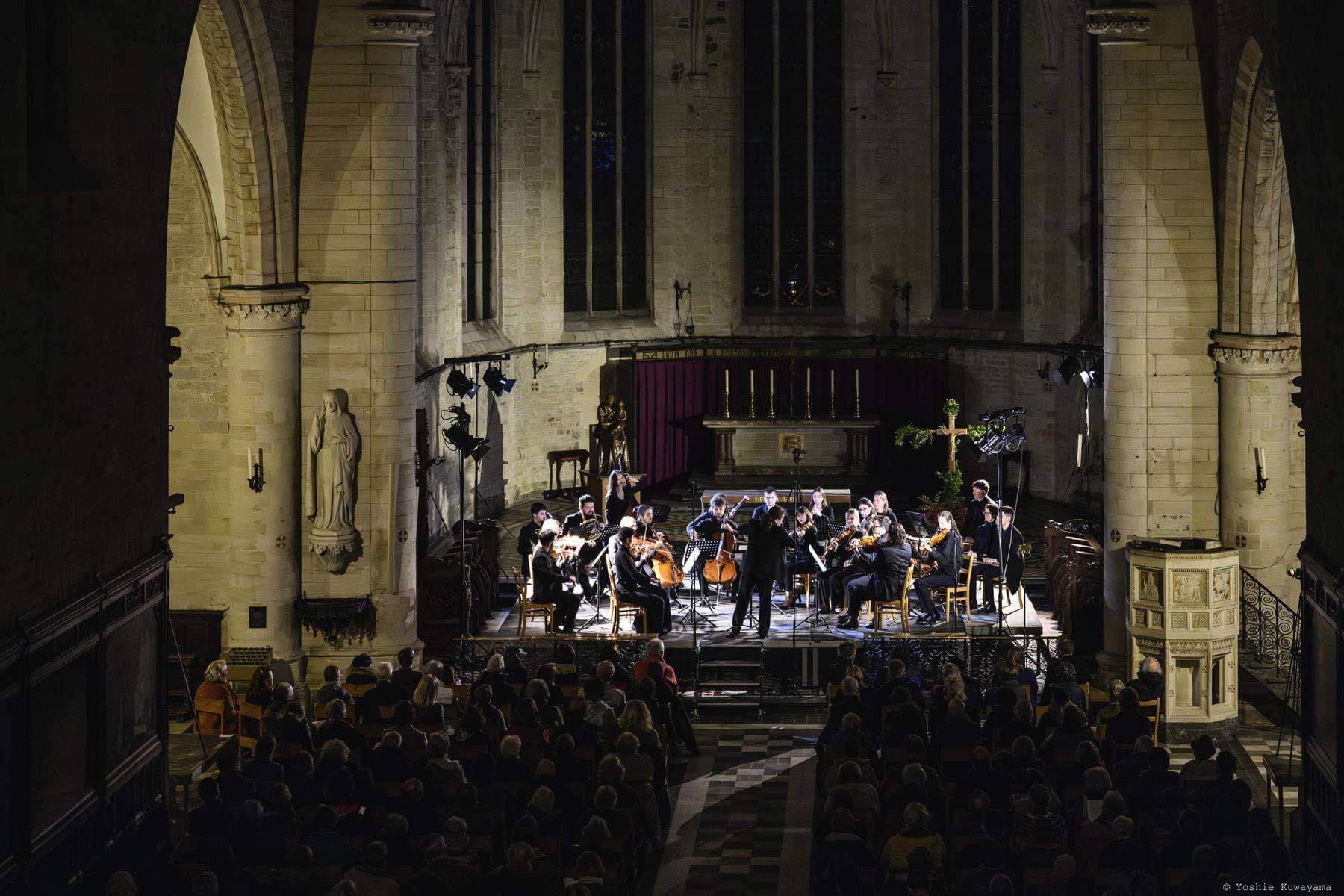
Haydn wrote two of the four known versions: one for orchestra and one for string quartet, although there is doubt whether Haydn wrote them at all. Not much later a version for piano appeared and some time later he heard one for orchestra and choir on his return journey from London to Vienna in Passau. Haydn was charmed by this, took the score home with him and began to improve things, but so seriously that it became a genuine composition and the text of Domkapellmeister Joseph Friebert from Passau was thoroughly rewritten by baron Von Swieten. For the first two versions by Haydn there is doubt about whether the earthquake, which the work ends with, came from his hand. You could write a book about it, but we'll stick to the orchestral version here, the first composed, albeit with the earthquake, which was performed in the abbey church of the Ter Kamerenabdij in Elsene (Brussels).
No better location imaginable: the surroundings of the abbey with the very last remnants of nature of what was once roughly the centre of the Ter Kamerenbos, most of the abbey buildings in 18th century Austrian baroque style and especially the gothic, simple chapel. One of the best concert halls for intimate religious music. That I had to discover this only now. My cheeks are blushing with shame…
It is, at least for myself, a Good Week to musically address you formally. There was the opening with the St. John Passion by Adriaan Willaert by Dionysos Now! and then followed this oh so beautiful, meditative concert by the Etesiane orchestra under the direction of Gabriel Hollander. Meditative, certainly through the content of the words, which were delivered by Walloon actor Bruno Georis (in French) in a text by French abbé Jean Pierre Nortel. It is a bit of a pity that the actor stood on the already small stage to declaim instead of taking a seat in the pulpit, which would have been an ideal setting for this. It would also have emphasised the atmosphere even more. But so be it.
Let us now present the Seven Last Words, read them and listen to a recording of this work. You don't have to be a pillar-biter to be moved. There is something universal in the feelings that Jesus, so nailed to the cross, experiences. He is on the one hand that Son of God and on the other hand so human. He knows what his mother, like every mother, experiences when a child of hers dies. His despair, his thirst, his resignation. Haydn was very good at characterising the state of mind in the various slow sections. Because of his pleasant nature, this work is perhaps somewhat too gentle, too friendly. Try waiting for your death like that, despised, humiliated, tortured, spat upon. Then you would actually expect somewhat more extreme rebellious, desperate, fatalistic melodies and harmonies. But Haydn remained himself and opted for more resignation and acceptance of fate without theatricality.
- Father forgive them for they know not what they do. ...
- Truly I say unto you today you shall be with Me in paradise. ...
- Woman behold your Son, Son behold your Mother. ...
- My God why have you forsaken Me? ...
- I thirst. ...
- It is finished. ...
- Father into Your hands I commit my spirit.
Gabriel Hollander conducts his young ensemble, this time no full chamber orchestra due to literal space limitations on the stage, very faithful to the score. This makes this fragile and very difficult to perform music not only clear, balanced and transparent, but you are also drawn into the event that in the Christian world led to what we know today as Good Week. For centuries it has strongly influenced and shaped our culture and society. It gave us many beautiful works of art in music, word, image. At such a moment I might perhaps want to be a monk in an abbey. It does affect one, the poignant story, the wonderful music, the intimate and yet grand surroundings… All in all it was an inspiring musical evening worthy of repetition.
Gabriel Hollander and his young project ensemble Etesiane orchestra can be followed on his website. There you will also find information about upcoming concerts.
- WHAT: Die sieben letzten Worte unseres Erlösers am Kreuze, Joseph Haydn
- WHO: Etesiane Orchestra conducted by Gabriel Hollander
- WHERE & WHEN: 25 March 2024, Ter Kamerenabdij, Elsene (Brussels)
- PHOTOS: © Yoshie Kuwayama