
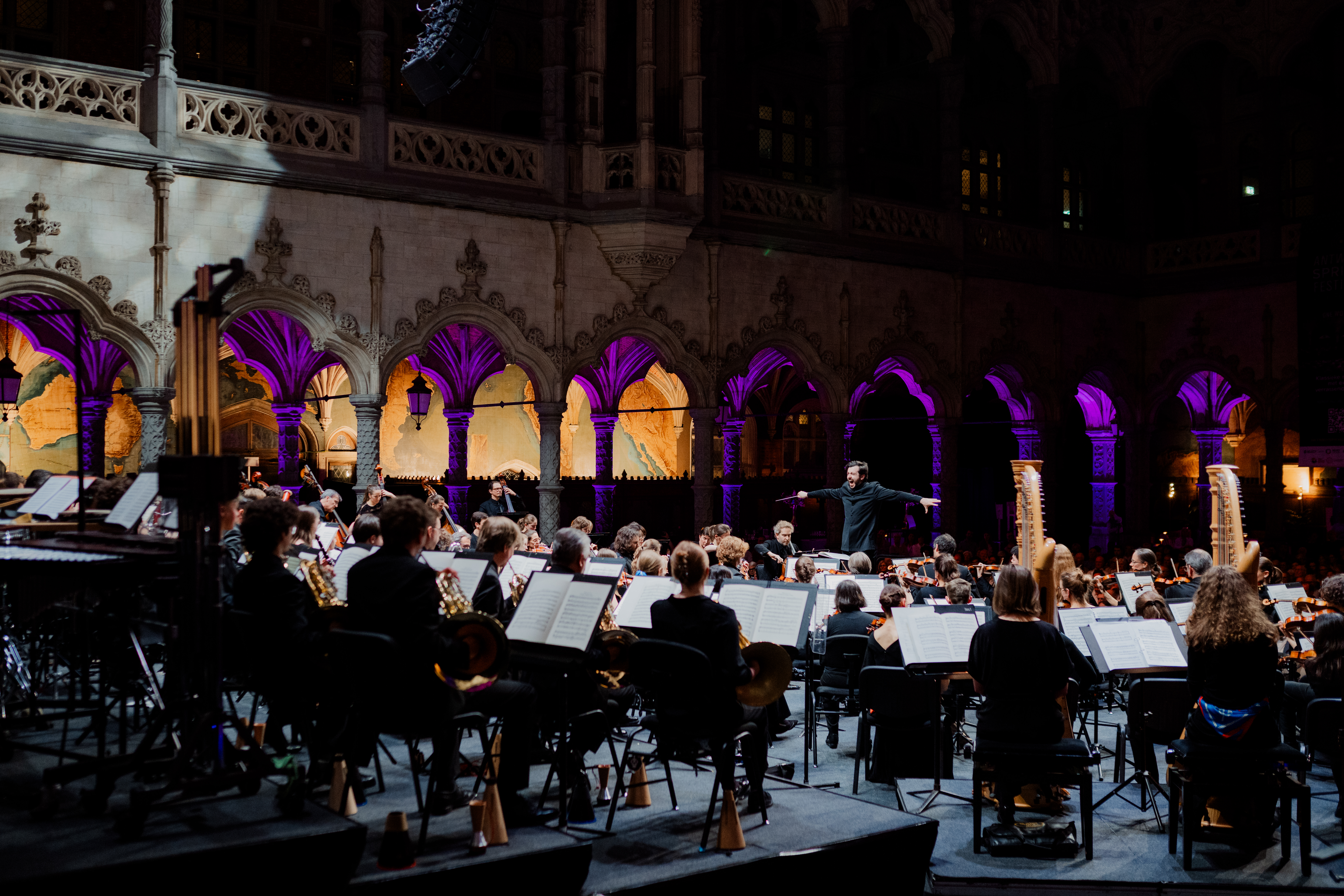
With The Planets, the Antwerp Spring Festival 2026 confirmed its ambition to be more than a classical concert programme. The programme – from Joseph Haydn (1732-1809) via Frederik Neyrinck (°1985) to Gustav Holst (1874-1934) – unfolded on Thursday, 23 April as a carefully constructed trajectory from primordial state to cosmic imagination. In the Handelsbeurs Antwerpen, that narrative gained not only a historical resonance with Symfonieorkest Vlaanderen (SOV), but also a distinctly contemporary expression.
Crucial to this was the role of chief conductor Martijn Dendievel, who approached the programme as a single continuous dramaturgical arc. In Haydn's Die Vorstellung des Chaos, he opted for a clear, transparent reading in which the music gradually ordered itself from apparent arbitrariness. At the same time, it was palpable that the orchestra was still finding its place in the space of the hall in the opening phase. Environmental sounds – the clinking of glasses and a rather pronounced air conditioning unit – made concentration far from self-evident. However, as the performance progressed, it found more focus and the tension building came into its own.
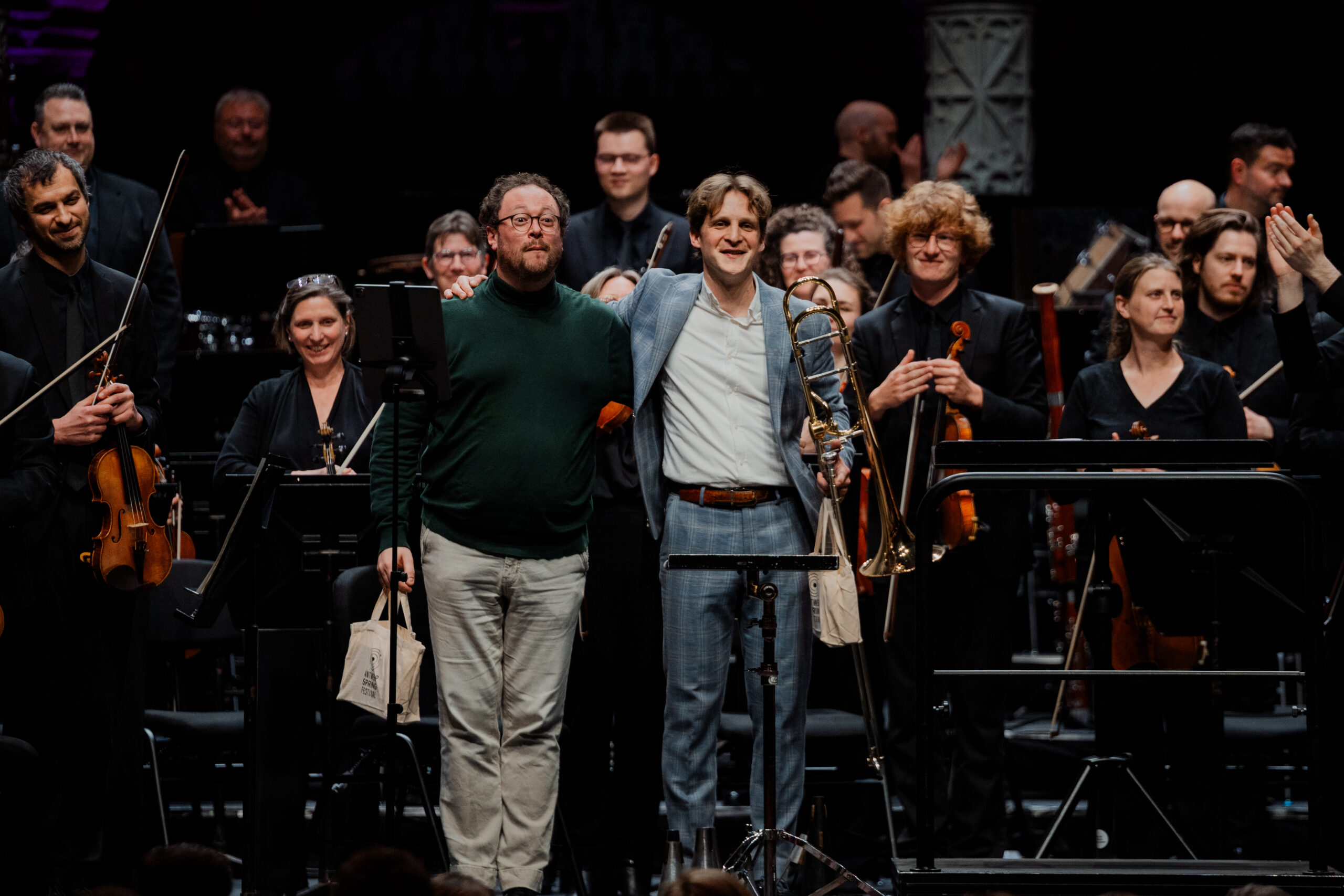
During the world premiere of Okapi, Frederik Neyrinck's trombone concerto, thinking in sound and space received a contemporary and particularly convincing translation. The work departed from an explicitly spatial concept: alongside soloist Bram Fournier, two additional trombonists were positioned on the first floor, resulting in a layered sound field in which echo, resonance and movement were central. Neyrinck approached the trombone as a multiple voice, separate from the traditional contrast between soloist and orchestra, and rather as part of a dynamic network of sound relations.
This yielded a richly nuanced listening experience in which timbre and space were constantly in dialogue with each other. The tension building unfolded in a more associative than linear manner, which gave the work an open and imaginative quality. This was also the greatest strength of Okapi: in the direct sensory impact and in the way it drew the listener into a sound world that gradually unfolded.
Fournier proved to be the ideal interpreter for this concerto, which seemed almost written for him. With playing that was simultaneously physical, expressive and refined, he drew a remarkably broad palette of colours from his instrument: from raw, grainy textures to silken lines and surprisingly subtle colour nuances. He gave the work form from within and made the versatility of the trombone tangible in all its facets. At the same time, the orchestra stood out for its rhythmic precision and clear coordination under the direction of Martijn Dendievel. Subtle reminiscences of jazz from the 1920s and influences from the musical tradition gave the whole an extra layer, keeping the concerto engaging from beginning to end.
After the interval, The Planets by Holst took their place as a culminating point, with Symfonieorkest Vlaanderen expanded with SOV Young and the women's choir of Octopus. No fewer than 28 young musicians took their places among the permanent orchestra members (56 musicians), resulting in a remarkable symbiosis between experience and youthful energy. The fact that the orchestra continues to take on this role and actively works on the integration of young musicians underscores the importance of such initiatives for the future of the Belgian musical landscape.
In Holst's cycle, Dendievel opted for a reading that placed clarity and structure at the centre. The interplay was polished and engaged, although in the more melodious sections there was here and there somewhat of a lack of typical English phlegm. Some lyrical passages, such as the well-known hymn in "Jupiter", sounded rather sturdy than sustained, with a slightly militaristic undertone. At the same time, there were plenty of moments that were quite convincing, with nicely worked lines and a warm orchestral sound in more contemplative passages. The finale with the ladies of the Octopus choir provided a pleasant disconcerting, almost esoteric atmosphere that worked well within the acoustics of the hall. Unfortunately, here too the final bars were somewhat disturbed by environmental sound, preventing the restrained effect from having the intended deep impact.
Taken as a whole, this concert demonstrated how consistently a programmatic idea can be carried through, from Haydn's creation chaos via Neyrinck's contemporary sound exploration to Holst's cosmic visions. The trombone concerto in particular stood out for its imagination and richness of sound, while the collaboration between permanent musicians and SOV Young proved not only artistically fruitful, but also emerged as a convincing model for the future.
The fact that all this came together in the Handelsbeurs Antwerpen, a space that allows both grandeur and intimacy, gave the concert an added dimension. In this way, the project gained form not only in the score, but also in the performance: music as a shared trajectory, carried by different generations and voices, and therein lay the lasting artistic added value of this evening.