
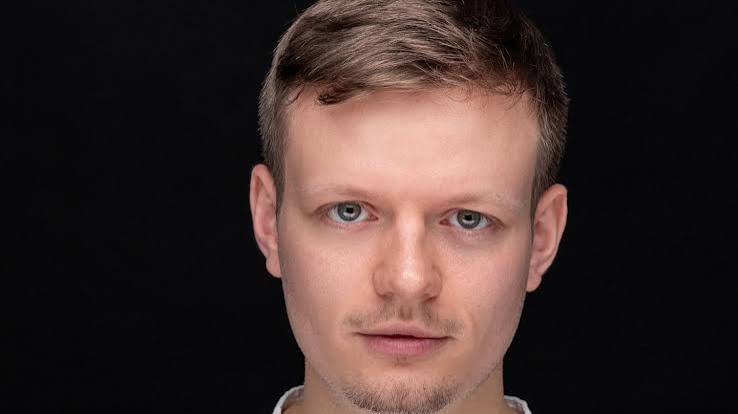
During an Orgelführung in the Berlin Marienkirche, I became acquainted with organist Xaver Schult in April. He took me through the history of the instrument, but I had not yet heard him play. I was delighted to accept his invitation to listen to him at the organ on Thursday, August 6, during the Berliner Orgelsommer. After days of tropical temperatures, an organ concert titled Wassermusiken could hardly have been more appropriate. It turned out to be a particularly well-conceived programme, in which each work connected to the theme in its own way, sometimes very directly through the title, sometimes rather through the musical images it evokes. The water would flow and splash during the concert, then grow still or develop into a violent storm.
Präludium G-Dur by Nicolaus Bruhns (1665-1697) sounds like a spring emerging: crystal clear and mobile from the first notes, with individual voices clearly distinguishable and the sound steadily developing further. With Passacaglia d-Moll by Dietrich Buxtehude (1637-1707), the character changes. The continuous movement sounds somewhat more restrained, as if the water settles after its initial turbulence. Schult's unadorned registrations and subtle accents ensured that the contrast with the preceding piece worked well.
During the Choralfantasie An Wasserflüssen Babylon by Johann Adam Reincken (1643-1722), it became clear how much knowledge Schult possesses of both the score and his instrument. I did not know the work, but it immediately became a convincing introduction. Based on the familiar chorale, based on Psalm 137 – the lament of the exiles by the rivers of Babylon – Reincken built an extensive fantasy in which the chorale melody constantly takes on new forms. At approximately twenty minutes, it is also the longest piece of North German Baroque – a scope that in Schult's performance, however, never makes the work heavy or tedious. The chorale comes to the fore at times and then seems to lose itself in a rich interlacing of voices. That is precisely where the strength of this interpretation lay: Schult did not make a demonstration of what the organ can do, but brought the different layers together into a moving, sometimes almost reflective sound experience. Each new turn opened a new perspective, and it was precisely in the finer nuances – a restrained registration here, a subtle transition there – that the music gained meaning without ever becoming ostentatious. Schult told me that this is one of his favourite works, and that was also evident in the way he performed it.
A striking step away from North German Baroque followed with Ave maris Stella by René Vierne (1878-1918), the brother of the well-known French organist and composer Louis Vierne. The time jump is considerable, but musically the choice proved to work well. The work begins restrained and almost still, only to develop into a veritable drama: the music gradually gains tension and movement, as if the Star of the Sea appears above a turbulent sea while the storm slowly subsides. Schult built up that development patiently and knew how to beautifully bring out the different timbres of the organ. For me, too, this was an unknown work, and precisely because of that, this performance became a surprising discovery.
With Wassermusik by Georg Friedrich Händel (1685-1759), the theme came to life very literally. Schult chose the third suite rather than the most obvious sections and made his own organ transcription of it – a fine find. Where Händel's original Wassermusik is written for winds and strings, here a single organist must bring together the different voices, colours and musical functions. Schult did not simply try to imitate the orchestra, but let the music speak from the possibilities of his own instrument. In his thoughtful transcription, the different layers remained recognizable and the music gained its own colour, without really missing the somewhat airier, dancing suppleness of a string ensemble.
And then there is, of course, Johann Sebastian Bach (1685-1750). In the Pièce d'orgue BWV 572, the water seems to splash from the first notes: lively and playful at first, steadily becoming more powerful, until it finally develops into a veritable storm. Schult started firmly right away and built up that development further without forcing the effect, so that the increasing power felt natural and the tension was palpable in the hall. Thus Bach's work formed a worthy conclusion to a programme in which water had constantly taken on a different musical form.
The Marienkirche and its organ proved to be an ideal combination throughout the evening. The space gives the sound sufficient time to develop, while the instrument allows for a remarkably broad palette of colours and dynamic transitions. From the most intimate moments to the monumental outbursts, the sound remained clear in the space, without the church or instrument ever seeming to dominate the music.
As an encore, a surprising transformation followed: Le Cygne from Le Carnaval des animaux by Camille Saint-Saëns (1835-1921). Here too, Schult showed how to translate a composition for your own instrument. The cello, which we associate so naturally with this work, was hardly missed: the swan song took on an entirely distinctive form on the organ, soft and sustained, and formed an almost unexpectedly restful end to a concert that had been in motion so often before.
After the tour in April, I already knew that Xaver Schult knows his instrument inside and out; after this concert, it became especially clear how deep that knowledge goes. In a carefully compiled programme, he not only showed the versatility of the organ, but above all how differently music can make water sound. From the first emerging spring in Bruhns to the storm in Bach and the quiet swan of Saint-Saëns: the water kept flowing throughout the evening.