
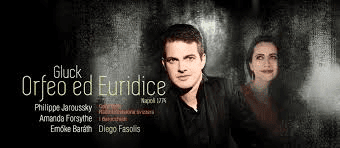
**** In his latest recording, Philippe Jaroussky takes on one of the most beloved musical icons: Orfeo, the singer who brings his beloved Euridice back from the dead. In doing so, he shifts slightly forward in time, from baroque to classical. Of course, it is his umpteenth brilliant role.
Christoph Willibald Gluck is known in music history as the composer of Reform opera. He had enough of singers embellishing their parts solely to show off the vocal acrobatics of their voice and wanted every inflection and color to have dramatic meaning and to depict the psychology of the character. Orfeo ed Euridice is a reference work in this regard. Gluck was assisted by his librettist, the Neapolitan Raniero de Calzabigi, who was familiar with the "tragédie lyrique" of Lully and Rameau.
The mythological story of the lovers Orfeo and Euridice is of course well known, with the tragic ending that Orfeo cannot resist the temptation to look back to see if his beloved is indeed following him out of the underworld, and loses her a second time. In Gluck's version, following the opera tradition of the time, there is a "lieto fine", a happy ending: the lovers are rewarded for their absolute faithfulness and Amor allows them to leave Hades together.
At the premiere in Vienna in 1762, Orfeo was sung by a male alto castrato, Gaetano Guadagni. Today the role is usually performed by a mezzo or alto, or very often, and as in the case of this recording, by a countertenor. Jaroussky states that the legendary figure of Orfeo fasccinates a singer in a special way. "He is half-human, half-god and he uses the power of his voice to win over the Furies as he enters the underworld. It gives the character a different dimension compared to other opera roles. If the voice sounds Orpheus' divine aspect, then his human aspect is represented in his doubt."
Irresistibly brilliant
That Jaroussky is one of the most talented countertenor voices of the moment is undeniable. The way he also voices the increasingly intense emotions of Orfeo on this recording is admirable. From the moment his lament in the first scene interrupts the chorus with the yearning exclamation Euridice, you are captivated by his tragedy. You feel the tension that drives him to win back his beloved. The thinness of his extremely high voice reinforces the mournful quality, but in the first scenes it does tend towards monotony. In the aria in the fifth scene Che puro ciel, che chiaro sol, the voice is as pure as the sky it describes. There is intense sorrow and fear, although for me this perfect countertenor voice often has something artificial about it. From the sixth scene onwards, when Orfeo, accompanied by Euridice, sets out on the way out of Hades, the performance is irresistibly brilliant. You share in Orfeo's tension and fear, his forced pseudo-indifference and Euridice's incomprehension. The color laid into the voice there emphasizes the words and heightens the meaning, for example in the famous aria Che farò senza Euridice. Gluck as he dreamed it, I suspect.
The two other performers are also excellent. Emöke Baráth has an even high voice with great expressivity. She brings the story to life and you believe in her warning. Amanda Forsythe is tender and fragile as Euridice. Moreover, the Coro della Radiotelevisione Svizzera is magnificent, with a delightful harmony between the different voices and with much interaction with the soloists. As expected, the orchestra I Barocchisti under the direction of Diego Fasolis plays nimbly and rhythmically, but with great refinement. The instruments often play a concertante role with the voice and thus become, as it were, actors in the story themselves, which is particularly evident in the aria Che puro ciel. The chorus and orchestra certainly have an important share in the overall result of the recording. The quality of the recording is so strong in itself that it hardly matters that Fasolis and Jaroussky have chosen here the version that was performed in Naples twelve years after its premiere in 1774. Euridice has a different aria in the sixth scene Tu sospiri…ti confondi, which replaces the original Che fiero momento and was meant to serve the coloratura soprano Anna de Amicis Buonsollazzi. The duet Vieni appaga il tuo consorte was also changed, albeit not by Gluck himself. Thus Erato in a sense has a world premiere with this recording of Gluck's Orfeo ed Euridice. Those who wish to see the opera in this version live and staged in a production by Robert Carsen can do so at the Théâtre des Champs-Elysées in Paris and the Opéra Royal in the Palace of Versailles.
- WHAT: Christoph Willibald Gluck (1714-1787) | Orfeo ed Euridice
- WHO: Philippe Jaroussky, Amanda Forsythe, Emőke Baráth, I Barocchisti cond. Diego Fasolis, Coro della Radiotelevisione Svizzera
- RELEASE: Erato 0190295707941