
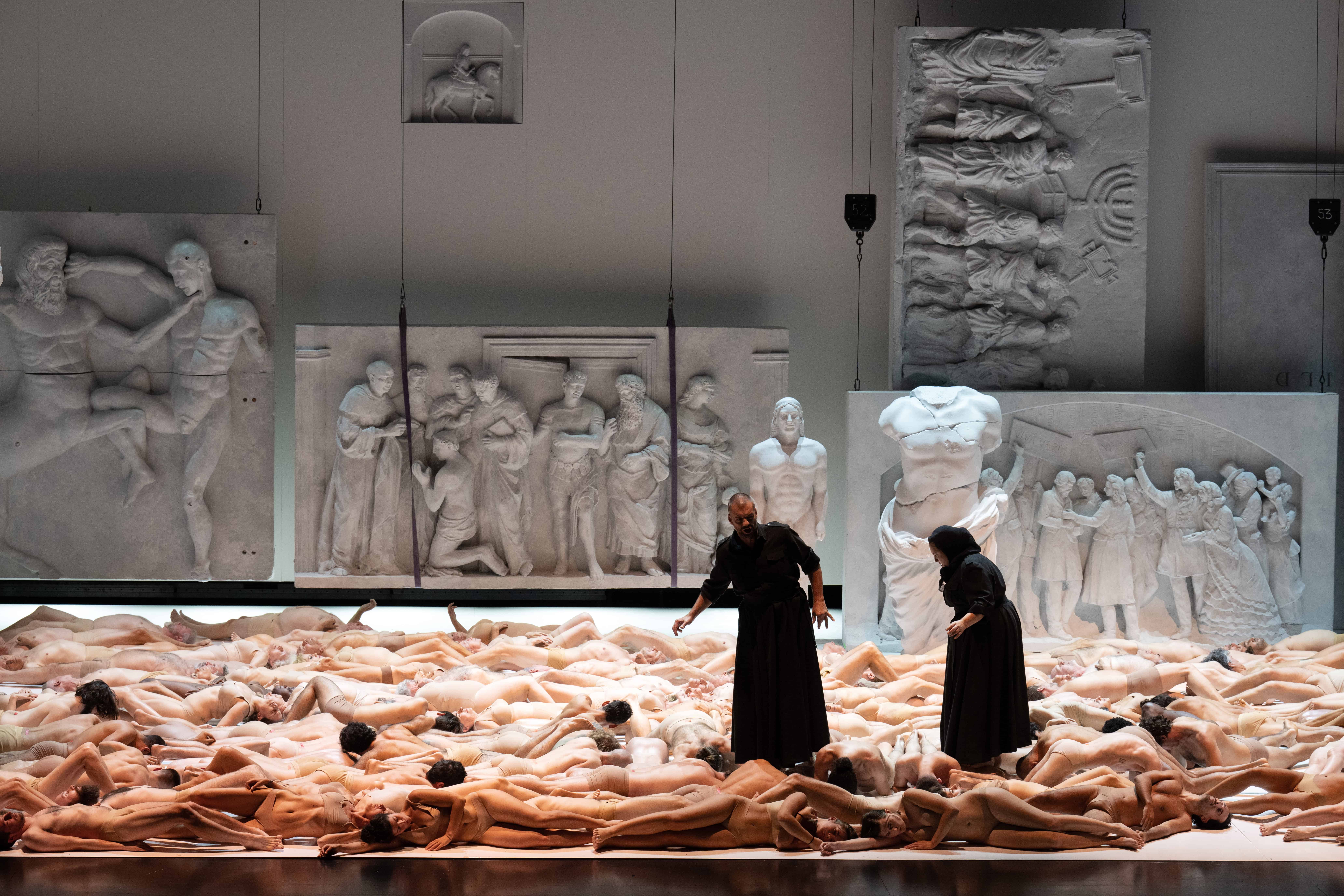
It has been since the eighties that Richard Wagner's discussed Ring cycle (1869-1867) was performed at the Munt. Almost half a century ago, that counts for something.
On 24 October 2023, the Munt and director Romeo Castellucci joined forces to give Das Rheingold (1869), under the direction of Alain Altinoglu, a timeless interpretation. The tetralogy Der Ring des Nibelungen (anno 2023) starts here with the musical creation of the one Ring.
One Ring cycle to rule them all
Although the renowned Germanist J.R.R. Tolkien, author of The Lord of the Rings, always denied that his work was influenced by Wagner, the Ring cycle seems to be a kindred spirit in thematic terms: the corruption of all things. Weakness and temptation – depicted abstractly in black at times – spares no one. Erda, sung by mezzo-soprano Nora Gubisch, even comes at one point to prophetically warn Wotan (bass Gábor Bretz). A curse rests upon it that will corrupt everyone outside the original maker, in this case the dwarf Alberich (tenor Scott Hendricks), and drag them into misfortune – even gods. This speaks to how desire can be all-destructive. Hidden with the Rhine Maidens (soprano Eleonore Marguerre and mezzo-sopranos Jelena Kordić and Christel Loetschz), the gold had a safe haven, but without love, magic quickly turns to destruction. The Ring here is the catalyst between good and evil.
The play of leitmotifs
That Tolkien is brought up is not without reason. Both he and Wagner drew their mustard from Germanic folklore and legends – including the epic poem Beowulf (10th century). The similarities come because they draw from the same source, but the intention stops there.
Wagner is the father of Musikdrama and thereby one of the greater influences on cinema development. His use of leitmotifs has a great effect on today's generation of film composers. An example of this? The masterful music of film composer Howard Shore for Peter Jackson's The Lord of the Rings (2001-2003). The basis of this? Tolkien's opus. Although motifs are nothing new, the parallels between the use of leitmotifs as "saying the unspoken" in music are strongly present in Shore's compositional techniques – this including the Ring motif.
With this I mainly want to say: Wagner still has a lasting, even growing, influence. That is a legacy – despite all controversy – that should not be forgotten. And discussing the Ring cycle without touching on the influence of the Leitmotiv? Impossible.
Power corrupts, also in Wagner
It is difficult to perform a work by Wagner without having to touch on the history surrounding the person and the use of his work and musical philosophy by Nazism. The Death of the Author (theory Roland Barthes) is applicable, but certainly not a sinecure. Yet this seems to be precisely what Castellucci wants from the audience, also for his own productions. He also says this when discussing Das Rheingold. This theory amounts to the interpretation resting with the audience, independent of the author's idea. Giving power to the viewer ensures that the work is not tainted by any negative ideas or influences from the original source. Does this work for Das Rheingold and the cycle in general? Yes and no. Outdated thoughts, such as the almost willing weakness of the female goddesses in abduction and deceit, are something that the libretto simply makes difficult to mask. By treating it as a timeless product, which Castellucci also does, the story as a whole becomes a vision of the past, present and future. That partly removes it from the history of the source (Wagner) and places it with more positive influences from the past. More on this in the next part.
WHAT: Das Rheingold (1869) by Richard Wagner (1813-1883) WHO: Alain Antinoglu (conductor), Romeo Castellucci (director) Gábor Bretz, Andrew Foster-Williams, Julian Hubbard, Nicky Spence, Marie-Nicole Lemieux, Anett Frisch, Nora Gubisch, Scott Hendricks, Peter Hoare, Ante Jerkunica, Wilhelm Schwinghammer, Eleonore Marguerre, Jelena Kordić, Christel Loetzsch, Symfonieorkest van de Munt WHERE: De Munt/La Monnaie, Brussels WHEN: Saturday 24 October 2023. Production from 24 October 2023 to 9 November 2023 Next opera (cycle): Die Walküre from 21 January 2024 to 11 February 2024