
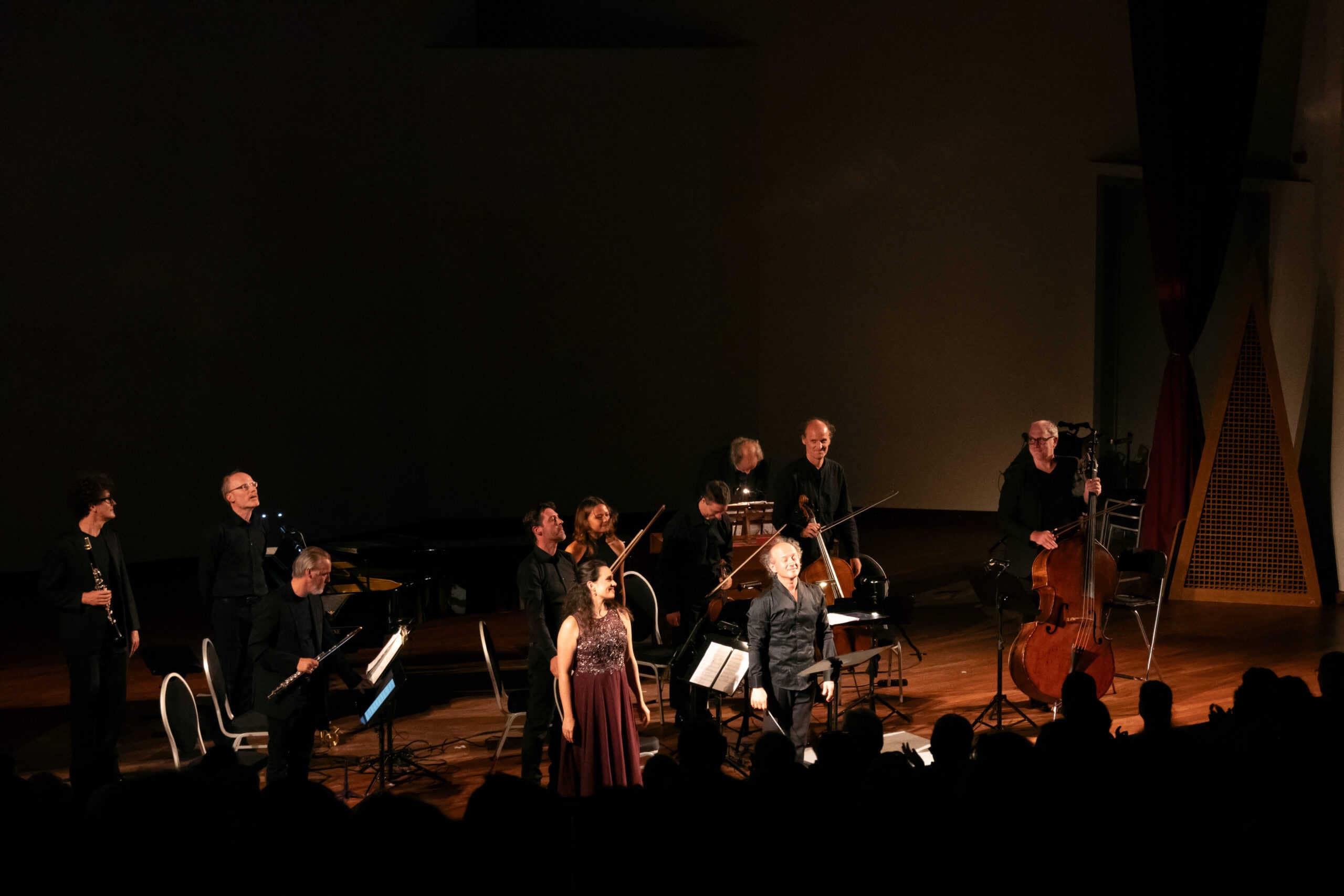
As opening concert, Festival 20·21 brought on 25 September in Leuven a combination that can be described as musically enchanting. The selection of Ferruccio Busoni, Alexander von Zemlinsky and Arnold Schönberg was rooted in twentieth-century music, but with a resounding romantic aftertaste. The end result was a successful performance by Het Collectief and soprano Katrien Baerts, under the direction of Ivo Venkov.
A romantic turn
The most striking aspect was the composition of the evening. The three works – the Berceuse élégiaque Op. 42 (Busoni, 1909), the Sechs Gesänge nach Gedichten von Maeterlinck (von Zemlinsky, 1910-1913), and Pelleas und Melisande (Schönberg, 1902-1903) – shared a clear ethereal theme. But, in contrast to their romantic predecessors, such as Gustav Mahler, and even the Russian Romantics (who were certainly not averse to grand musical suggestions in harmony and melody), these composers spoke with a kind of musical imbalance. This in a positive way: the musical noise was exchanged for a tonally ambiguous and harmonically sometimes cutting language. Later generations, such as film composer Dario Marianelli, certainly drew their inspiration from the school of the last romantic gestures. Here, Symbolism became the source. This is clearly evident in the application of texts by the Belgian Symbolist poet Maurice Maeterlinck.
Symbolism works as a unification of the Romantic Sehnsucht from the nineteenth century – the flight from reality to nature – with the reality of the presence of early urbanism. A good example of this is von Zemlinsky's song Die drei Schwestern from the sung song cycle. Three sisters in search of finitude who end up as the final piece in the urban world: Und die Stadt tat auf die Tore/Und mit heißen Liebesküssen/Ließ die Gegenwart sie wissen – the city brings them into the present. And this is characteristic of Symbolism. The early twentieth century was ultimately also that somewhat threatening period in which humanity accelerated in terms of modernity. The conveniences that are commonplace today were for the Symbolists a playground of discoveries.
With this selection, Ne Me Touchez Pas seems to open a kind of window to the past, but with a sense of tension and recognition – the past is not as far away as it seems.
Fatalistic encounters
The Berceuse élégiaque Op. 42 by Busoni was an interesting choice to begin with. A berceuse is a lullaby in its purest form. Het Collectief brought this composition with a gentle integrity. Busoni's Berceuse can certainly be placed alongside Stravinsky's oiseau du feu (1909-1910) – a personal favorite. The hair-fine intensity of such a quiet mystery gave the audience the musical theme of the evening right away.
[caption id="attachment_51185" align="alignleft" width="244"]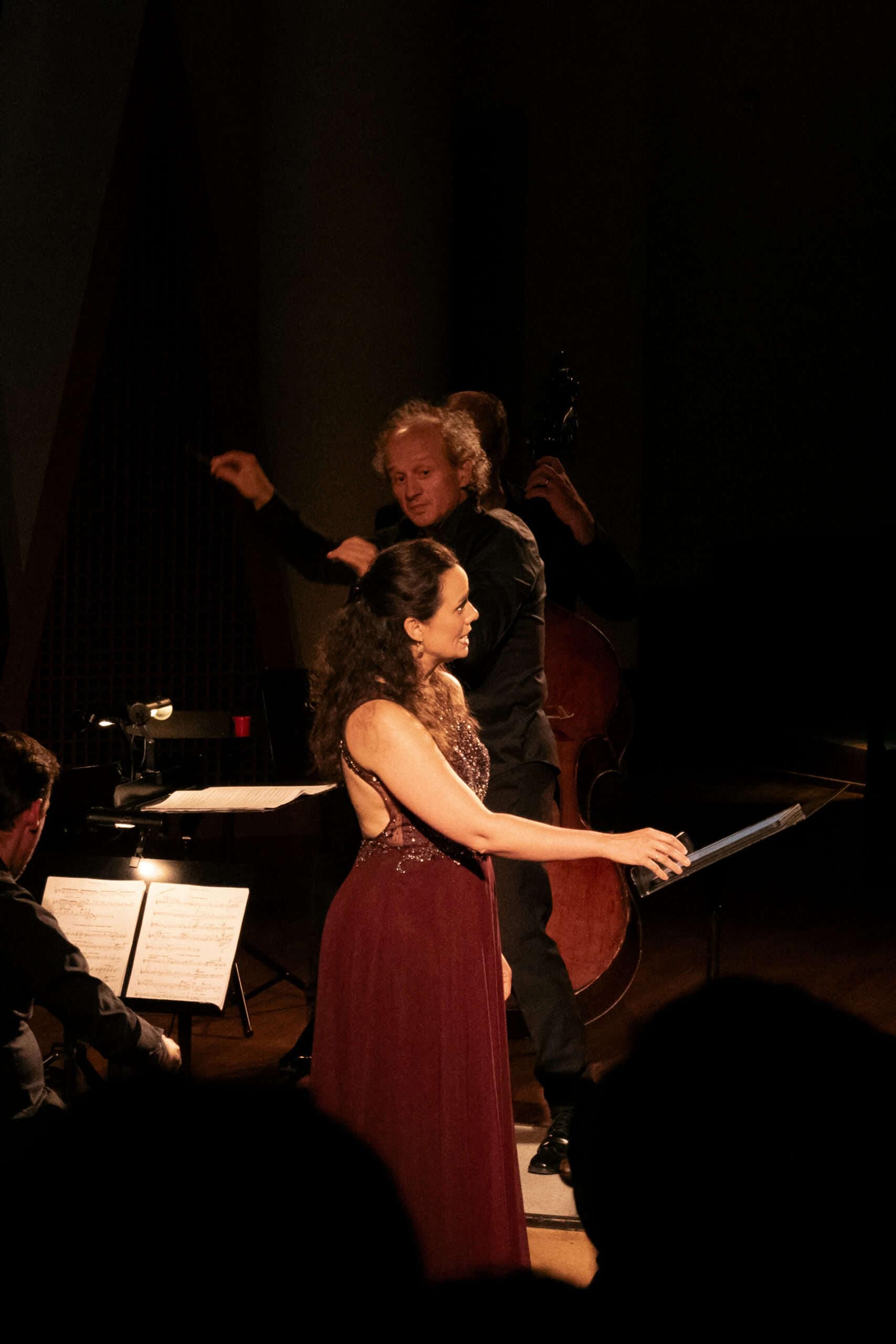 © Helena Gaudeus[/caption]
It was a good preview of the rest of the evening: the songs by von Zemlinsky. Baerts' voice had the fascinating power to be just as loud in the high notes as in the low notes. This is nevertheless, even if it sometimes seems so, not self-evident. Every singer seems to have to make vocal sacrifices somewhere, and in the case of the soprano this is usually the low notes. Something that was also noted by the great master singers, such as American mezzo-soprano Marilyn Horne. In the case of Katrien Baerts, this is absolutely not the case. In one of the songs there was a great tonal distance that went from bright heights to a very sudden depth. To my astonishment, I could pick out the famous bottom resonating perfectly, with a beautiful dark tone: bravo!
The final piece, Pelleas und Melisande, was sublime. Combined with the visual arts of Lise Bruyneel, the ensemble brought the story to life. It is difficult to explain how this composition, which felt like a concentrated symphony, touches you to the core as a listener. For the short duration you are swept from one emotion to the next – supported by the necessary melodic references. Schönberg gives overwhelming musical suggestions, and Het Collectief brought these forward with strong intensity. My recommendation is especially: experience it yourself.
The evening certainly brought forth intense, musical feelings. It was the experience of one myth after another. With this, the starting shot has been fired for what seems to be a fascinating concert series!
[caption id="attachment_51186" align="aligncenter" width="2560"]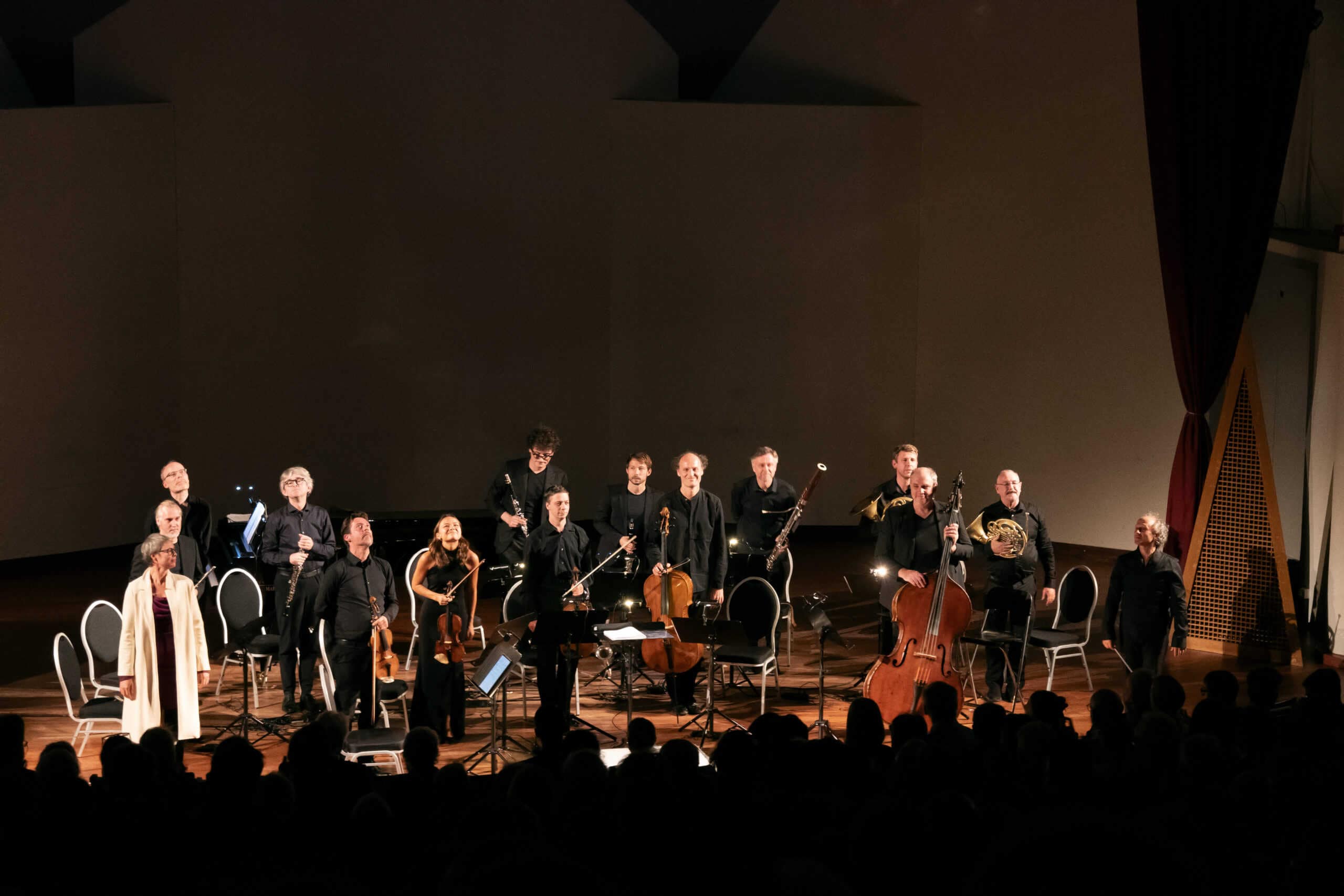 © Helena Gaudeus[/caption]
WHAT: Ne Me Touchez Pas, with compositions by Ferruccio Busoni, Alexander von Zemlinsky and Arnold Schönberg
WHO: Ivo Venkov (conductor), Het Collectief (ensemble), Katrien Baerts (soprano), Lise Bruyneel (video art).
WHERE: Festival 20·21, Leuven.
WHEN: Monday 25 September 2023.