
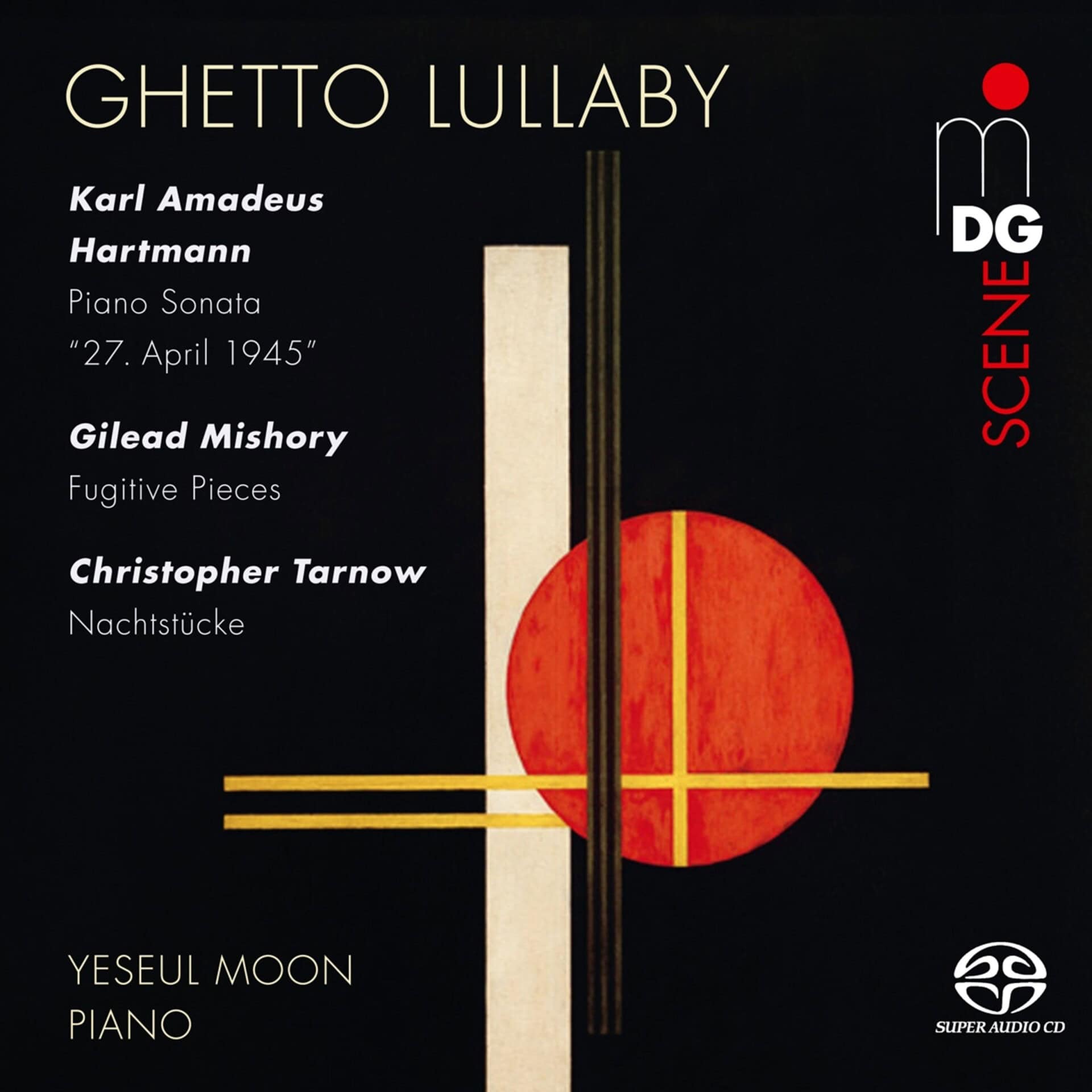
Directly drawing on a horrific event in April 1945, technically almost unplayable and running through all possible stages of human emotion, the piano sonata titled 27. April 1945 is not only a deeply incisive musical example of the human tragedy that Hartmann attempted to transform into moving sounds, as evidenced by Karl Amadeus Hartmann's description in the manuscript:
Am 27. und 28. April 1945 schleppte sich ein Menschenstrom von 20.000 Dachauer Schutzhäftlinge an uns vorüber. Unendlich war der Strom. Unendlich war das Elend. Unendlich war das Leid.
South Korean pianist Yeseul Moon performs on this album the three-movement version revised by the composer in 1947, with the Scherzo from the first version as a "bonus" at the end of the cd. The sonata is also characterized by a number of quotations, such as in the second movement the workers' song 'Brüder, zur Sonne, zur Freiheit' and in the finale 'Partisanen vom Amur', the German version of this Russian war song. In the added Scherzo, the 'Internationale' catches the ear. Gilead Mishory (*1960) composed his immediately striking Fugitive Pieces exactly sixty years later (the album title is taken from the equally named sixteenth piece). The eighteen short pieces are inspired by the eponymous book by Anne Michaels about the fate of Polish Jakob Beer, whose family was murdered by the Nazis. He managed to escape and later was miraculously saved by Greek archaeologist Athos. The (six) Nachtstücke (2012) by Christoph Tarnow (*1984), partly after poems by Hermann Hesse, are hereby released on cd for the first time. What connects these pieces with each other, besides the Holocaust, is the inhumanity of every war. Yeseul Moon proves to be the ideal interpreter of this so moving music.