
The creation of Les Bienveillantes with which intendant Aviel Cahn takes his leave from Opera Vlaanderen, hits hard. From director Calixto Bieito we could naturally expect no casual pictures. Composer Hèctor Parra we get to know immediately with this new opera as an unrelenting sound virtuoso. Fortunately they can work with selected soloists: they make the opera poignantly digestible. Or is it digestibly poignant?
Catalan composer Hèctor Parra (°1976) was prompted by director Calixto Bieito to compose an opera based on the novel by Jonathan Littell, which won the Prix Goncourt in 2006. Librettist Händl Klaus performed the titanic work of adapting the hefty novel into a libretto. Aviel Cahn wanted to bring another production directed by him to the stage at Opera Vlaanderen after Bieito's successes. Les Bienveillantes is not a historically linked story of deportation or holocaust. Yet the characters in it have everything to do with it. The plot is set in the mind of the main character, Max Aue. It is "a descent into the hallucinatory mind of the main character" as the press text says. That character is almost constantly on stage and performs what is – according to his own claim – the longest existing opera role! Max Aue returns in his memory to the period of Nazism, in which he was complicit in the extermination of Jews in concentration camps. It is anything but an anecdotal story of the camps or their victims. It is a "spiritual reckoning" that Max Aue experiences, like a flashback of facts and circumstances leading to those facts. The context is historical, but the story focuses only on the psychology and mutual relationships that Max Aue has experienced. As a spiritual search into one's own past. It may be the miracle of this production - and certainly of the direction and performers - that perhaps because of the cast and decor it hits even harder with the audience.
Concentration camps and incest
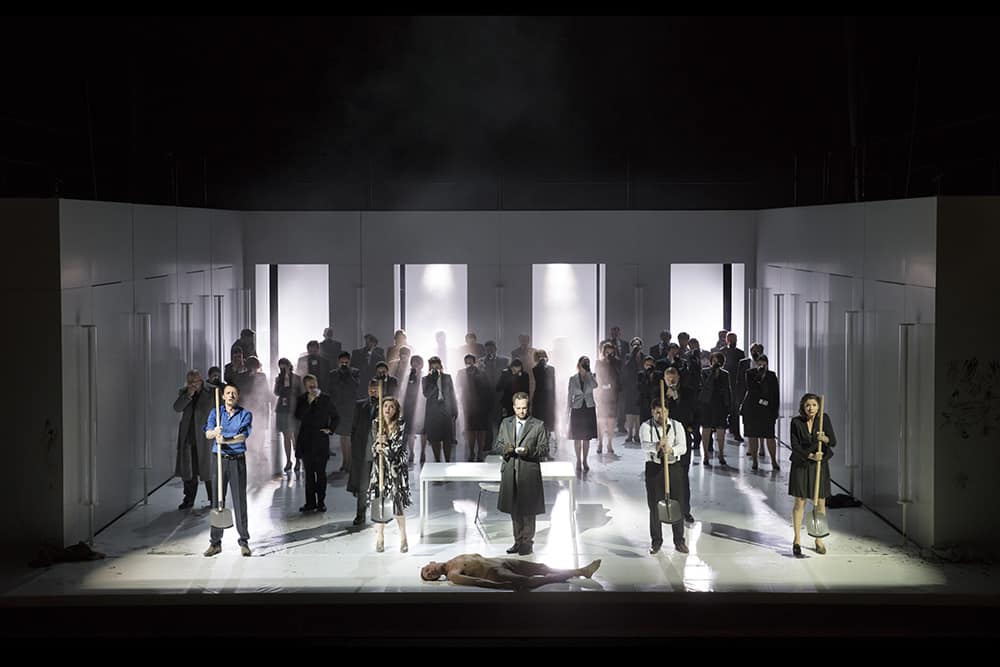
The opera begins with an image of the neat and well-dressed career man Max Aue in a pure white office with cool fluorescent lamps. But once the internal journey of the cultured bourgeois intellectual begins, we soon find ourselves in a (literally) filthy world of brutes, murderers and corrupt beneficiaries. As we penetrate deeper into the life and mind of Max Aue, the opera becomes harder and more biting. Despite his initial outward decorum, we penetrate deeper into the filthy inner world of Max Aue. His childhood tainted by incest with his twin sister, a relationship that continues to dominate his life and is immediately the second main theme in the opera. It is examined in virtually all possible aspects and also receives a visual counterpart with two small twin brothers who make childish fantasy drawings on the now defiled white walls of the set. The sexual fantasies of the terrible camps are also depicted without restraint. The pinnacle is the naked woman condemned to the gallows who becomes an object of abject abuse. A physically demanding performance by the extra!
Physically, there are a few other exhausting postures required, such as the young man who lies dead in the foreground of the stage or Una (Rachel Harnisch) who remains crouched in the long scene (Air) of perverse incest. That Aue also has a (albeit less illuminated or in any case less pronounced) more refined side to his personality must be evident from his (disappointed) desire for music. Bach is his musical idol and he would have liked to become a pianist. It also fits in with the bourgeois milieu to which his parents belong. This (only!) more tender element of the content provides the sublime set image of the piano being lifted almost imperceptibly into the air with pianist included – playing a sarabande from a suite by Bach. Finally a piece of lyricism in the brutal world of Max Aue… A small relief for the audience who gradually hopes for an intermission, literally!
The axe that appears at a few chilling moments in the story provides a clear link to the Greek tragic fate of Orestes, who is expected by his sister Elektra to murder his mother with an axe. It also provides a musical reminiscence of Richard Strauss.
The long scene with the incest story in the penultimate section (Air) is too explicit. As if librettist, composer and director enjoy shoving the pinnacle of perversion down the audience's throat. I cannot compare with the language used in the book, but reading such sexual terms in the privacy of individual reading is different from being confronted with them on stage. It is also a pity that the final scene (Gigue) is drawn out so long, at the end of an already very long sitting. What is supposed to pass for "humor" there does not come across at all after three hours of cruelty, filth and sex, in which there was no light spot or touch of irony or humor. The scene comes across rather as ridiculous and especially inappropriate and tedious. A shame and rather an anticlimax after the built-up tension. Only the "salvation" of Max Aue by the "Benevolent Ones" ("Les Bienveillantes" or the Eumenides from Greek tragedy) then offers a surprising and beautiful organ point.
Musical violence, unique achievement
If the substantive tone and language of the libretto are anything but veiled, then the music also plays the card of excess and violence. Complex orchestral masses and sharply constructed clusters storm relentlessly at the listener. As generously as the filth with which the scene is flooded. The accents that are laid down, however, are clearly dramatically delineated and compelling. The structure is taken from Littell's novel: the movements of a baroque suite by Bach. Bach's St. John Passion also permeates the opera as a layer expressing the suffering of humanity. But alongside the liturgical nature of an oratorio, the structure is also filled with references to Babi Yar by Shostakovich, Wozzeck by Alban Berg (Herr Doktor!), Bruckner, Richard Strauss, Theresienstadt composer Viktor Ullmann, or banal Nazi songs. The vocal language is anything but melodic: the singers must have an exceptional talent for Sprechgesang, but with extremely demanding tonalities and sometimes screaming high notes. Natascha Petrinsky (mother Heloïse) is masterful in this. She admirably masters her dreadful mother role both vocally and in terms of acting. Rachel Harnisch is also phenomenal as Una, Max's twin sister. What Peter Tantsits achieves as Max Aue is unique. He portrays cruelty, dominance, fear, suffering, passion, bourgeoisie, sex and nakedness as if they were all layers of his own personality. Real and without pretense. Vocally and fearlessly physical. Who could ever match this?! The choir plays a very expressive role and, like the orchestra, is masterfully conducted by Peter Rundel. A masterstroke of an orchestra that brings an extremely heavy task to a successful conclusion.
The composer titles his opera as "most terrible crazy project". Indeed! It seems like a punch in the gut from a rebellious departing intendant: see what I still dare to force down your throat …
- WHAT: Hèctor Parra (°1976) | Les Bienveillantes
- DIRECTION: Calixto Bieito
- VOICES: Peter Tantsits, Rachel Harnisch, Natascha Petrinsky, Günter Papendell, David Allegret, Gianluca Zampieri
- ORCHESTRA: Symfonisch Orkest Opera Vlaanderen, Choir Opera Vlaanderen conducted by Peter Rundel
- WHERE: Opera Vlaanderen Antwerpen (until May 2) – afterwards also in Gent (May 12, 14, 16 and 18, 2019)
- WHEN: Sunday April 28, 2019
- PHOTO: © Annemie Augustijns