
As you can read in the review by our contributor Arlette Hellemans, a special benefit concert took place in the Sint-Romboutskathedraal in Mechelen, performed by the Koninklijke Muziekkapel van de Gidsen.
The wind orchestra has existed since 1832 and is thus the oldest professional musical ensemble in the country. One can gradually look forward to the 200th anniversary of this internationally renowned ensemble. The concert opened with an arrangement by Arthur Prévost (9 July 1888 - 10 June 1967) of Johann Sebastian Bach's famous Toccata and Fugue for wind orchestra. A very successful arrangement that can serve as a model for many others.
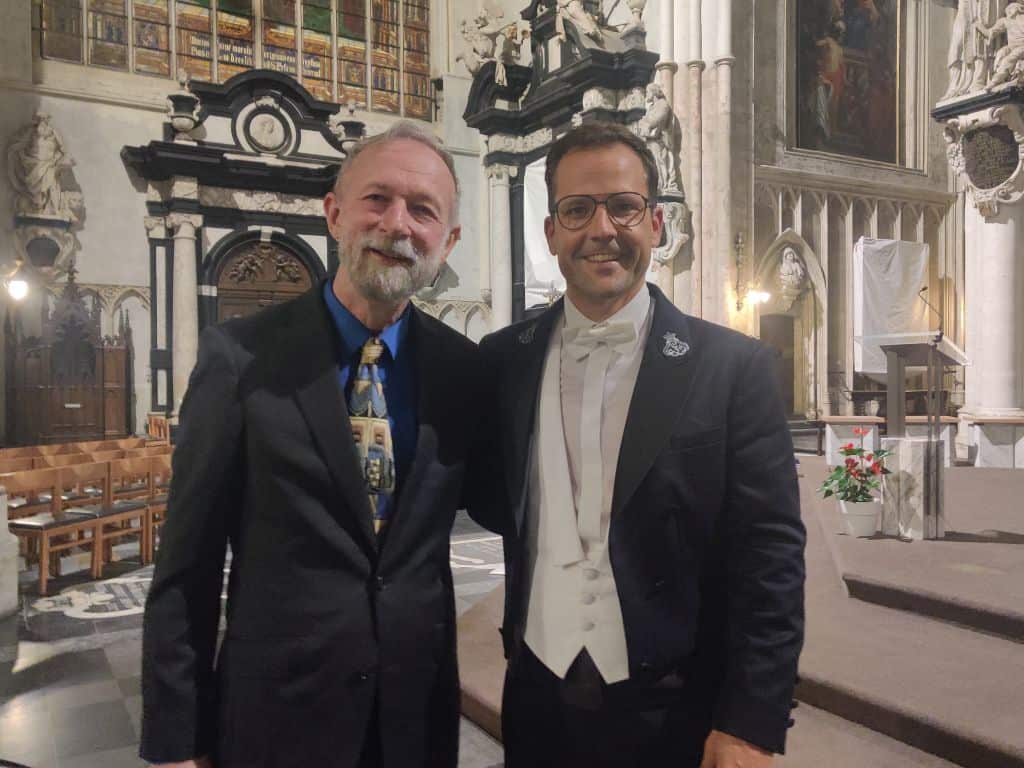
The second work fit within the framework of the concert that commemorated the end of WWII, a war that brought much suffering and where, especially in the case of Mechelen, reference was made not only to the civilian casualties who fell victim to the violence of the German army, but also to the many hundreds who lost their lives in very heavy allied bombings. The composer who was present spoke after the concert, deeply moved by the performance, saying that of all the ensembles he knows – there are many in the US – not a single one would be capable of performing it with such perfect understanding as the Muziekkapel van de Gidsen.
Thus these dead were honoured and for that purpose a new work by American composer Ch. Marshall was chosen. He composed 'Remembrance' in April 2024 in memory of his beloved partner. A work that cuts to the bone, that immediately gives the listener goosebumps. It is very melodic, harmonically warm, dreamy, gripping. You feel the loss and yet the living unity and hope. Pure moving beauty, one great arc full of Love, Love with a capital L.
The Enigma Variations – six of the fourteen were performed – gave a real 'wow-effect'. Masterful. You see a conductor, Yves Segers, at work who experiences along, who transmits, who expresses, who makes the orchestra with the right facial expressions and gestures into a very strong unity that follows precisely in all musical demands. I note very deliberately that this orchestra is perhaps the best large ensemble in our country for all (hafabra) music from the 19th century to now. The Muziekkapel van de Gidsen has always enjoyed international praise and that was and is absolutely justified. The orchestra continues on that momentum. May it long continue to serve music for all the tasks and occasions entrusted to it.
The second work by a contemporary composer that at times almost literally blew you out of your seat – so much force and decibels – was the first symphony 'Symphony Hell & Heaven' by Spanish composer Oscar Navarro (°1981). Brilliant music. He paints an almost frightening difference between heaven and hell, but you also hear the question being posed whether there is anything after our earthly existence and if there is, what is it then? All those familiar questions that everyone asks themselves at some point, he manages to interpret masterfully. You hear an angelus bell, you hear praying religious people, you hear gentle heavenly broad, bound, dreamy phrases and hellish, hot fiery, all-pulverizing sounds of a full orchestra in triple fortissimo. The work ends in a breathtaking apotheosis. So there will be something after all, after our temporary existence in this world?
The concert ended with obligatory march music – it remains a military music corps – of the Belgian army. That a standing ovation followed was the least the audience could do to indicate what a unique evening they had just experienced.