
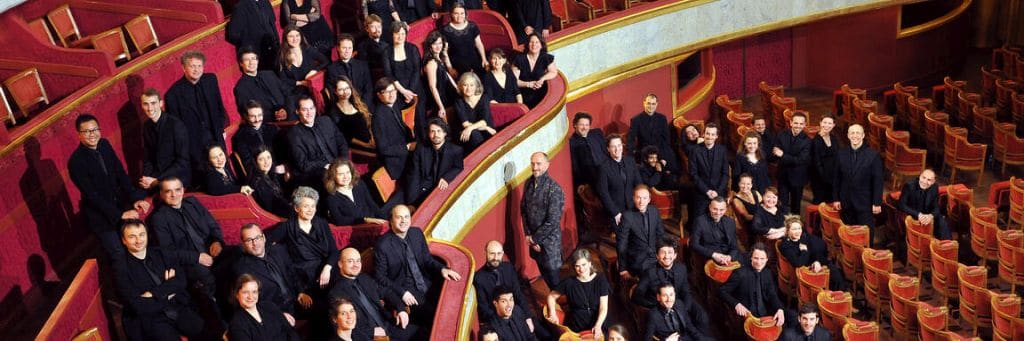
When music by Georg Friedrich Händel (1685-1759) resounds, it is a celebration. With their unmistakable flair for the dramatic, Le Concert Spirituel and Hervé Niquet tackled Sunday, June 29 two monuments from Händel's English period: the solemn "Te Deum for the Victory at the Battle of Dettingen" and the imposing "Coronation Anthems". These works, composed to the greater honor and glory of the English crown and nation, were not merely performed by Niquet, but received a new, playful breath during the prestigious Festival Musiq3 at Flagey.
Niquet's idiosyncratic approach to Händel
When Niquet ventures into a work by Händel, it is not just any interpretation we may expect, but an idiosyncratic, musical journey. As a connoisseur of Baroque music and a passionate advocate of the great Baroque repertoire, he resolutely chose a performance that harked back to the origins, both in terms of orchestration and performance practice. What was particularly striking in Niquet's reading, however, was his aesthetic choice to have the solo parts performed collectively by the choir. This decision is not merely an artistic choice, but a reflection of the ceremonial and theatrical dimension that Händel often weaves into his music.
The choir, which fully embraced its role as a collective, brought extra depth to the text and music, but the English pronunciation still needs some refinement. The alto voices deserve credit, as they came across very beautifully in the solo passages. When strings and choir made music together, the balance was good. When the trumpets and timpani came in, however, they often drowned out the other musicians.
The theme of the Coronation Anthems
The Te Deum was performed in a classical and correct manner, but actually all attention was drawn from the beginning to the second part, the Coronation Anthems. Because the choir performed in summer attire – and Niquet conducted barefoot – and certain rhythms were very dance-like and playful, these lofty anthems were somewhat demystified. The adapted sequence of the pieces is justifiable, because these anthems were played separately at different moments during the coronation ceremony. Content-wise, however, there is a golden thread in the normal order. Actually, these anthems should be performed at every major celebration of democracy, because they form an interesting exercise in reflection for politicians through the clear appeals to those in power contained within them.
First, the anthem "The king shall rejoice" (anthem 3) resounded. The 'salvation' was delivered profoundly; the Alleluia, in turn, received a somewhat mischievous interpretation with an unusual accent on "ha-ha". As if one wanted to sing out the joy / laughter, because a king is here again, or did one want to let off some steam here given the heavy task awaiting the monarch?
Then "Let thy hand be strengthened" (anthem 2) resounded with restraint. For me, this was the best part of the concert. There was a rightful moment of silence and reflection within all the musical festive commotion at "Let justice and judgement be the preparation of thy seat; let mercy and truth go before thy face.", so necessary in our topsy-turvy world!
Subsequently, "My heart is inditing" (anthem 4) was performed very dynamically, but due attention was paid to the closing section, which normally also contains a clear appeal as a final chord: "Kings shall be thy nursing fathers, and queens thy nursing mothers."
"Zadok the Priest" (anthem 1) resounded as the cherry on top at the end. You were surprised if you came listening with the tune of the UEFA Cup in your head. The opening began somewhat dance-like and the entry of Zadok resounded rather restrained and quiet. The first "God save the King" was also sung more softly than usual, only to subsequently develop further in crescendo. This approach was interesting and shed new light on a piece that has been played flat.
Niquet as an impetuous conductor and the balance between humor and seriousness
Niquet fired his ensemble with full dedication, but you did have to get used to the jokes between each anthem (via mime or a remark) which began to bother me as time went on. Niquet succeeded in performing Händel's music not merely with technical virtuosity, but in a new light. It was an exuberant Händel: a symbiosis of grandeur and grace, precision and inspiration. Here, music was not merely played, but came to life as a musical tableau vivant that lifted the listener out of time.