
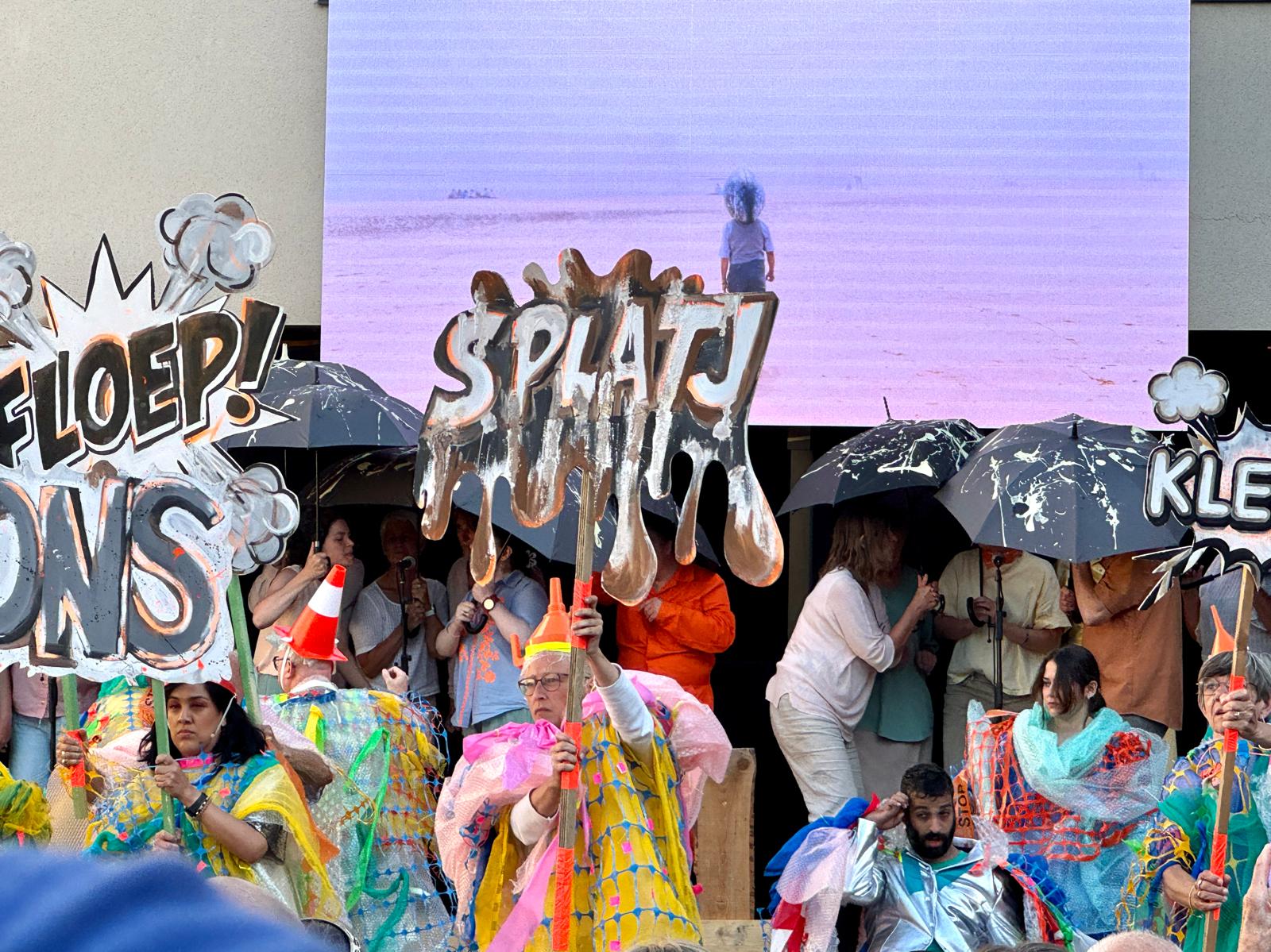
On Friday, August 7, the audience at Theater aan Zee in Oostende received a first extensive insight into Iedereen Meeuw, a participatory opera production that is expected to develop next year into a full-fledged performance. It was unmistakably a try-out: not a finished product, but a snapshot of a long creative process in which composer, theater makers, professional musicians, singers and performers with very diverse backgrounds are searching together for what this opera can become.
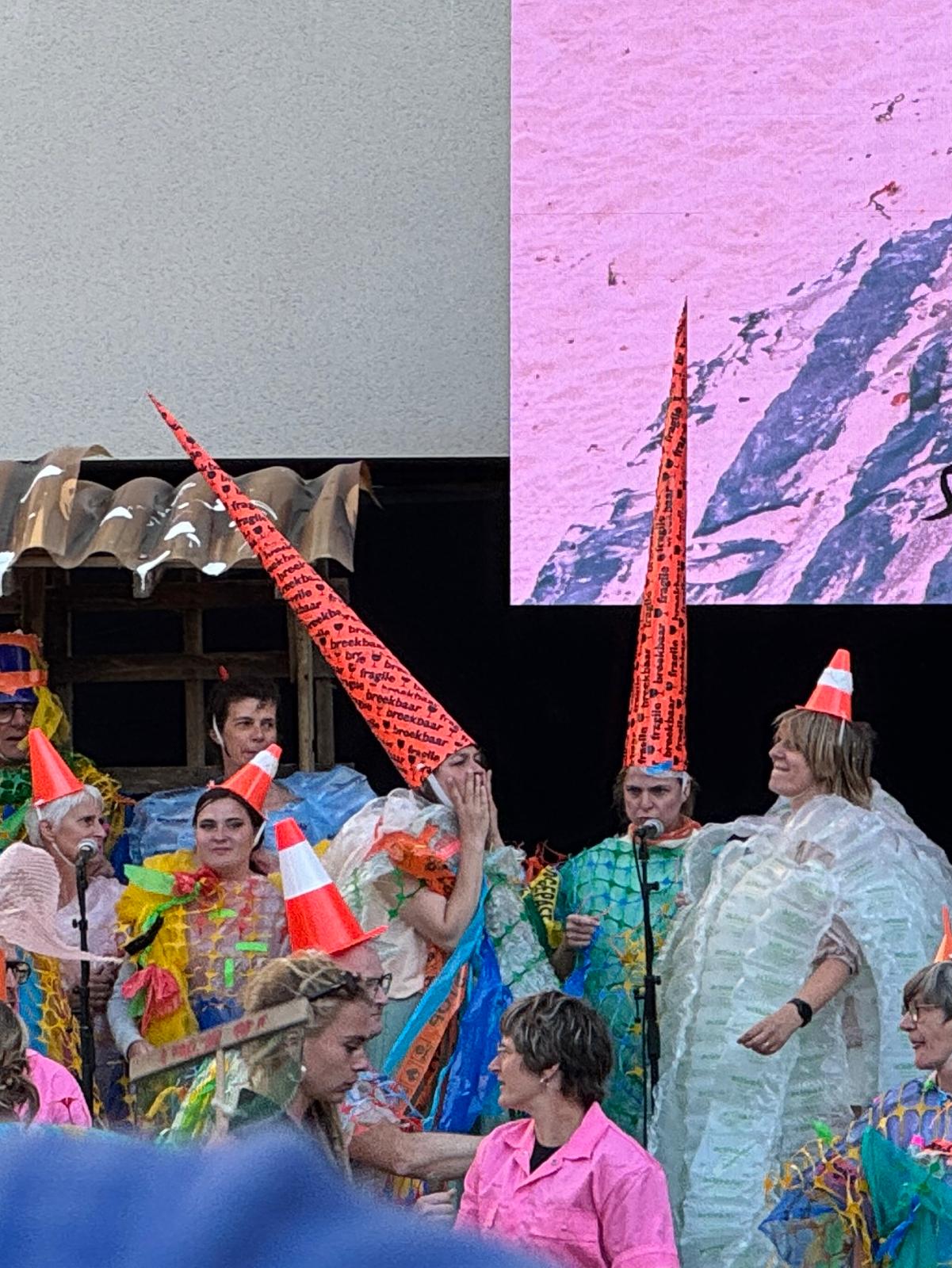 Iedereen Meeuw is produced by the Oostende arts organization kleinVerhaal, in collaboration with an extensive network of organizations that each bring people into the project and guide them from their own perspective. These partners include De Figuranten, Wit.h, Tartaren and the Stadskoor Kortrijk. The latter is led by conductor Diederik Glorieux and forms an important vocal force within the production. The music is by Peter Vermeersch, known as composer and driving force behind Flat Earth Society. Michiel Soete is responsible for the direction, Fikry El Azzouzi for the libretto.
Those who spontaneously think of "participatory opera" as a professional artistic core around which an amateur group is then assembled see only part of what happens in Iedereen Meeuw. The production brings together people who participate from very different positions: some have professional training as a musician, singer or actor, others do not. Some have been on stage for decades, others enter a theater space from a social organization or a choir practice. But during rehearsals, a simple contrast between artists and participants does not simply emerge. Everyone participates from their own expertise, experience, voice and presence.
This makes the artistic construction particularly complex. Vermeersch writes music for a diverse ensemble that includes professional musicians, singers, choir members and performers. Soete directs not only the movements and theatrical situations, but also intervenes during rehearsals in the way texts sound and are sung. The boundary between musical and theatrical direction thus proves constantly fluid. The ultimate form of the performance is also not developed on paper first and then executed by the group. It develops in working with this concrete group of people.
The try-out made clear how much material has already been built up. There is a pronounced visual world, there are group scenes and individual moments, spoken and sung text, absurdity, humor and passages where something much darker seeps in. Central to it is a community of beings that seems trapped in routines: working, cleaning, carrying out what must be done and moving on. "Everything is what it is," it sounds at one point. It is a sentence that seems almost banal, but in the context of the performance increasingly gains weight.
The characters seem to accept a reality that simply is what it is, but at the same time, movement, music, togetherness and sometimes resistance emerge within that very reality. This tension between passivity and action gives the performance a special charge.
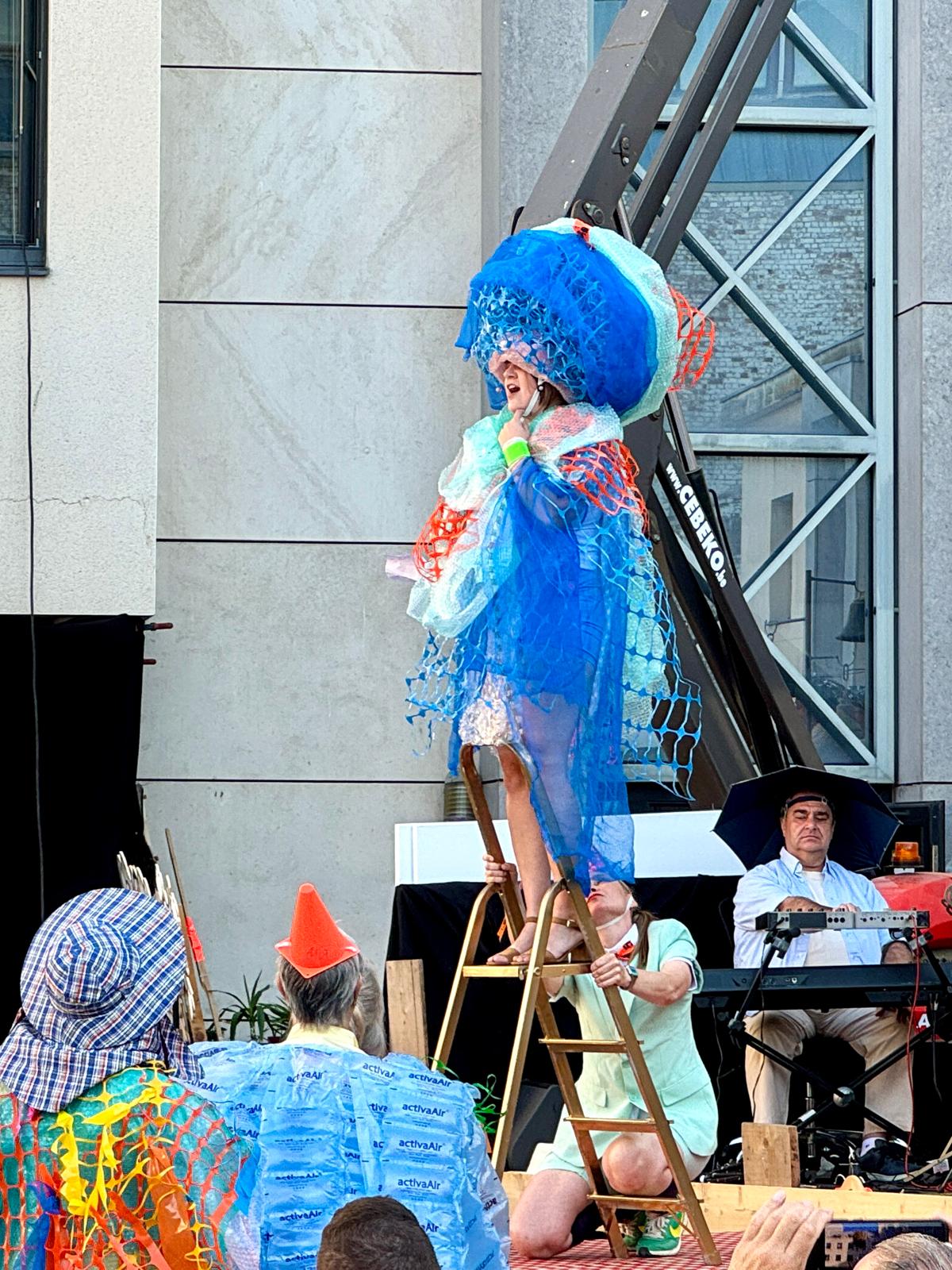 For now, it is still unclear where all this leads. And that is perhaps precisely one of the most interesting tasks for the further creative process. The title, after all, promises that these beings somehow become 'seagull'. During the try-out we saw a community emerge and heard its language and music, but the possible transformation contained in the title remains largely open. What does it mean to become a seagull? Is it escape? Rising above circumstances? Or rather learning to live with what cannot be changed?
That openness does not need to be a shortcoming at this stage. On the contrary: a try-out serves precisely to show where a performance has already developed its own strength and where room remains. What was particularly striking was how much was already there. The size of the group, the differences between the participants and the multitude of musical and theatrical languages could easily have led to a non-committal collage. That did not happen. A world is clearly emerging with its own laws, its own rhythm and an increasingly recognizable universe.
For a project like Iedereen Meeuw, moreover, the ultimate meaning will not lie solely in what the audience sees on stage next year. Equally interesting is how that performance comes about. KleinVerhaal and the partners involved have chosen a long-term trajectory (2024-2027) in which people are not brought together for one production and then disappear again. The artistic commitment consists precisely in searching for ways in which all those different voices, bodies, musical skills and life histories can truly become part of one work of art.
This makes Iedereen Meeuw more than an opera with a social dimension. The central artistic question seems rather to become what happens when the social is not organized around the artwork, but co-determines what that artwork can be.
The try-out ended as an exuberant popular festival. Performers, choir and orchestra launched the catchy final song "Ik ben een meeuw…", and the sizeable audience that attended was happy to be swept along and sang along. It was a simple but particularly effective ending, in which the boundary between stage and audience briefly blurred. The title of the performance thus became almost literally collective: for a few minutes, everyone seemed to be a seagull.