
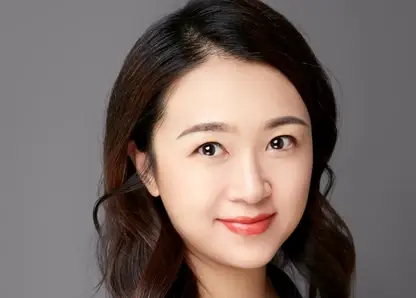
What does composer Zhang Ying want an audience to remember after a concert? Not a label, but a sound that continues to resonate. On the occasion of the German premiere of her Akademische Festouvertüre at the Young Euro Classic festival on Wednesday, August 5, Werner De Smet spoke with her for Klassiek Centraal.
For Zhang Ying, this premiere is not a cultural calling card, but an encounter between different musical traditions. In the conversation, she spoke about her dialogue with Brahms, the role of Chinese tradition in her music, and her conviction that sound ultimately matters more than origin.
Music as dialogue, not as display
Zhang Ying's music is often described as rooted in the Chinese tradition, but now sounds for a European festival audience. For her, that international context is anything but a form of musical export. "For me, this is not simply about 'taking' music into the world – it is rather a natural occurrence of 'dialogue,'" she says. Traditional Chinese culture forms, according to her, "the soil and the roots" of her creative work, but music itself is "a flowing language that transcends geographical boundaries." When she performs for European listeners, she does not want to display 'exoticism': "I rather share a way in which I experience the world." According to her, European listeners moreover possess a particular sensitivity to timbre and spatial silence, something that aligns with certain developments within contemporary Western music. The result is, in her words, not a sense of distance, but "a deep resonance".
From Brahms to her own "academic feast"
The work that will be heard in Berlin, Akademische Festouvertüre, experiences its German premiere there – not its world premiere. After earlier trial performances in China, Zhang Ying regards the version to be heard in Berlin as the definitive and more developed form of the work. The title inevitably evokes the memory of Brahms' famous counterpart. She herself does not describe her composition as a response to or challenge of that work. "Brahms' work with the same title is undoubtedly a majestic peak. My intention was not to 'challenge' it, but to redefine the sound of an 'academic feast' through my own perspective."
Where Brahms, according to her, embodies the dignity and academic tradition of the nineteenth-century German university world, she wants to show the vibrant energy of a contemporary Chinese conservatory, where centuries-old musical traditions and modern vitality coexist. The structure of the work also reflects that personal vision: according to Zhang Ying, the composition unfolds not as a linear narrative, but as five interweaving soundscapes. Sounds reminiscent of metal and stone gradually give way to seeking strings, after which elements from Zhejiang folk music and the singing style of Yue opera are deconstructed into a new sound fabric. Ultimately, everything culminates in what she herself describes as "rising pillars of light," which dissolve in an open echo.
Her work stands in the program alongside Chen Qigang's Er Huang and Bruckner's Second Symphony. Zhang Ying calls that programming "an extremely brilliant choice." In her view, Chen Qigang distills "elements of Peking opera into a pure, introspective sound philosophy," while she sees her own work more as "extraverted" and "festive." Thus, her overture forms, according to her, the ideal beginning of a program that develops from festive energy via hushed introspection to the monumental architecture of Bruckner.
A conservatory as musical home
The collaboration with the orchestra of the Zhejiang Conservatory of Music flows, according to Zhang Ying, from the long-term support the conservatory provides to new compositions by its own teachers and alumni. As one of the first teachers appointed after the founding of the conservatory, she feels honored to be able to compose a new work precisely in the year of the conservatory's tenth anniversary. "My professional career began here, and I have witnessed the development of the Zhejiang Conservatory over the past ten years. In this piece, I have expressed all my feelings and best wishes for the institution." That connection explains why the performance in Berlin is for her much more than a foreign premiere.
About the orchestra itself, which emerged from rector Wang Rui's vision of linking education and platform practice more closely, she says: "Our symphony orchestra is a very young ensemble, but it plays at a remarkably professional level and with enormous enthusiasm for new music." That it is precisely this orchestra that brings her composition to Berlin, she calls personally particularly meaningful. "It is not only the premiere of my own composition, but also a calling card of the artistic and pedagogical level of the conservatory." For her, the ensemble moreover represents a new generation of Chinese musicians who distinctly make their own musical voice heard. "Through their vitality, this orchestra has reminded me that youth itself is a voice worth hearing by the world."
Sound before structure
For Zhang Ying, composing does not begin with form, but with timbre. She describes her current musical language as "perceptible color tonality," a concept with which she wants to make clear that not structure, but the color of the sound is the starting point of every composition. "Timbre always comes first," she says. "I begin with imagining a space." For the third part of the Berlin overture, Lakes and Hills Nourish the Soul, for example, she imagined a misty morning path along the conservatory, sheltered against the hills, where two elegant swans glide silently past. "Only when that inner sound image is vivid enough do I search for the structure that can support it. Structure serves color, not the other way around."
That approach also explains why Zhang Ying places little importance on the question of whether an international audience understands all cultural references in her music. In her view, music is above all a direct bodily and emotional experience. "The essence of music is an immediate transfer of physical vibration and emotional resonance." Whoever is moved by a string passage or experiences rest in a long sustained tone, according to her, does not necessarily need to know the cultural background of the work. "Of course, I hope that listeners will also discover the stories behind the music, but if they are simply moved by the timbre alone, that is already a great success for me."
From the qin to Lachenmann
That Zhang Ying would become a composer was not a sudden calling, but the result of a gradual growth process. She began playing piano as a child and was admitted to a professional conservatory at twelve to study composition. Yet she points to one moment as decisive. In the library, she accidentally heard a recording of the qin, the ancient Chinese zither. That introduction proved to be a decisive turning point for her. The freedom and raw power of the free-rhythmic sanban passages made her realize "that music is not only about rhythm and melody, but also possesses a unique 'resonance charm' (yun)." From that moment on, she tells, it was no longer enough to only perform the music of others; she wanted to create sound herself. That quest for the meaning of sound runs as a golden thread through her artistic development.
When she reflects on her formative years, Zhang Ying mentions two composers who had the greatest influence on her. Ravel taught her "how fascinating timbre can be within an orchestral context", while Helmut Lachenmann introduced her to "a different logic of sound". Besides these Western influences, she emphasizes with equal force the lasting significance of Chinese musical traditions, including qin music, Jiangnan sizhu, Nanyin, Chinese opera and the great songs of the Dong people.
Her daily compositional practice also proceeds without haste, according to her. "My compositional life is quite slow." She prefers to work in the early morning, the moment when her concentration is greatest. Outside of music, she seeks inspiration especially in the world around her. Walking, observing, visiting museums and travelling nourish her imagination as much as scores do. She mentions both visual arts and sculpture as well as experiences during diving and hiking trips. For Zhang Ying, music does not arise exclusively at the writing desk, but equally from attentive looking, listening and living.
Looking Ahead
For many visitors to Young Euro Classic, this will perhaps be their first encounter with Zhang Ying's music. What does she hope they will take away when the final note has faded? Her answer connects seamlessly with everything she said earlier in this conversation. Not her origin, but the sound itself should linger. "I hope that when they leave the concert hall, what remains is not the label of a 'Chinese composer', but a concrete, vivid sound memory – perhaps a beautiful melody, or a powerful, full orchestral tutti." She hopes that her compositions can break stereotypes about contemporary Chinese music "and show that in China, alongside grand narratives, there also exist subtle, idiosyncratic individual expressions."
Her future plans also connect seamlessly with that ongoing search for new sound worlds. She would like to write an opera, "one that uses a thoroughly contemporary sound language, yet is deeply moving." Moreover, she is increasingly fascinated by the encounter between electronic music and traditional Chinese instruments. She wants to explore how the subtle gliding texture of the so-called "walking tones" (zou shou yin) of the qin can find a place within a digital sound world. "The path ahead is long," she concludes, "but I look forward to it with great anticipation."
Those who hear Zhang Ying speak notice how consistently one thought recurs throughout the entire conversation: not identity, nationality or cultural representation are central, but the power of sound itself. Her Berlin premiere is therefore above all an invitation to listen beyond labels and cultural expectations.