
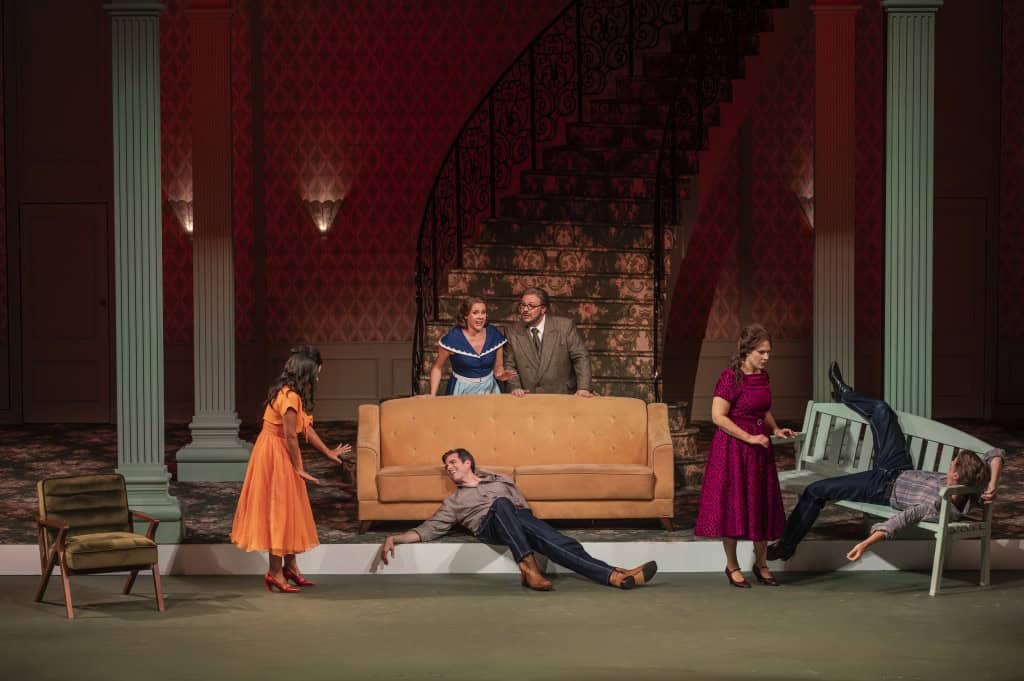
Così fan tutte at the Opéra Royal de Wallonie
Self-assured and somewhat slyly, Don Alfonso stands before the curtain rises during the overture on stage. He is the one who holds the threads of the intrigue in his hands, he guides the two couples through surprise, deception and seduction and he will amuse himself with it….Così fan tutte is one of the three masterful Da Ponte operas that Mozart composed. The opera can be summarized as follows:
Don Alfonso challenges the men Ferrando and Guglielmo to test their fiancées for their faithfulness. The two go into it confidently but must discover at the end of the trial that the women, Fiordiligi and Dorabella, indeed let themselves be won over by another - and by their respective fiancés no less! But director Vincent Dujardin immediately indicates that the deception to which the two couples will be subjected is a set-up game. The cynical joke is thus revealed at the end and the original relationships restored.
Concentration is a key word in this opera on all levels. Mozart composed his opera for only six characters, the story takes place over 24 hours, the scene is limited to the color of Naples. The direction makes a strength of that. The unified set cleverly changes by playing with the stage floor below for the evolution of the story and above for the scenes in which the two women question what is happening to them. A romantic background with a small boat evokes the Bay of Naples. The chamber walls below, with beautiful scenes, are cleverly rotatable to make characters disappear or appear. The women's room has a touch of bourgeois charm. The costumes too, from the sixties, are particularly well-crafted and original. The young men come across as seducers in a boastful manner.
The character direction gives the singers the opportunity to fully immerse themselves in the pseudo-naivety and the illusion. Step by step, Fiordiligi and Dorabella let themselves be drawn into the deceptive love game. Ferrando and Guglielmo convincingly play the soldiers and the "Albanians" who do their best to win the ladies, even to the point of marriage. The staging thereby emphasizes the amusing aspect but maintains the tension, without becoming sharp or bitter. Despina also plays her role as the cunning accomplice of Don Alfonso particularly credibly.
It was very exciting to meet the young conductor Sieva Borzak, who in 2025 snatched the first prize in the Concours International de Direction d'Orchestre d'Opéra of the ORW. With precision, he guided the choir and orchestra through the many nuances of Mozart's score, with fine passages from percussion (timpani!) and woodwinds (oboe, bassoon). He also provided the singers with clear good support. A magnificent performance for work that is certainly very demanding in all its concentration.
Francesca Dotto portrays the extremely difficult part of Fiordiligi with poignant emotionality. Her voice reaches the demanding high notes and her bravura aria Come scoglio is certainly a highlight. José Maria Lo Monaco seems like her playful self as the more frivolous and challenging Dorabella, especially in an aria like E amore un ladroncello. Together the voices of the two sisters match delightfully in duets like Prenderò quel brunettino. That matching of voices, by the way, applies to all ensembles in the performance. The male characters are also perfectly cast: the gentle yet precise Maxim Mironov as Ferrando, the more flamboyant Vittorio Prato as Guglielmo. José Maria Lo Monaco clearly enjoys the keen cunning she can display in the various guises of Despina! Marco Filippo Romano as Don Alfonso delightfully wields his authority as instigator of the "farce".
Did Mozart with his dramma giocoso Così fan tutte write a light opera about an ironic joke with partner swapping or a tragic one about farewell and abandonment? This question remains the attraction of this work and just like Don Alfonso, the audience has amused itself with it.
[embed]https://www.youtube.com/watch?v=_-kaDfAaBbI[/embed]