
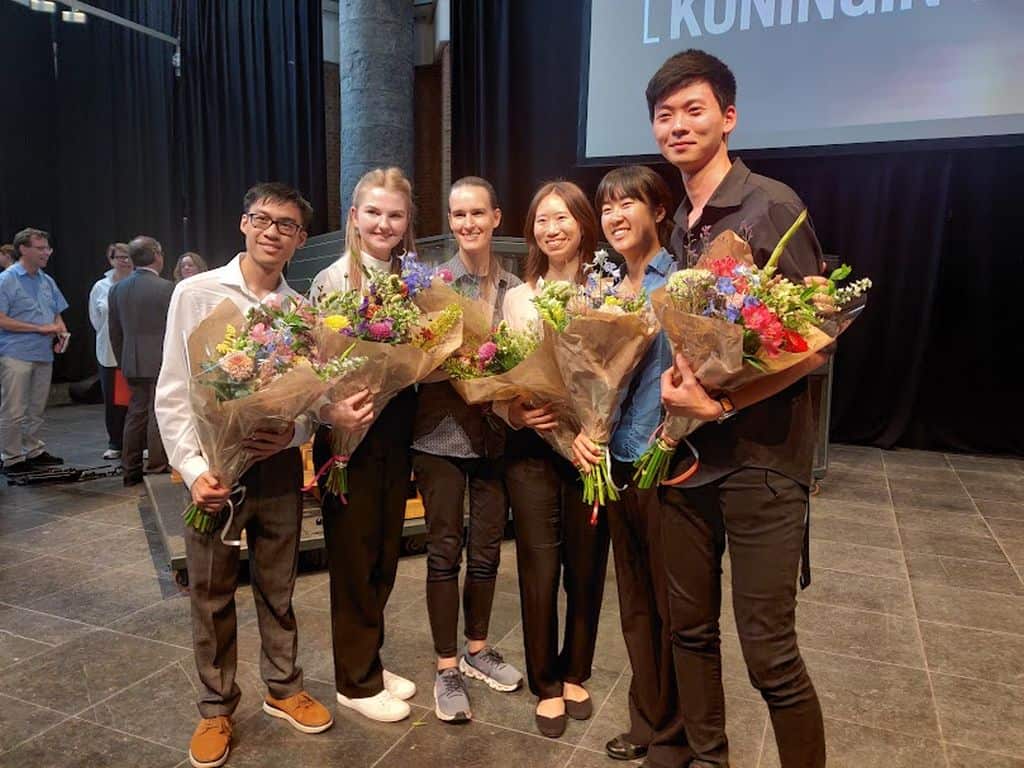
Claire Janezic (US), Annie Gao (US), Anne Lu (CAN), Oleksandra Makarova (UA) and Joseph Min (US) competed for the honor of a prize, if possible the first prize, the audience prize, the improvisation prize and / or the prize for the best performance of the required work during the 9th International Carillon Competition Queen Fabiola which has just concluded in Mechelen.
For a week, Mechelen, the carillon city par excellence in the world, was immersed in many hours of carillon sounds from the mighty Sint-Romboutstoren. 15 candidates from all corners of the world gathered to give their best in this undeniably most important carillon competition in the world. It was former director of the Royal Carillon School and city carillonneur Jo Haazen who took the initiative for this competition, whose first edition took place in 1987. The aim was not only to confirm Mechelen as a carillon center, but also and especially to raise the level of carillon playing and internationalize it even further. In all respects, this has succeeded. The level was raised to that of soloists of international top, more and more students came, especially from the United States of America, to the institute, a real carillon school emerged in Russia. It is up to the current, younger generation of carillonneurs to have more instruments built and allow outdated or other instruments to be repaired, renewed, replaced. Those who heard the young top artists at work can assume that they will ensure the future of the carillon, not without reason UNESCO intangible world heritage, and at an unprecedented high level.
After the preliminary rounds, the five mentioned candidates remained, who performed on Saturday, July 13 on the Sint-Romboutscarillon, where they performed, among other things, the required work by Joey Brink alongside repertoire pieces. On Sunday, July 14, they had to transform themselves from a solitary carillonneur high in a tower without sight of the audience into stage musicians who performed together with other instruments right in front of the audience. In the former monastery church of the Franciscans, now one of the cultural venues in Mechelen, a chamber carillon was set up next to percussion and the grand piano by Chris Maene. This was played by composer-pianist Jeroen Malaise, the percussion was provided by percussionist Daan Willems. How the carillon sounds in Mechelen is known, but how would a chamber carillon sound with percussion and piano and would that fit into a competition? In the past, this could have been debated. The instrument was not quite ready, the choice of ensemble – orchestra, brass band or something else… It was not obvious. Until now…
Jeroen Malaise made it his own – not that he necessarily wanted to become a carillonneur – but he insisted on knowing how a carillonneur behaves at the keyboard. He studied the movements, let his ears get used to the bell sounds and with the necessary information from seasoned carillonneurs he could set to work to write a piece, a 'Nocturne' which – however short it may be – can immediately be called a repertoire piece. This can certainly resound in any concert hall. It begins with a soft, fragile sparkle followed by a skip to slide back to the first phrases to fade away very softly, dreamily. The instruments flow into each other in a way that fills you with wonder. How can you suddenly doubt whether it is the percussion, the piano or the chamber carillon that resounds? And yet it is. The ensemble, the melodic lines, the rhythm, the ability the carillonneur has to interpret freely… Yes, it is a competition piece, certainly, but equally certainly a repertoire piece.
Having to listen to this nocturne five times was not at all disturbing, quite the opposite. It was challenging and more than with many other imposed works, the soloist could express themselves musically and prove themselves. And they certainly did. Five different versions, five times very tastefully performed.
In addition to Malaise's Nocturne, the candidates each played a choice piece. Notable was that four of the five chose a Baroque piece. Probably because the chamber carillon is very light and very suitable for Baroque, which is not immediately the case with the heavy carillon in the Sint-Romboutstoren. Time flew by like nothing, something that is always the case when great talents bring performances of very high caliber. It created an excited atmosphere among the audience, who applauded the five laureates, the jury members and the composers for a long time. Mark Janssens (Klara) connected this competition in rich terms and thus helped set the mood that had something of a family. That's how it should be. Look forward with Klassiek Centraal to the next edition in July 2029…
The five laureates and six prize winners
First prize, prize for required work: Joseph Min (US)
Second prize: Annie Gao (US)
Third prize: Anne Lu (CAN)
Fourth prize: Claire Janezic (US)
Fifth prize and audience prize: Oleksandra Makarova (UA)
Improvisation prize: Cao Linh Pham (US)