
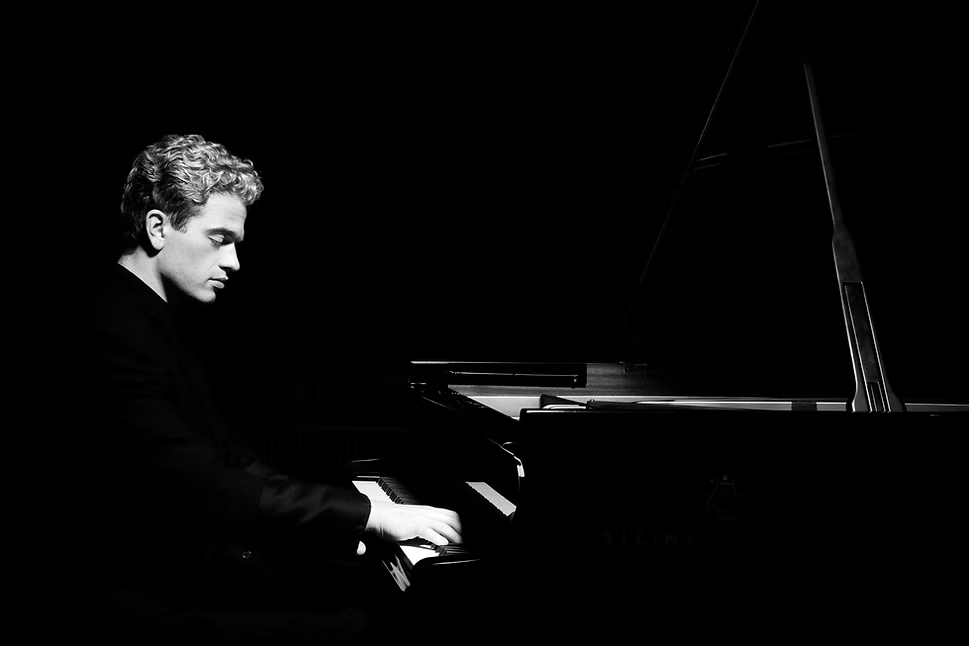
Pianist Joseph Moog performed on Sunday, August 2 with the Orchestre National des Jeunes du Luxembourg, an orchestra that has existed for only five years, during the Young Euro Classic summer festival in Berlin. For Klassiek Centraal, he reflected after the concert with Werner De Smet on that collaboration, on Rachmaninov's Rhapsody on a Theme of Paganini and on the qualities and challenges of a new generation of young musicians.
Energy that sometimes needs to be reined in
According to Moog, working with a young orchestra differs clearly from collaborating with an established ensemble. "Young orchestras have incredible dynamism, lots of energy and are so motivated that you sometimes even have to hold them back a bit," he says. "We noticed that immediately in the first rehearsals. They play extremely fast and can play incredibly loud – there's just so much power in it, so many horsepower."
That's precisely why the detailed work with conductor Pit Brosius was so important. The orchestra had remarkably much rehearsal time with the pianist: two work rehearsals of two to three hours each, followed by a general rehearsal. "That was almost luxurious," says Moog. He was able to apply his years of experience with the work and the scores directly. "You know where you play together with the tuba while it's far away, or where the orchestra has difficulty hearing each other internally. You can pass that experience on directly."
What struck him most was the attitude of the young musicians: "Very positive, exceptionally motivated and also very concentrated." According to him, they worked with remarkable discipline and quickly picked up instructions. "Every nuance. Sometimes it was even a bit exaggerated when you indicated something," he adds with a laugh.
Paganini, the devil and dance
Moog has already performed Rachmaninov's Rhapsody on a Theme of Paganini in various circumstances. He worked, among other things, with the ballet of the Opéra Garnier in Paris, in the choreography of Frederick Ashton, which was approved by Rachmaninov himself. That experience has strongly influenced his view of the work: "Since then, it has very much to do with dance for me. It's simply dance. It's certainly Paganini, it's certainly the devil."
Moog emphasizes that he doesn't mean a concrete story like in a film. Yet he sees in the music a strong imagination of a talent kissed by the devil: someone who receives a dark, almost supernatural gift and then continually develops it further. "It builds up, it almost boils over," he observes. The virtuosity of Paganini thus becomes not only a technical challenge in Rachmaninov, but also takes on something demonic and irresistible.
In doing so, Moog sees a striking connection with another work by Rachmaninov. The Dies irae motif that appears in the Rhapsody the composer later used prominently in his Symphonic Dances. "He was in love with that motif," says Moog. According to him, it fits surprisingly well with Paganini's Caprice: "All the emotions are in it, but it's diabolical. It ratchets up. It's almost supernatural."
Outstanding instrumentalists
Has a new generation of young musicians also developed a different way of making music? Moog answers cautiously. He doesn't want to claim that one generation is better than the other, but he does notice certain shifts. According to him, the level of individual musicians is particularly high – an impression he also finds in conversations with conductors: "The young musicians are instrumentally incredibly good in terms of their own instrumental skills." At the same time, he wonders whether another development has not become somewhat weaker: broad knowledge of the repertoire, including the standard repertoire. According to him, young musicians are often highly specialized and technically excellent within their own domain. The challenge then lies in connecting those individual qualities with those of the other musicians: "The musicians are somewhat more on their own and it's harder for them to bring that together with the others."
In doing so, Moog touches on an essential question within ensemble playing. After all, an orchestra does not consist of a collection of individual soloists. The point is that each musician can control his own voice while constantly listening to the whole. Moog describes this vividly: "I am a part of the orchestra, a part of the swarm in this constellation and we must make this movement together." That sense of the whole, he says, may not have developed to the same extent as ten or fifteen years ago – even though the instrumental quality of individual young musicians has undeniably increased greatly.
Young Euro Classic as a glimpse into the future
What makes Young Euro Classic particularly special for Moog is ultimately the concept itself. Youth orchestras now exist in virtually every country. Luxembourg now has one as well, and above it is the European Union Youth Orchestra as a kind of culmination of all those national ensembles. Moog compares it to a Champions League or European championship: the best young musicians from different countries come together there. According to him, a similar system also exists in the United States with youth orchestras at the level of individual states.
According to Moog, that concept fits perfectly with the summer period. "So much energy comes out of those working phases of the orchestras." For someone who lives in Berlin, it's also special to be able to choose from a range of different ensembles and programs. Each orchestra brings its own program, traditions and musical background. As a result, Young Euro Classic becomes not only a festival of young musicians, but also a meeting place of different musical cultures.
And for Moog there is yet another dimension: the future. Many of the young musicians who perform on these stages today will later find their place in major professional orchestras. He knows that process from his own experience with youth orchestras. So anyone who listens to Young Euro Classic today may now be making acquaintance with the orchestra musicians of tomorrow – a thought that gives the festival an extra dimension for Moog.
What lingers
What does Moog hope the audience takes home with them after such a concert? "Mainly that people see how alive classical music is, how many young, talented people are dedicated to it – professionally or simply with great love and passion." But for him it's about more than just the future of classical music. According to Moog, music also has a unifying power: across cultures and generations: "That's what music can do: release emotions, have conversations without words."
And that's precisely where, according to him, the special power of youth orchestras may lie. The young musicians are not only at the beginning of their professional careers; they also bring enormous energy, curiosity and commitment to the stage: "You can experience that very intensely with youth orchestras."