
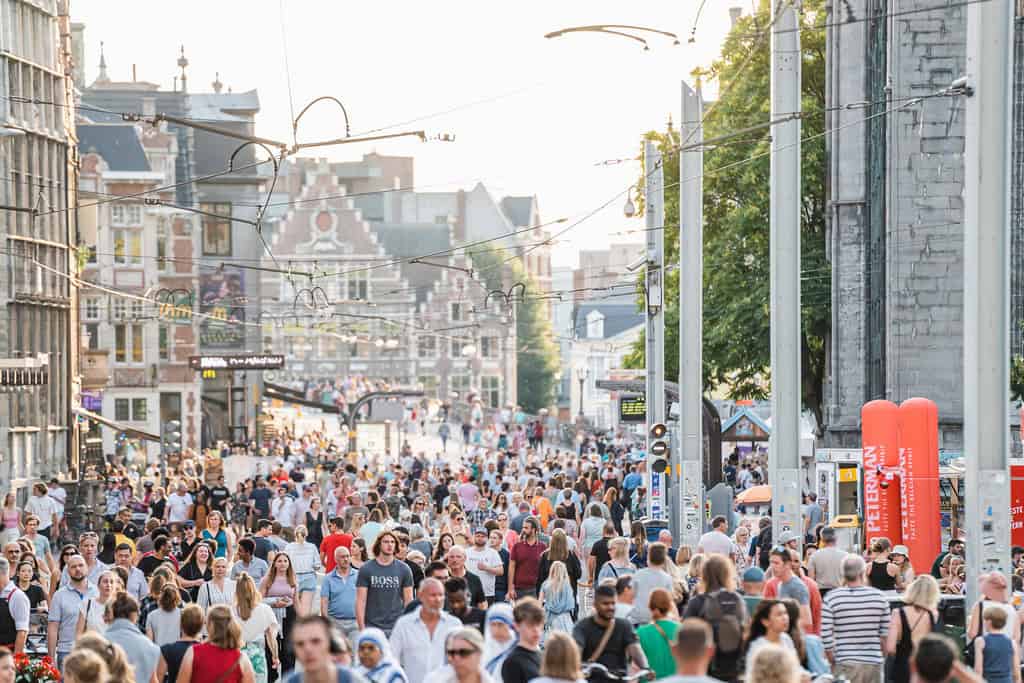
From July 14 to 23, the Genste Feesten took place again. One of the largest folk festivals and multi-day cultural festivals in all of Europe. Ten days of culture in the city, with both paid and free performances. Well-known names in cultural venues and on the squares, alongside street musicians who often surprise passersby. Among the hundreds of events there is also a lot of classical music. I attended a dozen concerts, recitals and street performances. An impression of a few vocal concerts and an organ recital.
Close Opera in Huset
Opera on your skin. That's the best way to describe the four-day Project Close Opera. In the salon of Huset on the Hoogstraat there is room for about fifty listeners. Packed together, there is barely a meter between the front row and the singers. On the evening of the national holiday, students of singer Jolien De Gendt perform, together with Jolien herself. Soprano Annelies Deweerdt and mezzo-sopranos Jente Totté and Sanderyn De Muynck in a varied program with arias by Mozart, Johann Strauss, Schumann, Donizetti, Purcell etc. Sometimes they sing alone, sometimes with two at the front. With their loud voices they fill the entire salon and all our heads. In terms of clothing there is a striking contrast between the singers, one in an evening gown the other in a boyish blazer, but that was apparently the intention and is part of the playful side of the project. The only one who looks normal is pianist accompanist Greet Steeman, a rock in the surf between these swirling arias and melodies. As a moment of rest she also plays the slow movement from the sonata, for me the most poignant moment of the entire evening. At the end they all sing together Voi che sapete from Le Nozze di Figaro and Jolien pulls another singing student from the audience, baritone Xavier De Paepe. The five of them sing their exuberant finale Là ci darem la mano from Don Giovanni with full voice.
Organ recital in Sint-Michiels
In various churches the organ is played during the Genste Feesten. During the musical interludes on July 22 in Sint-Michielskerk a concert with trumpet and organ is scheduled by two Bulgarian musicians, Georgi Grozev on trumpet and Vessela Dyakova on the organ. There is a last minute change; trumpeter Grozev is unavailable and they explain why. His mother, visiting from Bulgaria in Ghent, had a serious fall with her bicycle and is being operated on today. In this bicycle-fanatic city where the car is condemned and almost everyone is forced onto a bicycle, sometimes fatal accidents happen with speeding cyclists and e-bikes. The bicycle fundamentalists in the city council will perhaps only come to their senses when they themselves are involved in an accident. Anyway, due to this bicycle-fanatic policy no trumpet today.
Vessela Dyakova has to manage alone at the small organ, the organ positive in front, where she sits visibly for the audience. It sounds more intimate than the large organ, but no less colorful, with all those different registers which Vessela pulls in and out at the beginning of each piece like the levers of a tram cab. The great Bach cannot be missing, just as lesser gods from the baroque and romantic periods. Dyakova is over seventy, but with her name Vessela (Bulgarian for cheerful) she can delight her audience for many years to come with her beautiful organ playing and her cheerful expression.
Polish song evening
Café and concert room Afkikker on Sint-Kwintensberg lies outside the festival zone but also deserves attention. "Afkikker" is a somewhat misleading name. Not a place for addicts in recovery, but for music lovers and seekers of added value. Hostess Rita De Vuyst regularly invites musicians, singers, speakers to her large salon. On the drizzly evening of the twenty-second of July, Polish baritone Artur Rožek and pianist Martijn van Sas were scheduled. Polish songs by Szymanowski, Malecki, Nowowiesjki, Lutoslawski, after the intermission alternated with the more late-romantic idiom of Ignaz Paderewski. Poland is not only a great country, it is also a great musical nation.
The singer wears a dark pair of glasses, he is blind. All the more he can concentrate on the profound songs of his great Slavic homeland Poland. In between the pianist is allowed to perform solo in two nocturnes by Chopin, which cannot be missing from a Polish evening. He plays this brilliant music with intense devotion. Van Sas feels completely at home in these nocturnal sounds. Rita's café is also called on the website Medieval Stone or "Hooghuys" from the medieval Sint-Pietersdorp. A staircase descends to the medieval vaults, an unexpected immersion in the greatest past of our city.
Choir concert "Rencontre"
Choirs have been providing beloved musical interludes in Sint-Michielskerk during the Genste Feesten for decades. When the choir Rencontre from Ath takes the stage I think: "They are not in uniform". A yellow shirt, red trousers, a pink blouse. As they all take the podium the sartorial choice becomes clear. Everything between yellow and red, a successful color palette. In this way each choir member individually gives his or her accent between red, orange and yellow.
No well-known composers, no classical evergreens but a combination of different contemporary works, interspersed with a choral work by Fauré. To make it swing a bit, a gospel piece in between and they close with the number Sanomi, with which the group Urban Trad achieved second place at Eurosong 2003. That last thing says something about the choir. With catchy contemporary pieces, they want to please the audience. In this they also succeeded well this afternoon, although the intonation was not always excellent, the standard they have been achieving in the choir competition for years. Visually, the riot of colors of the fifty enthusiastically singing women and men compensates. Fifty shades of orange.