
Le Nozze di Figaro, music by W.A. Mozart, libretto by Lorenzo da Ponte premiered in Vienna in 1786. This opera has already known countless stagings worldwide, is mature and can certainly use some extra impulses in 2023. Opera purists will have to get used to the staging. No shortage of originality.
Young director Tom Goossens, with a crush on opera, adapted Mozart's opera buffa to his hand and injected the whole thing with some extra spicy textual material. He had the courage and inventiveness to push Le Nozze di Figaro off the safe ledge. No restraint in the calculated risks he took. He handles the undercurrent of competing emotions very plastically. This in an unconventional form that is nonetheless classical, stylish and above all visual. It is a matter of pure, simple refinement. Beyond the artificial façade of the opera. With the underlying intention to bring opera to a broader audience… and… mission accomplished and appreciated for the full 100%.
For an extra dose of humor, actors Stefan Degand and Eva Van Der Gucht are brought in. Two performers bursting with energy. Their acting can be described as playful impetuosity, ardor and vitality. The music vibrates and pulses, this duo provides extra spice.
[caption id="attachment_50336" align="alignleft" width="300"]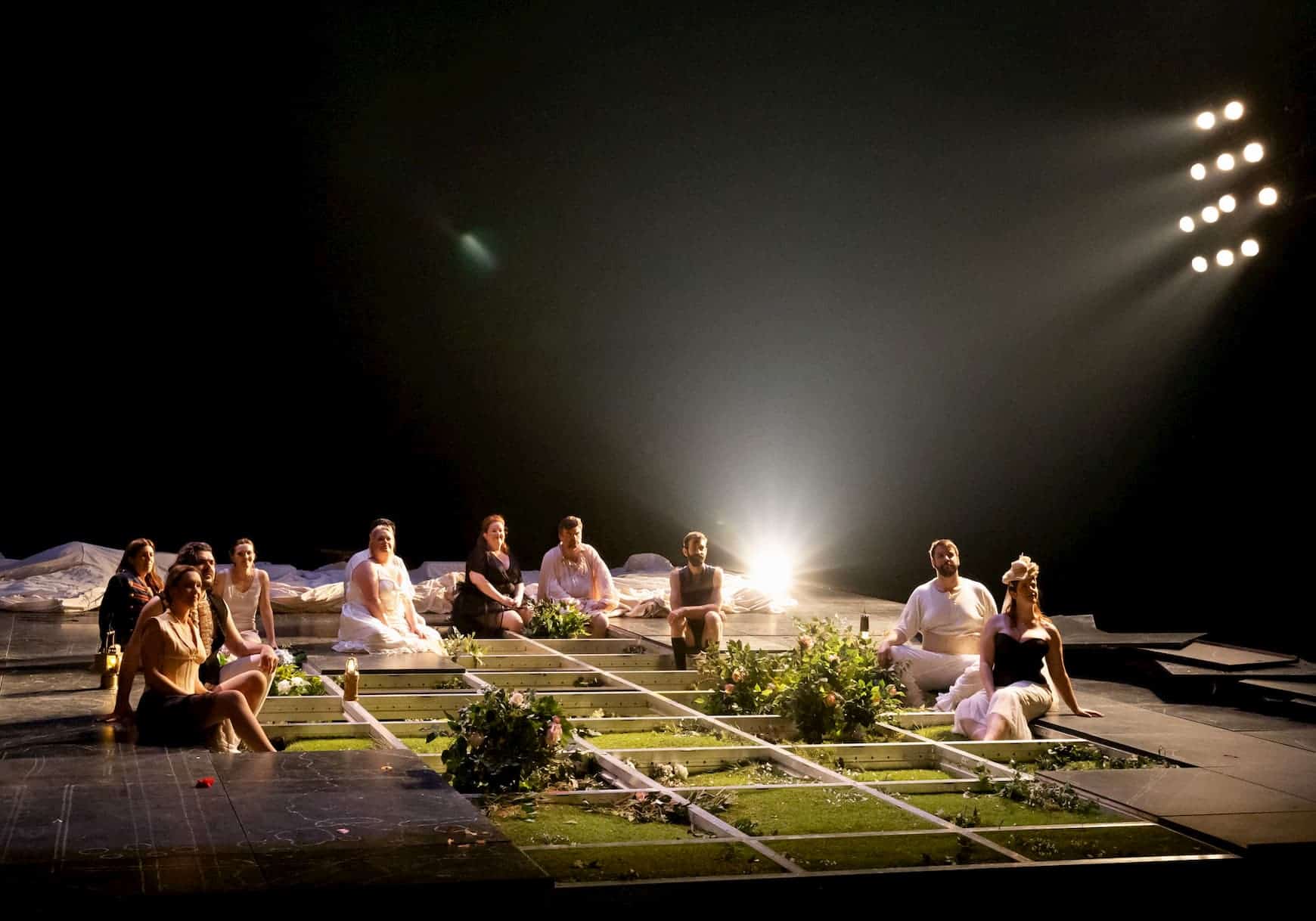 © Annemie Augustijns[/caption]
Staging
The performance starts with an open curtain. No mega set. The spectators see an inclined plateau, with on it an immense jigsaw puzzle. Neatly laid out are columns, ladders, cabinets, doors, window frames, slats, etc… a large construction kit, scenography by Sammy Van den Heuvel. The storage facilities of Opera Ballet Vlaanderen are packed with materials and costumes. Virtually everything in this production is recycled. The circular economy has also penetrated this cultural temple. This production scores on multiple fronts.
A man in a cream-colored outfit appears with a blueprint in hand and begins placing pieces together, measuring out the floor plan. Shortly after, this turns out to be Figaro, embodied by British bass-baritone Božidar Smiljanić.
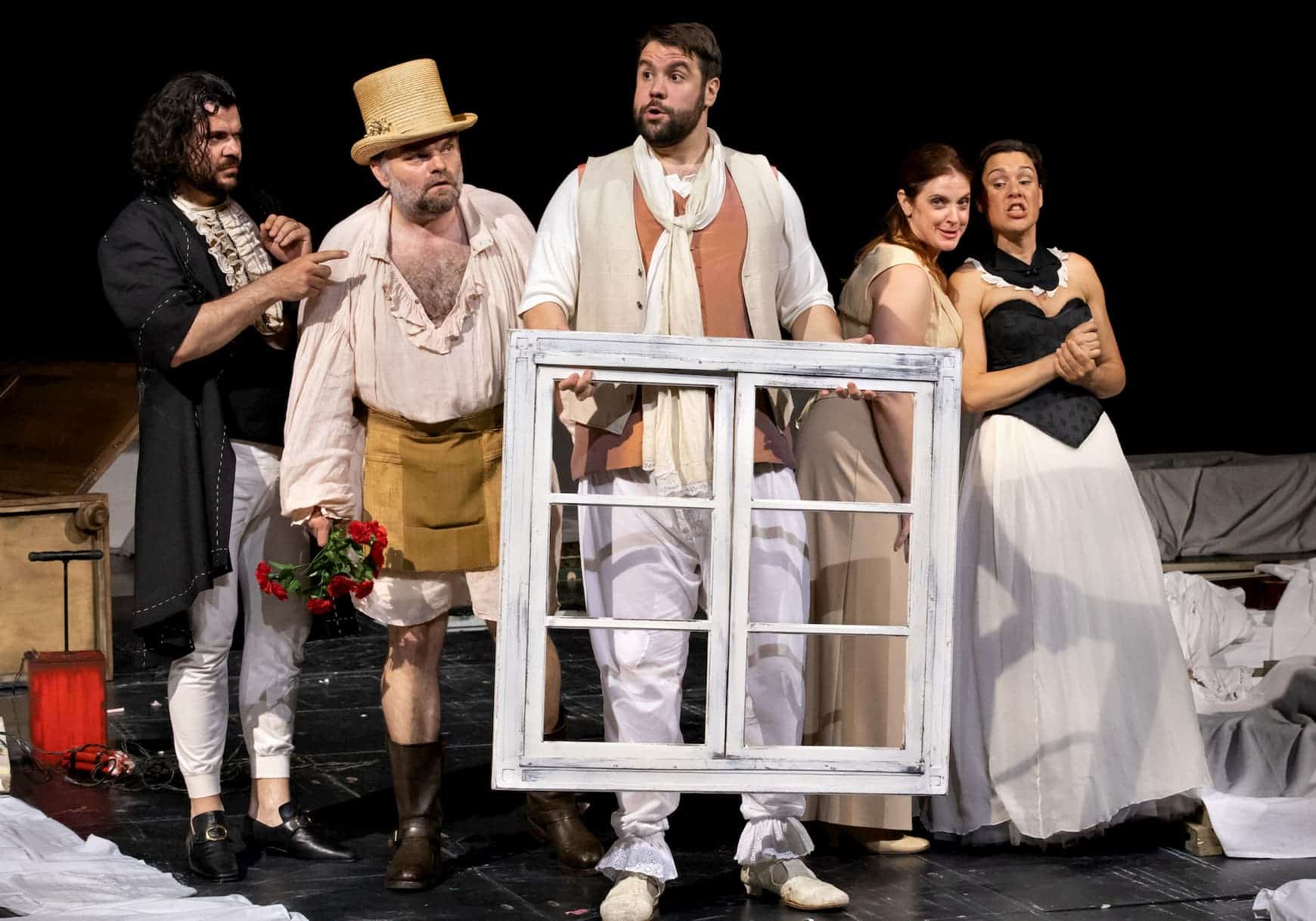
During the overture, more tinkering happens and he gets help from his girlfriend Suzanne, a role for American soprano Maeve Högland. They want to marry, but the Count sung by Turkish baritone Kartal Karagedik, although married to Rosine, has set his sights on this lady. The droit de seigneur, the right of lords to seduce young women, he had abolished shortly before by law. But the lustful hunger remains. Very clumsily and amusingly he tries to put a bed together. A story full of misunderstandings, avoidances and eroticism unfolds. One wants the other and the other the one. Cherubino, Italian mezzo-soprano Anna Pennisi, yearns for the Countess. In the opera tradition she is a boy. Tom Goossens introduces gender fluidity. Marcellina wants her marriage to Figaro to proceed. She waves a contract stating in black and white that Figaro still owes her money and must marry her if he cannot come up with the cash. In this scene Eva Van Der Gucht shows what a top comedienne she is. The set elements are used with particular inventiveness. A door with frame is straightened up, suggestively marking the boundary of a room. One can eavesdrop. The door falls again… it becomes the entrance to a cellar. Much is not explicitly shown. Thus the spectators' imagination is set to work. The outline of a window is grabbed. Cherubina jumps down to escape the jealous Count's wrath. Shortly after he is caught. An immense cannon is rolled onto the stage. As in a circus act Cherubino is placed in it and catapulted into the air. In a further scene he falls from the sky, right into the linen closet. From the soldiers' rifles no salvos ring out but bouquets emerge. Make love not war! Tom Goossens knows how to employ all possible theatrical tricks. There are beautiful solos and duets from the Countess, Suzanne and Cherubino in a broad range of timbre and finesse. The women team up against the Count.
After the intermission the stage is completely empty. In the background is a construction of white sheets. The protagonists are hidden under white sheets. The silhouettes resemble burkas. The isolation of women. The wishes and whims of the Count, lies told in the name of love, cannot stand. A tribunal takes place in which the legal validity of Marcellina's contract with Figaro must be established. The plot development becomes somewhat tedious when it takes a totally unexpected turn, like a deus ex machina. Marcellina turns out to be Figaro's mother. The debt is forgiven and warm embraces follow. This scene puts Suzanna on the wrong foot again. The sheet construction implodes. The lovers want to unmask each other and/or meet. The scene is partly deconstructed and a peaceful garden emerges. Eva Van Der Gucht's monologue, a guide through the plot, makes the whole thing somewhat drawn out. In a dark scene the couples, armed with a lantern, go in search of each other. As in a darkroom one feels about with titillating images. In the final phase the Count receives forgiveness from his wife.
Le Nozze di Figaro, a splendid season finale. As a comic opera should end: honeyed harmony after a storm in a beautiful interplay of soloists, musicians, Mozart's brilliant music and an extremely skillful and surprising direction by Tom Goossens. Expectations are now sky-high for his further creations.
The audience constantly fanned themselves in these tropical temperatures. The many fluttering fans made it seem like a butterfly-like spectacle. Musicians and protagonists, on the other hand, had to act, sing, dance... and did so with great dedication. Bravo!
Music: W.A. Mozart
Performer: Choir and Orchestra Opera Antwerpen
Conductor: Marie Jacquot
Cast:
Suzanne: Maeve Högland
Figaro: Božidar Smiljanić
Count: Kartal Karagedik
Countess: Lenneke Ruiten
Cherunino: Anne Pennisi
Marcellina: Eva Van der Gucht
Bartolo: Stefaan Degank