
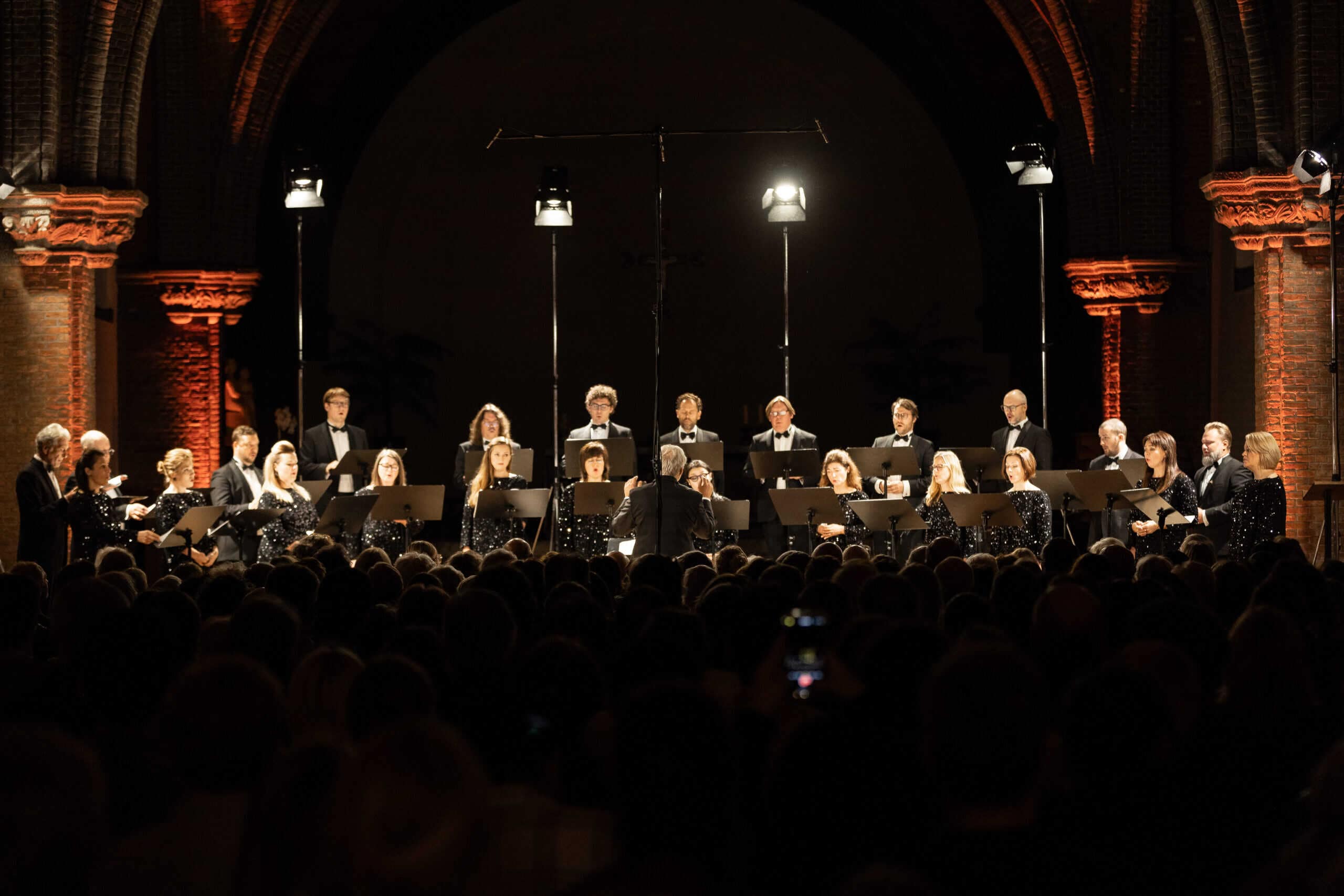
East European choral music speaks to the imagination thanks to a sophisticated blend of religion, Slavic languages, a generous helping of polyphony, deep male voices, a whiff of Gregorian chant and a touch of avant-gardism. Festival 20.21 presented on Monday evening the programme Eternal Light by the vocal collective Latvian Radio Choir in which Baltic, Russian and Hungarian composers were central.
Of the Great Vigil Service by Sergei Rachmaninoff nine of the fifteen movements were sung, all from the vespers and matins of the liturgy of the hours. The work is built from a dynamic variation between four- and eleven-part movements (in Glory to God in the highest) and basses that descend into the deepest recesses of their register. Devotion and Russian nationalism reinforce each other in the use of Church Slavonic. The composition is an example of symphonic writing, in which voices and vocal groups are regarded as instruments in a symphony orchestra. This came across convincingly in the seventh movement in which eleven vocal groups produced fortissimos like a violent last judgement, without losing sight of nuance and balance.
Where Rachmaninoff strives to limit the number of notes, Eriks Esenvalds (°1977) cannot get enough of notes. His Drop in the Ocean (2006) is a combination of four prayer texts dedicated to Mother Teresa. She regarded her work as "a drop in the ocean". Esenvalds has the choir whisper, blow, recite monotonously, and whistle. Sometimes fragments sound reminiscent of resistance songs, but then the choir withdraws into contemplation with a delicate solo for soprano. Music, faith and identity are the essential features of Esenvalds. Ultimately the choir moors itself whispering and softly whistling away into the mystery of the indefinite.
The Scottish composer James MacMillan (°1959), a devout Catholic, clearly immersed himself in the writing of Miserere in the like-named classic that Gregorio Allegri wrote in 1638. But the Scottish version is of a different order. MacMillan opts for great outbursts of expression, which contrast with moments of deep silence. MacMillan's Miserere is a concretised version of Biblical fidelity, he dwells in the texts, which leads to a personal interpretation. The result is a fluent and accessible work, furnished with quotations from Allegri, which, whether modulated or not, are very recognisable and provide structure.
No fewer than sixteen choral parts are featured in the renowned Lux Aeterna by Hungarian composer György Ligeti (1923 – 2006), uncrowned world champion of sound clouds. Lux Aeterna (1966) is an example of so-called micropolyphony in which shifts between different voices can no longer be heard because there are too many voices. The layers blend into a cloud-like arrangement. The score is almost a metre high to accommodate all vocal groups, so that the vertical coordination can be made to work. The Latvian Radio Choir, under the direction of the genial gesticulating conductor Sigvards Kļava, distinguished itself especially in the building up of the vocal layers in the opening. It was a sluggish sunrise, developing from a fragile exploration to a promising beginning of a warm summer day, spun out layer by layer.
Nunc Dimittis (2001) by Estonian composer Arvo Pärt (°1935) are the words from the blessing of the old Simeon before his death, who sees the infant Jesus as the Messiah, as the Holy Spirit had told him. Pärt's Nunc Dimittis is, like many of his other works from the late nineties and early 2000s, composed in a free tintinnabuli technique. This is a characteristic composition technique of Arvo Pärt, in which a melodic line is accompanied note by note by notes from the basic triad of the key in which the melody sounds. Different musical textures alternate according to the paragraphs of the text. That text is certainly not dramatic, and Pärt's composition technique shows little colour and flair at first glance. But in the interpretation of the Latvian Radio Choir, Pärt continues to fascinate because the singers provide space to look at what lies behind the notes. Through precise placement of the notes, whereby attention to the space between the sounds gains in importance, the choir was able to give strength to simplicity.
A contemporary of Pärt, Latvian composer Pëteris Vasks (°1946) closed the concert with The Message of the Great Tit (2004) for eight-part choir. Vasks has his hallmark on homophonic textures but adds playfulness to them through vocal glissandos (sometimes vibrating), groaning from the bass voices and alienating sound clusters. With rhythms from the flamenco tradition and here and there a belly laugh, it became a fitting and expressive conclusion.
WHO: Latvian Radio Choir
WHAT: Eternal Light
WHERE: Abbey Church Keizersberg, Leuven
SEEN: 16 October 2023
ORGANISED BY: Festival 20.21