
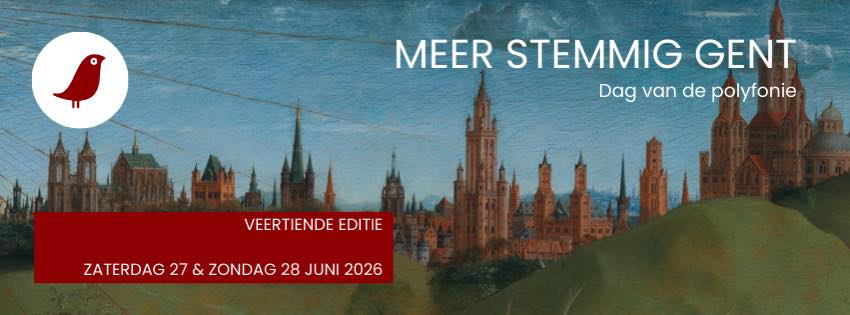
With its fourteenth edition, Meer Stemmig Gent confirms its place as one of the leading polyphony festivals in Flanders. What began in 2012 as an initiative by Jens Van Durme and Aart de Zitter grew into a permanent fixture in Ghent's summer landscape: small-scale in conception, but intellectually rigorous, with ensembles of international caliber in historic spaces that are more than mere backdrop.
This year the festival focuses on the migration of Franco-Flemish polyphony: music that found its way from centers such as Ghent and Paris via colonial networks and figures such as the Ghent Franciscan Pedro de Gante to the New World. A story of transmission, transformation and survival, but also a way to hear the repertoire in its historical breadth.
From Notre-Dame to Macharius
Saturday opens with a lecture by musicologist Pieter Mannaerts (Alamire Foundation / KU Leuven) as part of the DavidsfondsAcademie. He outlines the development of polyphony from the early Notre-Dame school to the stile antico in Monteverdi. An substantive introduction that immediately sharpens the listening framework.
In the evening, the Huelgas Ensemble under the direction of Paul Van Nevel takes over. In the Sint-Machariuskerk – a space whose high vaults and dry, focused reverberation do not wrap around this repertoire but illuminate it – the ensemble presents a program centered on Parisian Notre-Dame polyphony.
A continent in one day
Sunday forms the core of the festival, with a program that combines conceptual coherence with stylistic diversity. Francis Maes (UGent) opens with a lecture that further outlines the international network behind the polyphony.
El Grillo brings a compelling Belgian perspective on the repertoire. Cappella Mariana from the Czech Republic stands for a strict and refined vocal idiom, while La Fonte Musica closes the festival with works by Matteo da Perugia: music on the border of medieval and renaissance, fitting within a day that continually moves between musical worlds.
One of the conceptual highlights is the concert of Cappella Pratensis, with a program centered on Pedro de Gante. The Ghent Franciscan, who helped lay the foundation for a local polyphonic practice in Mexico, is thus brought back to his musical origins. The ensemble, with its thoroughly source-conscious approach, is a logical choice for this: not as mere reconstruction, but as living performance practice.
Fringe program and participation
In addition to the concerts, Meer Stemmig Gent continues to focus on broadening access. A workshop by Caroline Sordia is aimed at amateur singers, while Muziek op Schoot (Tinkel) introduces the youngest listeners to polyphony. Under the heading Stemmig Gents, Shahab Azinmehr (vocals and setar) brings a subtle dialogue with non-Western sound worlds – more of a lateral opening than an explicit statement, but no less relevant for that.
Meer Stemmig Gent thus remains true to its formula: intellectual rigor, historical awareness and careful artistic selection, without excess. The fourteenth edition clearly opts for depth over spectacle, and lets the music speak in a context that does not illustrate its history but makes it audible. Music that left Ghent five centuries ago returns here to its point of departure – and sounds as if it never left.
Klassiek Centraal looks forward to this journey of discovery and will bring a travel report from it.