
It is and remains a remarkable phenomenon: that humans are by definition inclined to progress, striving toward advancement, yet in much music precisely the way backward is followed: that of historicizing performance practice, in which musicians try to come as close as possible to their ideal: namely, to make music in the way it was bon ton centuries ago. This can be discussed at length, with plenty of pros and cons, but this practice cannot be dismissed in any case (any longer). It has even become a dominant factor, and certainly where it concerns the performance of music from the (early) Baroque and (Viennese) Classical periods. This process has certainly not proceeded without fits and starts, but in the meantime we have reached a stage where both the instrumentation (mostly replicas) has been improved, musicians can handle it (much) better, and particularly thanks to musicology with new knowledge and corresponding insights, a much more reliable picture (which also includes the so-called 'Urtexte') of that distant past has emerged. We know our 'classics' in this regard, so to speak; or we think we know them...
For the music lover there is certainly added value in this historicizing performance practice. That does not make performances 'from the old school' any less interesting, but this practice has made it possible to experience the music from (even) more fascinating perspectives. As far as Mozart's piano concertos are concerned, the interpretations of, for example, Clara Haskil, Annie Fischer, Murray Perahia or Mitsuko Uchida remain as fascinating and current despite(?) this historicizing, but that there is a remarkable shift from 'traditional' to 'authentic' is just as evident.
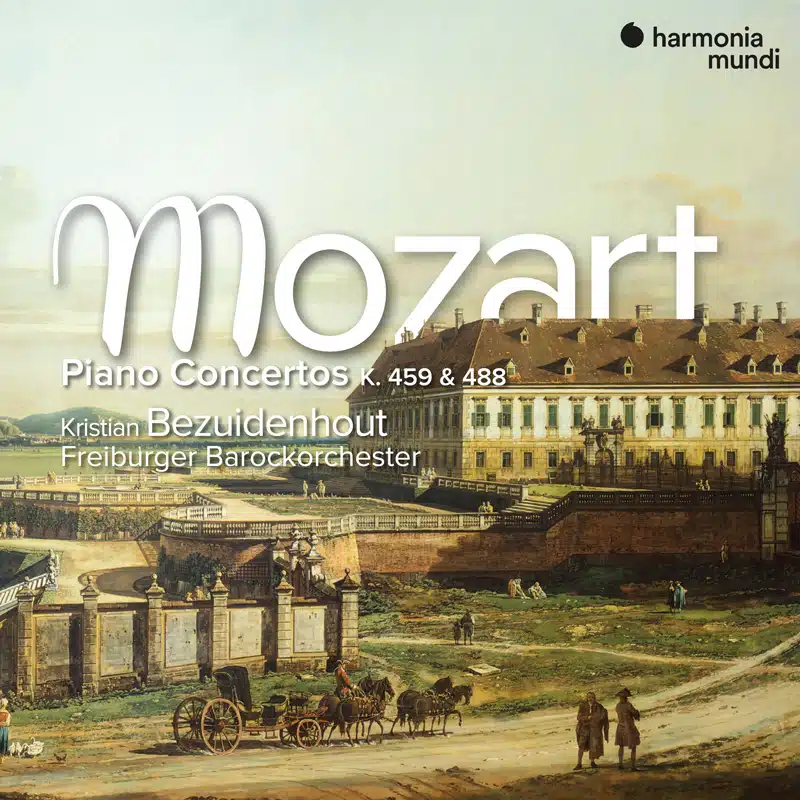
The South African fortepianist Kristian Bezuidenhout and the Freiburger Barockorchester (they have worked together for a long time and you can hear it in this new album as well) have distinguished themselves commendably on the 'authentic' front. Their Mozart series has now grown to five albums and they are thus almost halfway through the project that will encompass all 27 piano concertos (which also includes the two concert rondos KV 382 and 386.)
Unlike with Beethoven, the (forte)piano was not Mozart's most important instrument, although the quality of his output in this area is certainly not to be judged by that. Beethoven is even said to have exclaimed to the pianist Cramer that he, Beethoven, would never be able to compose anything like 'such a thing' (Mozart's KV 491). It was also Mozart who lifted the piano concerto out of its hitherto conventional constraints. And it was Mozart who in the later concertos finally gave the woodwinds a truly independent and often even prominent role, instead of merely a supporting role. He did not even shy away from making it a participant in the operatic realm of expressive discourse. It could hardly have been otherwise, and for Beethoven these piano concertos, and especially from KV 453 onward, must have been an important point of reference for his own artistic explorations in this field.
However much Beethoven admired Mozart, he was not entirely enthusiastic about his piano playing. He found it rather fragmented and smacking of the harpsichord. He himself liked to play with curved fingers, with the thumb often underneath. A striking characteristic of his piano playing was furthermore the use of the pedal, which according to his student and admirer Carl Czerny was even more abundant than what was written in the score (or the manuscript). This certainly meant in cantabile playing a more sustained sound, albeit with the connotation that excessive pedal work on a fortepiano results in a less muddied sound than with what our modern piano or grand piano has become.
An interesting aspect is certainly the cadenza, which many pianists recite as a neat lesson or get off easily by choosing an existing cadenza, either from the composer himself or from elsewhere. But not Bezuidenhout, who often presents the piano concertos with his own cadenzas, which is also somewhat in line with the performance practice of the time in which improvisation was held in high regard and to which Mozart was no exception either (although he sometimes did write out a cadenza completely). In his cadenzas, Bezuidenhout naturally remains true to the 'spirit of the times,' embodied in the prevailing eighteenth-century rhetoric that betrays profound knowledge of the stylistic aspects regarding (not only) Mozart's piano concertos. In the CD booklet, however, not a single word about this.
In these two piano concertos, KV 459 and 488 (the independent woodwind parts are evident in them), the Freiburgers and Bezuidenhout are once again in optimal form: it is all sparkle, the joy of playing radiates from it. The musical character that so distinctly marks this music is further supported in this excellent recording by very contagious enterprise and much sense of adventure. The whole moreover radiates so much concentrated vitality that it is a true delight for both ear and heart. The intimacy in the slow movements is equally heartwarming, the vibrato serving exclusively as a delimited expressive device that does not impair the desired clarity of the discourse: refined, modest and above all aesthetically justified.
The solo instrument used is a copy made in 2008 by Paul McNulty of a Viennese Walter from around 1805.