
Director Tom Goossens is making his first full-fledged directorial debut of a repertoire piece with his staging of Le Nozze di Figaro for Opera Ballet Vlaanderen. He is anything but a neophyte in the world of theater and opera. He has already worked as an assistant, designed productions for Transparant and in 2019 also created an adaptation of Verdi's Macbeth for Opera Ballet Vlaanderen as a family production: "Banket!". So I looked forward with great expectations to his direction of Le Nozze di Figaro. Those expectations were more than fulfilled.
Perhaps a brief summary after all.
Figaro and Susanna, both in the service of Count and Countess Almaviva, are about to be married. Count Almaviva wants to exercise the ius primae noctis, even though he has only just abolished it himself.
The Count is far from a model of marital fidelity and the sorrowful Countess devises an intrigue with Figaro to make the Count jealous. They will make him believe that the Countess has a lover and at the same time expose his infidelity and his seduction attempt of Susanna. They invite him to a secret rendezvous, where Cherubino disguised as Susanna will appear. This becomes the garden scene of the final act with the variation that the Countess will appear as Susanna. This leads to the sobering unmasking of the Count: he seduces his own wife, believing he is seducing Susanna. The switches result in everyone reconciling with one another. The "mad day", "La folle journée" ends in reconciliation and celebration.
Meanwhile there are all sorts of other intrigues. Cherubino is also in love with practically all the women and is punished by the Count for his infatuations and sent away as an officer. He crosses the entire story - disguised as a girl.
And then there is the intrigue around Marcellina and Bartolo: Marcellina is in love with Figaro, Bartolo is angry with Figaro, they discover that Figaro is their supposedly lost son.
Shrewd insight into social comedy
Tom Goossens has understood Mozart's opera well and also the satirical play by Beaumarchais that underlies it, "La folle journée ou le marriage de Figaro" from 1784. This is evident from every aspect of his staging. He succeeds in depicting the "world theater of love" (Walter Felsenstein) in an apparently innocent musical comedy with universal human traits. He does this with original inspiration and much imagination that goes directly over to the audience. A masterstroke in itself.
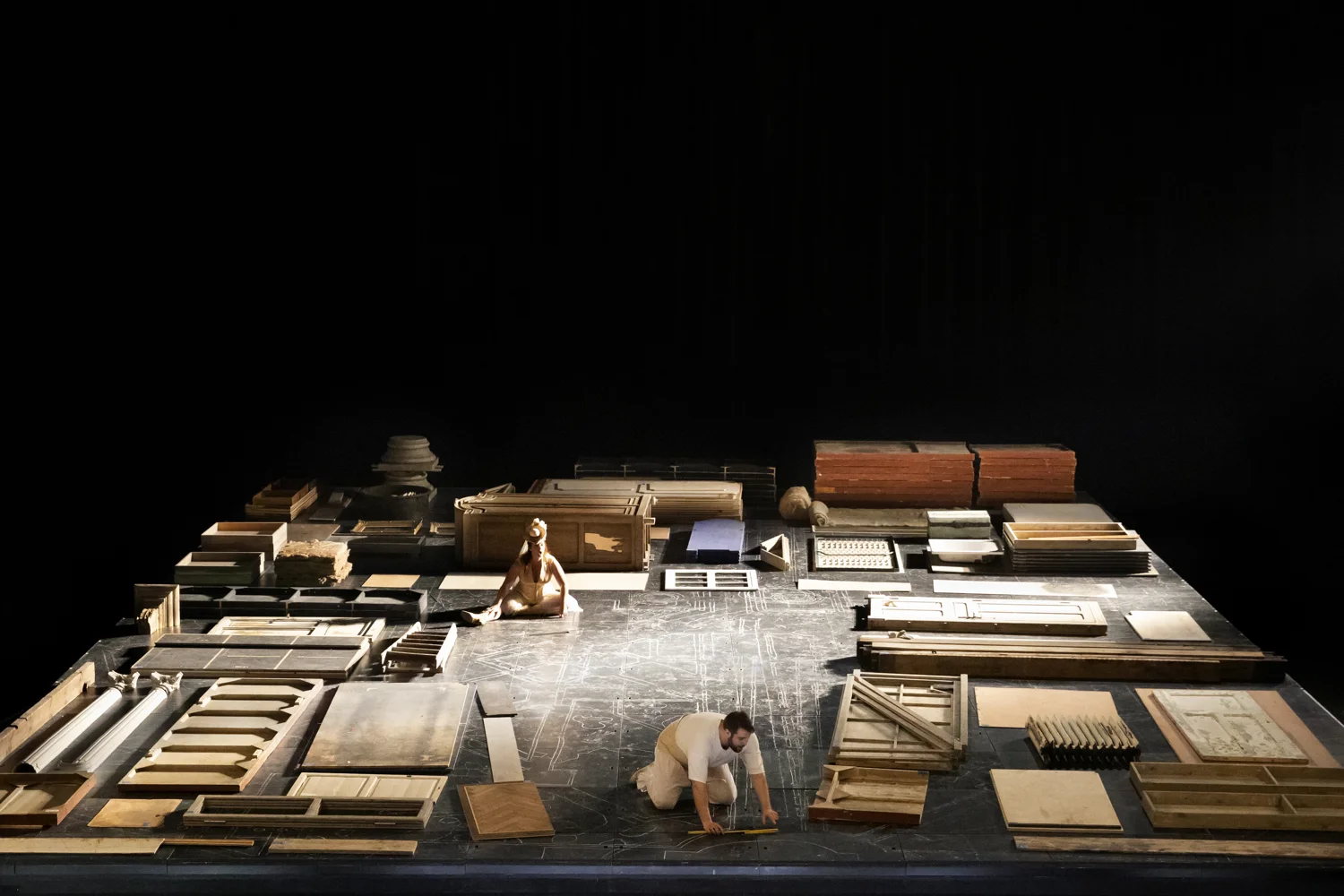
Goossens' theater experience gives him the opportunity to engage the viewer's imagination in such a way that he sets the piece in a setting that only provides templates. These can be filled in further by both the characters and the audience. The opera begins in the room intended as the room of Susanna and Figaro in the palace. But there are only pieces of wall frames, tiles, fictitious doors and lying chests, which become useful as a character needs to come through the door, close it (the scene where the Count locks the door!), hide in the chest (Cherubino!) or jump out the window (once again Cherubino when he escapes to the garden). It repeatedly leads to hilarious comic situations that also advance the irony of the whole. An excellent device by the director that brings out the essence of the Mozart opera and expresses his grasp of the society-critical approach to the aristocratic world. The "unfinished" set looks very nice in the final garden scene with flower beds growing here and there out of tiles. The costumes are also "unfinished" as if the characters - especially the men - are still in test costumes. Count Almaviva's jacket still shows check marks and he wears it over a corset and a kind of long underpants… Perhaps nobility is "outwardly" as ridiculous as inwardly?
Brilliant sharpness of Da Ponte's and Goossens' text
However keenly Goossens grasps Mozart and this comedy of abuse of power and adultery, he has made a very personal intervention in it. He has namely written his own Dutch-language dialogues for the (minor-?) characters Marcellina and Bartolo, which are then performed not by singers but by two actors. Fortunately not the least experienced ones, because otherwise it could go completely wrong… Stefaan Degand and Eva Van der Gucht feel at home in the ironic picture of the opera. The new text is (mostly) absolutely fitting in the revolutionary libretto for which Da Ponte based himself on Beaumarchais. Degand rattles off the texts with rapid tongue and admirably plays a pseudo-naive Bartolo. Eva Van der Gucht throws herself with obvious pleasure and much aplomb into her somewhat silly but genuinely moving character of Marcellina. In the intro where Degand comes at the beginning of the performance to explain what it's about, I was briefly afraid it would go wrong because it was somewhat pedantic, but their actual part in the piece is pure theater. Only the "moral" that Eva Van der Gucht gives once more in the final scene about abuse and boundary-crossing behavior I find a bit cheap concession to topicality - although Goossens says in an interview in De Tijd (27-5-2023): "You often hear that opera and theater must be current and relevant, but for me those are not synonyms". It will be a small concession to give the actor roles more weight, because his production is undoubtedly relevant. Let me leave it at that the expectations have been almost - but not quite - fully met.
Musically somewhat disappointing
Mozart's command of Da Ponte's libretto manifests itself clearly in the vivid characterization of the characters in his music. As far as acting was concerned, we were far from disappointed: all singers threw themselves completely into their roles. Unfortunately, the vocal performance was not always at the same level. The male leads – both the Count (Kartal Karagedik) and Figaro (Božidar Smiljanić) – combined their vocal performance entirely with their convincing acting. The ladies did not do the same. Anna Pennisi was least convincing as Cherubino. Her sparkling arias Non so più cosa son, cosa faccio and Voi che sapete lacked sparkle. Maeve Höglund was a beautiful Susanna but in her numerous duets lacked the rich suppleness to be vocally convincing. Most disappointing was Lenneke Ruiten as the Countess, especially since you would expect her refined soprano voice. In pearls of the opera such as the simple aria Porgi amor (act II) and the meditative Dove sono i bei momenti (act III) she seemed almost to force it, which took away the shine. Perhaps an off day? The influence of summer heat on the voice? Least convincing of all was the orchestra. The young conductor Marie Jacquot seemed to make Mozart's Nozze mainly a tour de force. She certainly did not lack drive and energy, but therein lay the rub. She drove the orchestra mainly towards liveliness, while the gentle introductions and sensitive phrases were submerged in the dynamics. A pity, it deprived Mozart's Nozze of some of its richness.
All in all, an opera evening that leaves you with a happy feeling leaving the theatre, and the audience made that clear with overwhelming applause.
WHAT: Wolfgang Amadeus Mozart Le Nozze di Figaro
WHO: Marie Jacquot, conductor Tom Goossens, direction,
With: Maeve Höglund, Božidar Smiljanić, Kartal Karagedik, Anna Pennisi, Lenneke Ruiten, Eva Van der Gucht, Stefaan Degand a.o.
WHERE: Opera Ballet Vlaanderen
WHEN: 27-6-2023 more performances until 6-7-2023