
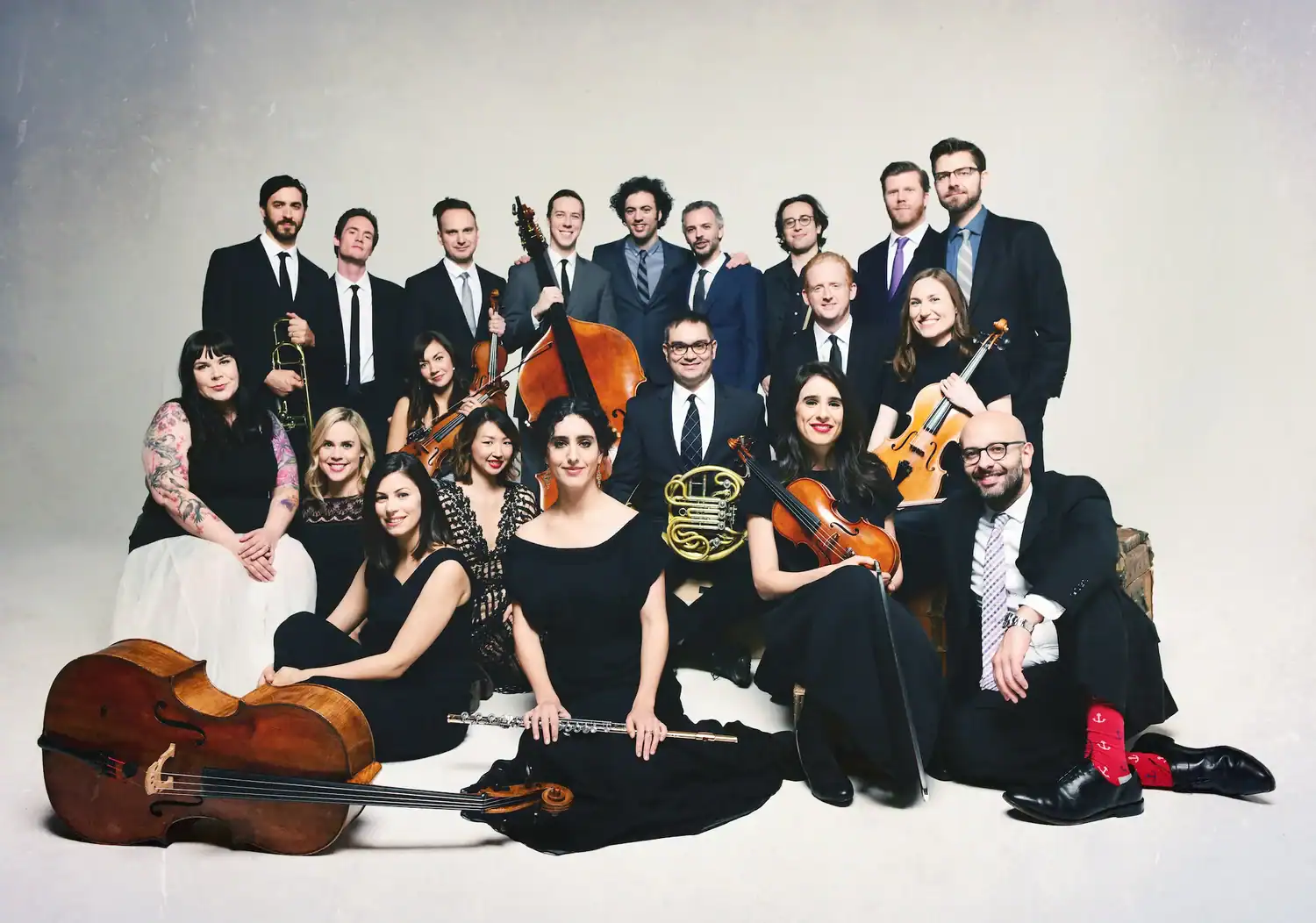
The concert by The Knights and Martynas Levickis on April 14 at the Konzerthaus in Berlin ranks among the most exceptional musical experiences I have had: an evening that was completely "right" from beginning to end – coherent, breathing and self-evident in its grandeur.
What appeared on paper to be a versatile program unfolded in the hall as one continuous movement in which everything developed organically. Under the direction of Eric Jacobsen, styles, colors and tempi flowed into one another to form a natural stream.
From the first measures, the exceptional cohesion of the ensemble stood out, along with the naturalness with which it moved through diverse musical worlds. The joy of playing was a constant undercurrent that gave the evening its energy.
Refined opening and a world in motion
The opening with Entr'acte by Caroline Shaw (°1982) immediately created a sonic world in which movement and stillness continually flowed into each other. What stood out was the refinement with which detail and line converged: the string orchestra unfolded with a natural breath, in which rich textures, pizzicato and lyrical lines combined into one organic whole that continuously developed without losing its direction.
The closing moment, in which the cellist turned away from the ensemble and directed the final notes directly toward the audience, gave the stillness a special intensity. The conductor's subsequent brief remarks, in which he spoke of showing "a different America," took on an almost symbolic weight in that light, as a reflection on a program in which different musical worlds were not set against each other, but related to one another in a natural dialogue.
Energy, freedom and a new sonic thinking
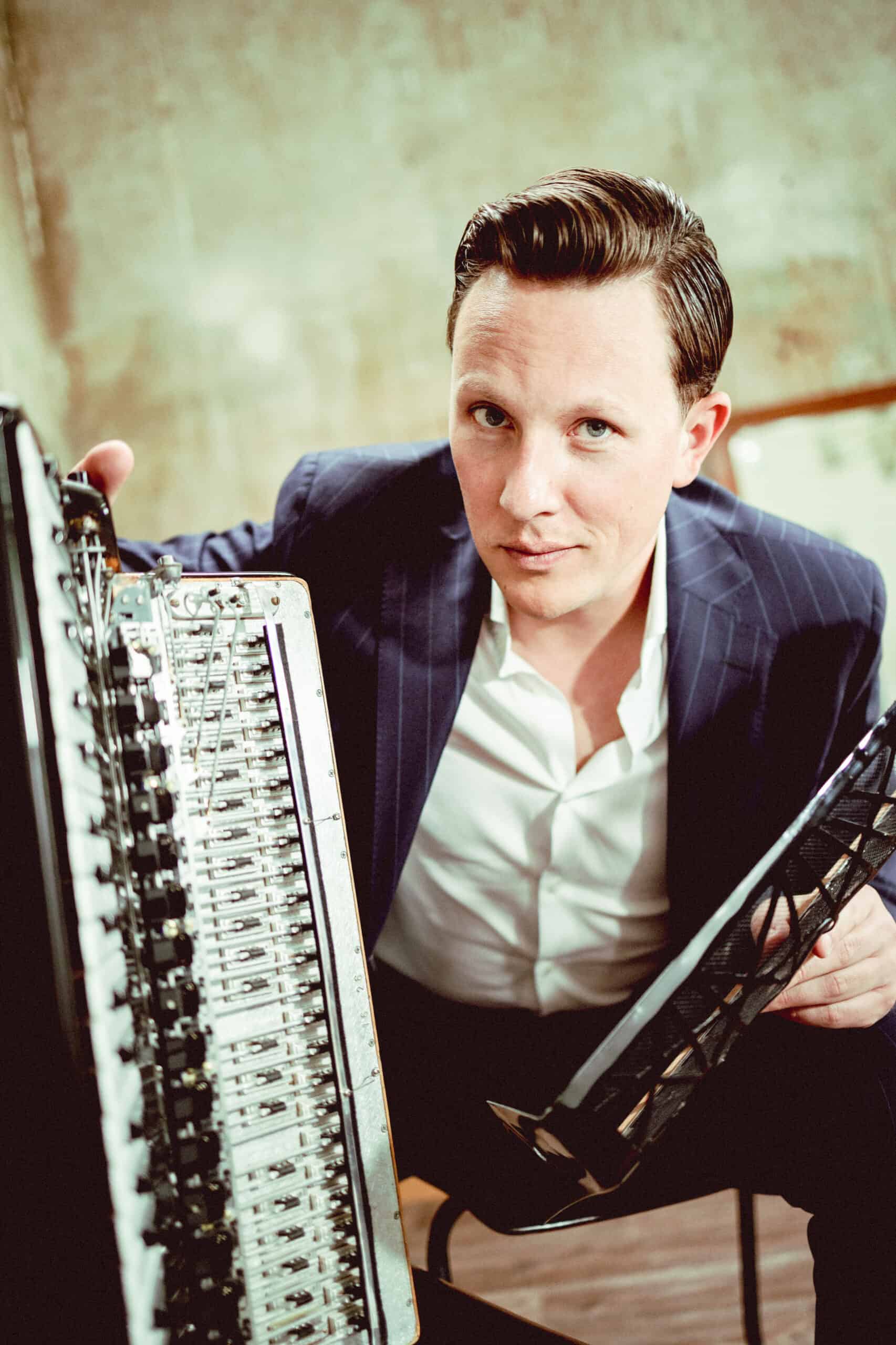 With Rhapsody in Blue by George Gershwin (1898-1937) in Levickis' arrangement, the perspective shifted toward a sonic world of energy, rhythm and direct, almost physical expression, in which the work unfolded in a new light without losing any of its iconic character.
What Levickis demonstrated here confirmed him unmistakably as an exceptional top talent: a musician who not only masters his instrument but completely reconceives it as an expressive medium. The accordion was not an alternative to the piano here, but a natural and even revealing carrier of the work – richer in color, more direct in expressiveness and remarkably versatile in character, through which the different moods of the score came to the fore with rare clarity.
The Knights responded to all this with the same intensity of listening and reacting, creating a rare form of ensemble playing in which orchestra and soloist manifested themselves as one body, one breath and one shared musical intention.
The first encore, introduced by Levickis, brought a refined and playful arrangement of the third movement from the second piano concerto "Tirol" by Philip Glass (°1937), in which once again that natural musicality and organic coherence found expression.
Transparency as poetic space
Appalachian Spring by Aaron Copland (1900-1990) became a moment of pure emotion and stillness. The music grew into a broad landscape of long, breathing string lines and finely colored woodwinds, unfolding step by step into a space of light, movement and inner clarity. With eyes closed, one effortlessly gained the impression of listening to a fully-fledged symphony orchestra: so rich was the sound, so layered the texture and so convincing the support of each individual voice within the whole.
The Knights achieved here a rare form of collective unity in which transparency and fullness did not exist side by side, but converged into one breathing sonic world of self-evident beauty and inner logic – a performance that settles into memory with great naturalness, and of which one can easily imagine that Copland himself would have accompanied it with a broad smile.
Intimate storytelling and resonance of tradition
Martynas Levickis' (°1990) own work based on Lithuanian folk songs formed the culmination of the evening, a musical stream that unfolded with seemingly inexhaustible melodic richness that continually pulled the listener forward: each phrase flowed from the previous one, creating an arc of tension that never slackened and kept you literally on the edge of your seat.
The melancholic undertone, akin to Philip Glass' repetitive idiom, took on its own shape through the organic interweaving of Lithuanian folk influences, creating a rich and layered sonic universe.
Moments in which wind players let air flow through their instruments gave the music an almost immaterial dimension, while the accordion unfolded from whisper to full resonance. The Knights followed this with exceptional unity of intention, so that orchestra and soloist merged into one body and one soul.
Two more encores followed. Levickis first came forward alone and let time stand still for a moment in a tango-like evocation, a moment of restrained intensity. Subsequently, The Knights brought a warm, heartfelt arrangement of the folk song I'll Fly Away, in which the vocal colors within the ensemble – subtle and unforced – added an extra layer of expression and let the evening fan out naturally.
An evening that was completely "finished"
What made this evening with The Knights and Martynas Levickis so exceptional was the ease with which everything came together into one continuous musical experience, a living totality in which every detail found its place. Under the direction of Eric Jacobsen, a musical breath unfolded in which everything flowed into an experience of rare intensity.
Denn es muss von Herzen gehen,
Was auf Herzen wirken soll.
(Johann Wolfgang von Goethe, Faust II)
Here music sounded that rose from the heart and found its way directly to the heart of the listener – an experience that settles as something exceptional: complete, self-evident and unmistakably finished in every fiber of the experience.