
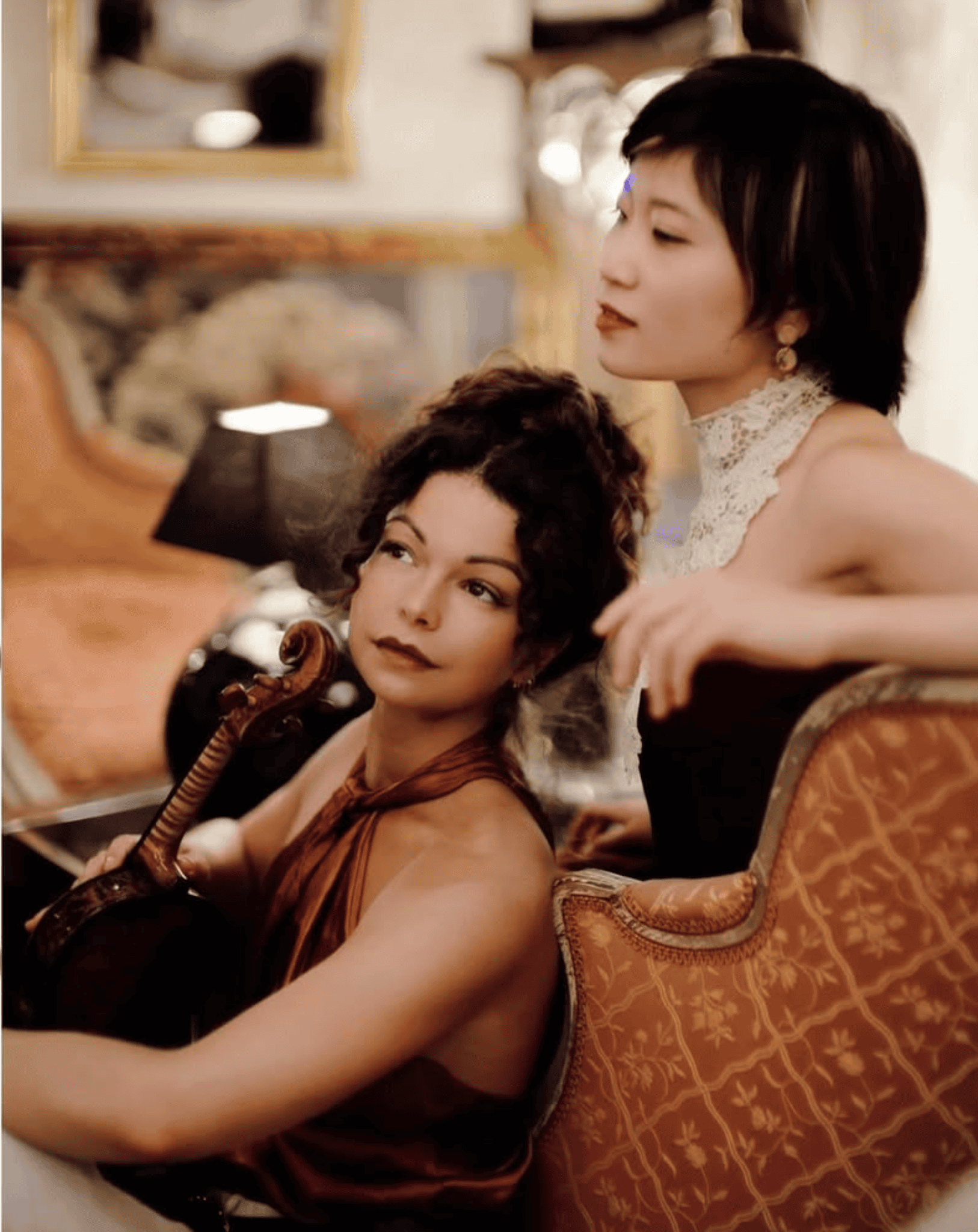
Musical Treasures – in every sense of the word
The title of the series proved to be particularly well chosen. The music on the program – works by Ravel and Saint-Saëns – can without question be regarded as musical heritage of the highest order. But the title applied equally to the performers themselves. Maya Levy and Marina Saiki are artists of exceptional caliber, musicians who not only excel technically, but who infuse their playing with vision, refinement, and a tangible artistic conviction.
That all this took place in the Royal Library was in itself a discovery. Those who know this impressive building primarily as a repository of books, manuscripts, and historical documents do not immediately expect an intimate concert hall where music can sound so direct and intense. Yet the location proved to be an ideal setting for this afternoon concert. Moreover, there were scores and other documents on display that related to the program, through which the music was, as it were, embedded in its historical context. The audience was numerous and responded from the outset with warm attention and enthusiasm.
A captivating program
From the first notes of Ravel's Kaddish it became clear that this would be an exceptional concert. Levy's violin sounded warm, fervent, and deeply felt. She played with a natural phrasing, with a tone that radiated both vulnerability and inner strength. Saiki followed and led simultaneously; her piano playing was richly nuanced and perfectly balanced, never merely accompanying, but always in dialogue.
In the Habanera, the duo revealed another dimension of Ravel's language: sensual, subtly rhythmically profiled, and with refined lightness. Here their perfect coordination became evident. Every nuance, every acceleration or slowing was shared together, without ever sounding contrived.
With Saint-Saëns' Sonata No. 1 op. 75, the concert took on a more monumental character. The sonata demands both virtuosity and structural insight, and both musicians responded to this challenge with conviction. Saiki produced a powerful, clear piano sound, with impressive control over dynamics and texture. Levy combined technical mastery with a passionate intensity that gave the work dramatic tension without sacrificing elegance. It was music-making at a level worthy of the great concert halls.
Tzigane – fire and refinement
The closing piece, Ravel's Tzigane, formed the crowning moment of the afternoon. On the previously discussed single, the duo chose to use the luthéal, the instrument Ravel originally had in mind, which gave the recording a special timbre. In the live performance, the work sounded in the version for violin and piano, which offered a different, but no less fascinating perspective.
The long, free opening of the violin was simply breathtaking. Levy built the tension with an almost theatrical intensity, never losing the musical line. When the piano enters, a dialogue unfolds full of energy, precision, and refinement. Saiki's playing was rhythmically sharp yet supple, a solid foundation on which Levy could let her virtuosic lines sparkle. The combination of technical brilliance and musical sophistication made this performance captivating from beginning to end.
A well-deserved ovation
The concert captivated from the first to the last note. Not a moment did attention wane, no passage became routine. What Maya Levy and Marina Saiki brought was music-making at the highest level, with an intensity and maturity that made a profound impression.
The exuberant and prolonged applause with which the audience rewarded them at the end was more than well deserved. This afternoon at the Royal Library proved that Musical Treasures is not a hollow title, but an apt description of what was offered here: music and musicians of exceptional value.